Multiple Choice
Passage
Copper plays a vital role as a trace mineral for biological processes. The amount of dietary copper needed by an adult each day is about 30 μg/kg of body weight, and blood plasma normally has a copper concentration of 1 mg/L.Copper is an essential element, and toxic effects are not common. However, given sufficient exposure to high levels by inhalation, absorption, or ingestion from sources such as industrial hazards or contaminated groundwater, copper toxicity can occur.Salts that are more soluble tend to exhibit higher toxicity when ingested, but the solubilities of copper salts vary and are also temperature-dependent, as shown by selected examples in Figure 1.
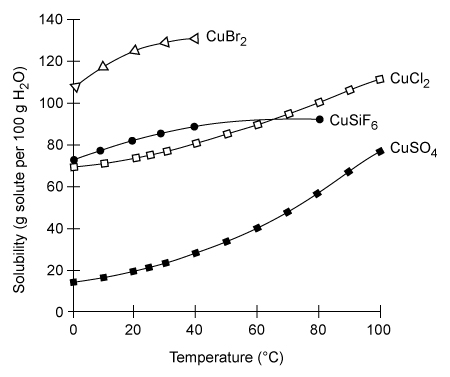 Figure 1 The solubility of selected copper salts in distilled water with increasing temperatureSome copper salts have solubilities much lower than those shown in Figure 1. For example, CuF2 has a solubility of only 0.075 g per 100 g of water (at 25 °C) . This indicates that CuF2 dissociates in water only to a small extent (Reaction 1) and that the equilibrium favors the undissociated salt, giving CuF2 a solubility product constant of Ksp = 1.6 × 10⁻⁶.
 Reaction 1Compound-specific properties can also impact solubility. In CuF2, the dissociated F− ion is mildly basic (pKb = 10.8) , causing the equilibrium to be influenced by the pH of the solution.Specific characteristics of copper can also play a role. For example, copper ions in solution express an affinity to form coordinate bonds with available lone-pair electrons of nitrogen atoms in amines (Reaction 2) .
 Reaction 2If excess amine ligands are present, coordinate bonds like that shown in Reaction 2 will continue to form until each Cu2+ ion in solution is coordinated with four nitrogen atoms. This acquisition of copper ions by ligands in solution can also impact the solubility equilibrium of copper salts by forming soluble coordination complexes.
-Suppose that a research technician wants to separate an aqueous mixture of CuF2 and BaF2 (Ksp = 3.0 × 10⁻⁶) by precipitating CuF2 from the solution. What should be added to the solution to perform the separation?
A) Cu(NO3) 2
B) NaF
C) Ba(NO3) 2
D) H2O
Correct Answer:

Verified
Correct Answer:
Verified
Q283: Passage<br>Nuclear medicine uses radiopharmaceuticals for disease treatment
Q284: Passage<br>Although acetylsalicylic acid (aspirin) is a well-known
Q285: Passage<br>The bicarbonate (HCO<sub>3</sub><sup>−</sup>) buffer system (Reaction 1)
Q286: Passage<br>Kidney stones are a common ailment affecting
Q287: During beta decay, a radioactive atomic nucleus
Q289: Passage<br>Copper plays a vital role as a
Q290: Passage<br>The tendency of a chemical species to
Q291: <img src="https://d2lvgg3v3hfg70.cloudfront.net/MD0008/.jpg" alt=" Given that the
Q292: Passage<br>Amino acids and copper both serve vital
Q293: Passage<br>Sulfur is the 10th most abundant element