Multiple Choice
Passage
In polluted urban environments, airborne proteins can undergo nitration reactions that increase their allergenic potential toward the human respiratory system. For example, upon exposure to ozone (O3) and nitrogen dioxide (NO2) under atmospheric conditions, the amino acid tyrosine is known to undergo a two-step irreversible reaction leading to the formation of nitrotyrosine. The first step involves the formation of a reactive oxygen intermediate (ROI) tyrosyl radical through oxidation of the phenolic site of tyrosine. Nitrotyrosine is then formed in the second step through addition of NO2 by a radical-radical termination reaction. The elementary steps for this reaction are shown in Scheme 1.
 Scheme 1 Elementary steps of nitration of tyrosineAirborne protein particles can exist in a variety of environments including the aqueous phase, gaseous phase, or as conglomerates with other biomolecules such as lipids. Because the thermodynamic properties and kinetics of the nitration reaction vary based on the chemical environment in which it occurs, recent studies have focused on understanding the reaction under different conditions.Density functional theory is a powerful computational quantum-mechanical modeling method that can determine the properties of many-electron systems by producing approximate solutions to the Schrödinger equation. Researchers used density functional theory to model the geometries and potential energy surfaces of the reactants, intermediates, and products of the nitration reaction in gaseous, aqueous, and lipid-rich environments. From this modeling, the thermodynamic and kinetic properties were calculated. Figure 1 shows the calculated activation energies Ea in kJ/mol, and Table 1 lists the associated thermochemical properties for both steps of the reaction in all three environments.
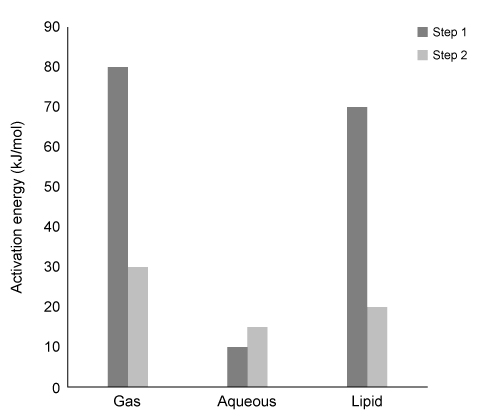 Figure 1 Calculated activation energies for each step of the studied reactions in three environmentsTable 1 Calculated Thermochemical Properties of the Studied Reactions (298.15 K)
 Adapted from Sandhiya L, Kolandaivel P, Senthilkumar K. Oxidation and nitration of tyrosine by ozone and nitrogen dioxide: reaction mechanisms and biological and atmospheric implications. J Phys Chem B. 2014;118(13) :3479-90.
-If the first step of the nitration of tyrosine in a lipid environment is slower than the second step, what is the rate law for the overall reaction?
A) Rate = k1[tyrosine][O3]
B) Rate = k1[tyrosine][O3][NO2]
C) Rate = k2[ROI][NO2]
D) Rate = k2[tyrosine][O3]
Correct Answer:

Verified
Correct Answer:
Verified
Q295: Passage<br>Potassium permanganate (KMnO<sub>4</sub>) is a highly reactive
Q296: Passage<br>Dmitri Mendeleev is credited with grouping the
Q297: The overall reaction for the generation of
Q298: Passage<br>Magnetic resonance imaging (MRI) interprets the nuclear
Q299: Passage<br>Combustion occurs when an oxidation-reduction reaction takes
Q301: Passage<br>Potassium permanganate (KMnO<sub>4</sub>) is a highly reactive
Q302: What is the approximate molar concentration of
Q303: Passage<br>The primary structure of a protein is
Q304: Consider the dimerization of nitrogen dioxide at
Q305: Passage<br>The bicarbonate (HCO<sub>3</sub><sup>−</sup>) buffer system (Reaction 1)