Multiple Choice
Passage
Dmitri Mendeleev is credited with grouping the elements by atomic mass and observing that similar properties emerge periodically. Henry Moseley then determined that a fundamental property, which Ernest Rutherford later called the atomic number, is more important than atomic mass for ordering the elements.As the periodic table took shape, scientists noted certain properties and trends. For example, Rayleigh and Ramsay observed that some elements are unreactive and gave them the name noble gases. But it was not until Niels Bohr described his model of the atom that scientists understood why noble gases are stable.Another important trend was discovered by Linus Pauling. He was the first to identify electronegativity as a way to describe bonds that are neither completely ionic nor completely covalent. Pauling assigned fluorine the highest electronegativity value of 4.0 because of its strong tendency to attract electrons when bonded to other atoms. All other atoms were assigned values relative to fluorine. This became known as the Pauling electronegativity scale.Scientists identified other trends based on x-ray crystallography and reactivity studies. Figure 1 shows the first ionization energy of the elements, and Figure 2 shows electron affinity.
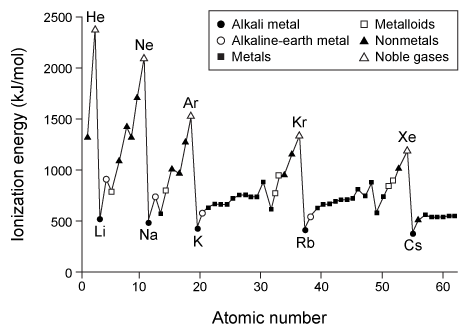 Figure 1 First ionization energy of elements
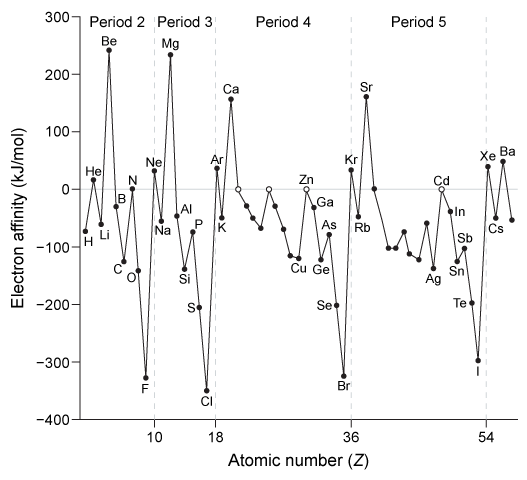 Figure 2 Electron affinity of several elements (larger negative values indicate greater electron affinity)
-The difference between the first and second ionization energies for magnesium is approximately 700 kJ/mol. The difference between the second and third ionization energies will likely be:
A) higher because the first and second ionization energies remove electrons from the p orbitals whereas the third removes an electron from an s orbital.
B) higher because the first and second ionization energies remove valence electrons whereas the third removes a core electron.
C) lower because the first and second ionization energies remove spin-paired electrons whereas the third removes an electron that is not spin-paired.
D) lower because the first and second ionization energies remove electrons from the n = 2 subshell whereas the third removes an electron from the n = 3 subshell.
Correct Answer:

Verified
Correct Answer:
Verified
Q291: <img src="https://d2lvgg3v3hfg70.cloudfront.net/MD0008/.jpg" alt=" Given that the
Q292: Passage<br>Amino acids and copper both serve vital
Q293: Passage<br>Sulfur is the 10th most abundant element
Q294: Passage<br>Sulfur is the 10th most abundant element
Q295: Passage<br>Potassium permanganate (KMnO<sub>4</sub>) is a highly reactive
Q297: The overall reaction for the generation of
Q298: Passage<br>Magnetic resonance imaging (MRI) interprets the nuclear
Q299: Passage<br>Combustion occurs when an oxidation-reduction reaction takes
Q300: Passage<br>In polluted urban environments, airborne proteins can
Q301: Passage<br>Potassium permanganate (KMnO<sub>4</sub>) is a highly reactive