Multiple Choice
Passage
In polluted urban environments, airborne proteins can undergo nitration reactions that increase their allergenic potential toward the human respiratory system. For example, upon exposure to ozone (O3) and nitrogen dioxide (NO2) under atmospheric conditions, the amino acid tyrosine is known to undergo a two-step irreversible reaction leading to the formation of nitrotyrosine. The first step involves the formation of a reactive oxygen intermediate (ROI) tyrosyl radical through oxidation of the phenolic site of tyrosine. Nitrotyrosine is then formed in the second step through addition of NO2 by a radical-radical termination reaction. The elementary steps for this reaction are shown in Scheme 1.
 Scheme 1 Elementary steps of nitration of tyrosineAirborne protein particles can exist in a variety of environments including the aqueous phase, gaseous phase, or as conglomerates with other biomolecules such as lipids. Because the thermodynamic properties and kinetics of the nitration reaction vary based on the chemical environment in which it occurs, recent studies have focused on understanding the reaction under different conditions.Density functional theory is a powerful computational quantum-mechanical modeling method that can determine the properties of many-electron systems by producing approximate solutions to the Schrödinger equation. Researchers used density functional theory to model the geometries and potential energy surfaces of the reactants, intermediates, and products of the nitration reaction in gaseous, aqueous, and lipid-rich environments. From this modeling, the thermodynamic and kinetic properties were calculated. Figure 1 shows the calculated activation energies Ea in kJ/mol, and Table 1 lists the associated thermochemical properties for both steps of the reaction in all three environments.
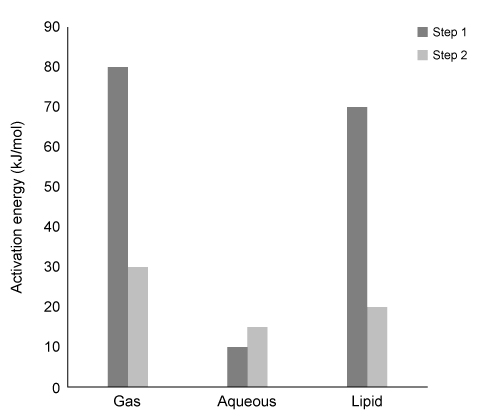 Figure 1 Calculated activation energies for each step of the studied reactions in three environmentsTable 1 Calculated Thermochemical Properties of the Studied Reactions (298.15 K)
 Adapted from Sandhiya L, Kolandaivel P, Senthilkumar K. Oxidation and nitration of tyrosine by ozone and nitrogen dioxide: reaction mechanisms and biological and atmospheric implications. J Phys Chem B. 2014;118(13) :3479-90.
-Which of the following are true concerning the overall reaction in an aqueous environment?The rate constant increases exponentially with increasing temperature.The rate constant increases exponentially with decreasing activation energy.The reaction rate decreases exponentially with increasing activation energy.The rate constant of the catalyzed reaction will be smaller than the rate constant of the uncatalyzed reaction.
A) I and II only
B) I, II, and III only
C) II and IV only
D) I, III, and IV only
Correct Answer:

Verified
Correct Answer:
Verified
Q41: A 0.040 M HCl solution is measured
Q42: Passage<br>Catabolism is an oxidative process in which
Q43: Passage<br>An automated external defibrillator (AED) is a
Q44: The spin quantum number m<sub>s</sub> describes the
Q45: Passage<br>Household cleaners commonly contain either ammonia (NH<sub>3</sub>)
Q47: Passage<br>Students were asked to bring items from
Q48: Passage<br>The tendency of a chemical species to
Q49: Passage<br>Nuclear medicine uses radiopharmaceuticals for disease treatment
Q50: Passage<br>In polluted urban environments, airborne proteins can
Q51: Which compound has the bond with the