Multiple Choice
Passage
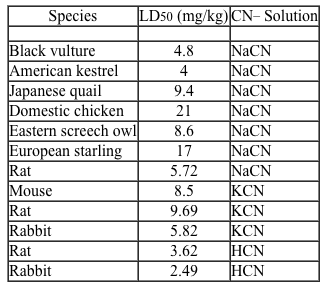
Cyanide (CN−) is a powerful, rapid toxin that binds to the cellular respiratory enzyme cytochrome c oxidase. The resulting enzyme-cyanide complex blocks the transfer of electrons to oxygen in the last step of the electron transport chain. This results in cytotoxic anoxia, causing asphyxiation at the cellular level.Exposure to cyanide can occur from dietary sources, medical treatments, industrial applications, smoke inhalation (structural fires) , and intentional use (suicide) . While dietary exposure from moderate consumption of naturally occurring plant compounds such as cyanogenic glycosides rarely results in acute adverse effects in humans, chronic effects have been observed from prolonged diets with significant levels of these compounds. In the developed world, risk of significant cyanide exposure is most likely to result from smoke inhalation during building fires or from industrial/occupational exposures.The impact of a given exposure depends on the amount (dose, duration) , the chemical composition of the cyanide compound (HCN, NaCN, KCN) , and the route of exposure (inhalation, absorption, ingestion) . The ionic salts (NaCN, KCN) and free acid (HCN) forms of cyanide each have different acid-base properties that interact differently under the physiological conditions associated with each route of exposure.To better understand the toxicity of different forms of cyanide, animal models have been studied for comparison to known human exposure case studies. Table 1 presents a summary of selected animal toxicity studies that examine exposure via ingestion. The table provides the lethal dose to 50% of the population (LD50) in milligrams of cyanide per kilogram of body weight (mg/kg) .Table 1 Compilation of LD50 Cyanide Values in Various Animal Species
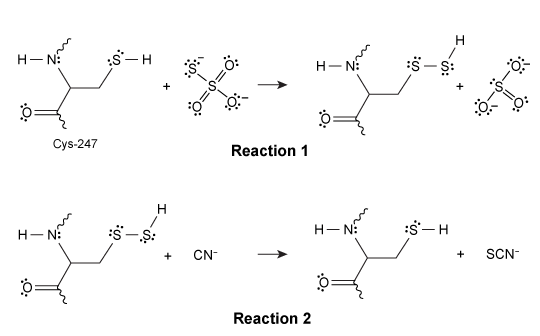
 Based on animal models, one treatment developed for cyanide poisoning involves assisting the rhodanese enzyme in metabolizing CN− to SCN− via an intravenous solution of NaNO2 and Na2S2O3. The Na2S2O3 assists in the formation of a reactive S-SH (persulfide) bond in the enzyme on cysteine-247 (Reaction 1) , which then reacts with the cyanide ion to form thiocyanate (Reaction 2) .
 Adapted from: Hall AH, Isom GE, Rockwood GA. Toxicology of Cyanides and Cyanogens, Experimental, Applied and Clinical Aspects. John Wiley & Sons; 2015: 1-20; and Egekeze JO, Oehme FW. Cyanides and their toxicity: A literature review. Vet Q. 1980; 2(2) : 104-114.
-The acid dissociation constant Ka for HCN is approximately 1 × 10⁻⁹. What is the value of the pKb?
A) 5
B) 9
C) 14
D) −5
Correct Answer:

Verified
Correct Answer:
Verified
Q3: Passage<br>Gastric acid is one of many acids
Q4: Passage<br>Dmitri Mendeleev is credited with grouping the
Q5: Which of the following molecules has the
Q6: Which of the following molecules exhibit an
Q7: Passage<br>Depending on the active compound's specific method
Q9: Passage<br>The alkaline-earth metals are a highly reactive
Q10: Copper plays a vital role as a
Q11: Passage<br>The alkaline-earth metals are a highly reactive
Q12: A sample of potassium-42 was measured to
Q13: Passage<br>Catabolism is an oxidative process in which