Multiple Choice
Passage
Household cleaners commonly contain either ammonia (NH3) or bleach (NaOCl) as the principal active ingredient. Mixing ammonia-based and bleach-based cleaners can be hazardous, as the resulting reactions can form several toxic products. One of these reactions forms the irritant dichloramine (NHCl2) as follows:
 Reaction 1The overall reaction has a standard enthalpy change of −55 kJ/mol and a standard entropy change of −150 J/mol·K. Partial thermodynamic data for formation of Reaction 1 reagents from their elements are shown in Table 1.Table 1 Partial Data for Enthalpies, Entropies, and Free Energies of Formation of Several Compounds at 25 °C
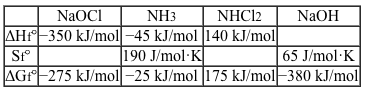 After it is formed, dichloramine readily enters the gas phase, where it may be inhaled. In the lungs, dichloramine reacts with water to produce hydrochloric acid and ammonia, as well as reactive oxygen species. In small doses, these products cause mild irritation, but inhalation of large amounts of chloramines can lead to pneumonitis (inflammation of the lungs) and may require medical intervention.
Adapted from Trogolo D, Arey JS. Benchmark thermochemistry of chloramines, bromamines, and bromochloramines: halogen oxidants stabilized by electron correlation. Phys Chem Chem Phys. 2015;17(5) :3584-98.
-During the formation of dichloramine and NaOH, the order (organization) of the system:
A) decreases because entropy is always increasing.
B) stays the same because the number of moles stays the same.
C) increases because the change in entropy is negative.
D) does not change because the system is at equilibrium.
Correct Answer:

Verified
Correct Answer:
Verified
Q10: Copper plays a vital role as a
Q11: Passage<br>The alkaline-earth metals are a highly reactive
Q12: A sample of potassium-42 was measured to
Q13: Passage<br>Catabolism is an oxidative process in which
Q14: Passage<br>Oxytocin is a naturally occurring peptide hormone
Q16: If MgCO<sub>3</sub> undergoes a double replacement reaction
Q17: The C=S double bond in carbon disulfide
Q18: Passage<br>Potassium permanganate (KMnO<sub>4</sub>) is a highly reactive
Q19: Passage<br>The tendency of a chemical species to
Q20: In chemical bond formation, covalent bonds are