Multiple Choice
Passage
Two key ingredients found in many soaps are PEG 150 distearate and ethylhexyl glycerin. Both can be synthesized from glyceryl tristearate (Figure 1) .
 Figure 1 Formation of PEG 150 distearate and ethylhexyl glycerin from glyceryl tristearateThe first step in this process requires the saponification of glyceryl tristearate. The resulting stearate molecules can then react with PEG 150 in an acid-catalyzed Fischer esterification to form PEG 150 distearate. The glycerol produced during saponification is used as a nucleophile to form ethylhexyl glycerin through a base-catalyzed SN2 reaction with an ethylhexyl halide.Studies have shown that hand washing with soap can substantially reduce the number of germs present on hands and that washing hands before preparing food is particularly effective in reducing illness. Researchers examined the effect of washing for 20 seconds with different amounts of soap containing PEG 150 distearate and ethylhexyl glycerin and found an inverse correlation between the volume of soap used and the amount of bacteria recovered from the hands. The data are shown in Figure 2.
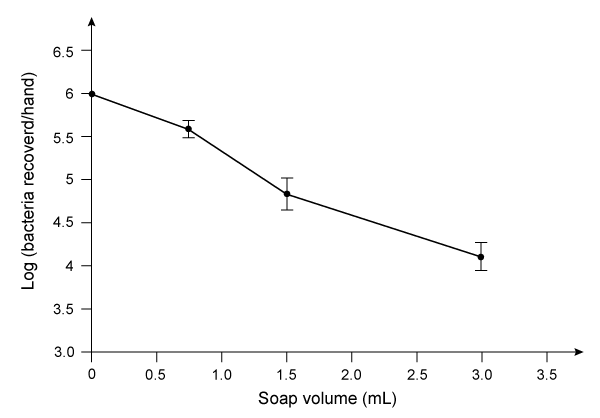 Figure 2 Bacteria recovered from hands after washing with varying amounts of soapThe researchers then investigated the effect of hand washing with different kinds of soap on the transfer of bacteria from hands to objects. Volunteers washed with a fixed volume of soap for 30 seconds, then handled sterilized plastic spheres for 30 seconds. Bacteria were then recovered from the spheres. The results are shown in Table 1.Table 1 Bacteria Recovered from Objects
 Adapted from Fuls JL, Rodgers ND, Fischler GE, et al. Alternative hand contamination technique to compare the activities of antimicrobial and nonantimicrobial soaps under different test conditions. Appl Environ Microbiol. 2008.
-Researchers produced ethylhexyl glycerin using a partially deuterated ethylhexyl halide and generated the product shown below. 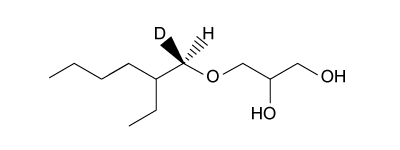 What was the configuration of the deuterated carbon prior to the reaction?
A) S, because the configuration is inverted by the reaction
B) R, because the configuration is inverted by the reaction
C) S, because the configuration is preserved by the reaction
D) R, because the configuration is preserved by the reaction
Correct Answer:

Verified
Correct Answer:
Verified
Q1: Passage<br>The N-terminus of an amino acid must
Q2: If thin-layer chromatography shows that a distillation
Q3: Passage<br>Solid-phase peptide synthesis is normally carried out
Q5: The amino acids Val, Leu, and Ile
Q6: What is the product of the reaction
Q7: Passage<br>Students used three classification tests to study
Q8: Which of the following amino acids would
Q9: Passage<br>Aldehydes are organic compounds encountered in everyday
Q10: Compound <strong>1</strong> shown below is converted to
Q11: <img src="https://d2lvgg3v3hfg70.cloudfront.net/MD0008/.jpg" alt=" Compound <strong>1</strong>, a