Multiple Choice
Passage
Solid-phase peptide synthesis is normally carried out on a resin bathed multiple times in dimethylformamide (DMF) -a toxic, polar, aprotic solvent-which poses an environmental problem because a large amount of toxic solvent waste is created. Cyclic carbonates such as propylene carbonate (PC) and ethylene carbonate (EC) are nontoxic, polar, aprotic solvents that could be used as an alternative to DMF.Compounds 1 and 2 are modified L-amino acids. They were coupled to form Compound 3, a dipeptide, which was then deprotected to yield Compound 4 (Figure 1) .
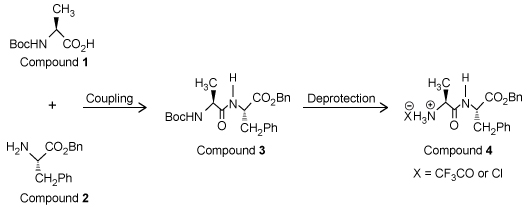 Figure 1 Synthesis of Compound 4To determine the effect that solvent type and temperature have on the synthesis of this peptide, the nontoxic solvents PC and EC as well as the toxic solvent DMF were each used in separate syntheses of Compound 4 at different temperatures. The reaction solvent was also used to rinse the resin. Table 1 shows the results of these syntheses.Table 1 Results from the Synthesis of Compound 4
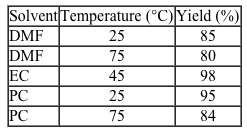 The successful synthesis of Compound 4 using nontoxic solvents encouraged researchers to pursue the synthesis of a larger, biologically active peptide. Bradykinin, a vasodilator containing nine amino acids (Arg-Pro-Pro-Gly-Phe-Ser-Pro-Phe-Arg) , was synthesized using the same solid-state peptide synthesis protocol used to synthesize Compound 4. Separate syntheses were done using either DMF or PC, and the purity of bradykinin from each synthesis was analyzed by high-performance liquid chromatography (HPLC) (Figure 2) .In each chromatogram, peak 1 has the same retention time as commercially obtained bradykinin, and the other peaks correspond to impurities. In chromatogram A, the impurity has a similar retention time to the product peak whereas the impurity peaks in chromatogram B have distinct retention times compared to the product peak.
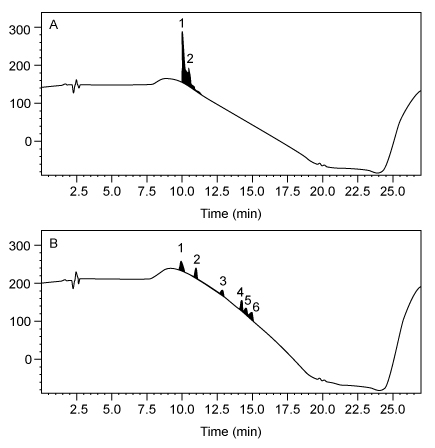 Figure 2 HPLC of synthetic bradykinin: (A) synthesis in DMF; (B) synthesis in PC
Adapted from S. B. Lawrenson et al., "The greening of peptide synthesis." Green Chem. ©2017 The Royal Society of Chemistry.
-Why is PC a better solvent than DMF for peptide synthesis? Results of the peptide syntheses as described in the passage indicate that when PC is used as a solvent:
A) the yield is doubled compared to using DMF in the synthesis of the dipeptide.
B) impurities can be separated from the final product in the synthesis of bradykinin.
C) the yield decreases compared to using DMF in the synthesis of the dipeptide.
D) there are no impurities present in the synthesis of bradykinin.
Correct Answer:

Verified
Correct Answer:
Verified
Q1: Passage<br>The N-terminus of an amino acid must
Q2: If thin-layer chromatography shows that a distillation
Q4: Passage<br>Two key ingredients found in many soaps
Q5: The amino acids Val, Leu, and Ile
Q6: What is the product of the reaction
Q7: Passage<br>Students used three classification tests to study
Q8: Which of the following amino acids would
Q9: Passage<br>Aldehydes are organic compounds encountered in everyday
Q10: Compound <strong>1</strong> shown below is converted to
Q11: <img src="https://d2lvgg3v3hfg70.cloudfront.net/MD0008/.jpg" alt=" Compound <strong>1</strong>, a