Multiple Choice
Passage
The diagnosis of a child with a serious disability significantly impacts the child's parents. While positive psychological outcomes are sometimes possible, evidenced by research showing that for some parents a child's disability is eventually viewed as a chance for personal growth, research also indicates that many parents of children with disabilities are at greater risk for poor physical and mental health outcomes. Coping with a child's initial symptoms, providing ongoing care, and dealing with prejudice from others present significant stressors for parents. This stress may also disrupt marriages; results of a meta-analysis showed a modest, increased risk for divorce in parents of children with disabilities. Another line of research has identified significantly higher rates of anxiety and/or depression in parents of children with disabilities. The fact that parental distress often results in poorer outcomes for their children points to a need for evidence-based interventions for parents of children with disabilities.In Study 1, researchers compared the effectiveness of two interventions in reducing depressive symptoms in parents of children with cognitive disabilities. Researchers recruited 30 parents of children with intellectual disorders from the contact list of an affluent community wellness center and randomly assigned them to a meditation (M) group or a humanistic psychotherapy (HP) group. Both groups were led by peer mentors trained in specific interventions who taught and demonstrated the techniques to the participants during the weekly sessions. Participants completed self-report measures of depressive symptoms at baseline (pre-test) , 4 weeks into the intervention (midpoint) , at the end of the 8-week program (post-test 1) , and 4 weeks after the program ended (post-test 2) . The findings are shown in Figure 1.
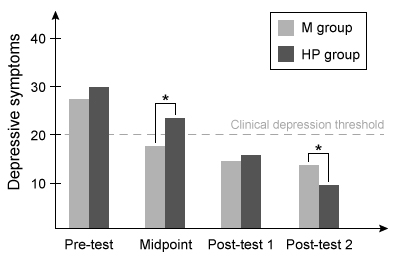 Figure 1 Depressive symptoms at pre-test, midpoint, post-test 1, and post-test 2 (Note: * indicates p < .05.) In Study 2, researchers examined the impact of coping strategies on distress in 80 parents of children with muscular dystrophy. Participants were asked to think of a recent stressful, threatening event and report whether they had classified their future expectancy for the event as "changeable" (situation is able to be modified) or "unchangeable" (situation is not able to be modified) . They were then asked whether they attempted to cope with the event primarily by regulating their emotions (emotion-focused) or by modifying aspects of the situation (problem-focused) , such as seeking help from others. Lastly, they were surveyed about their level of distress after they tried to cope with the stressor. Figure 2 illustrates the findings.
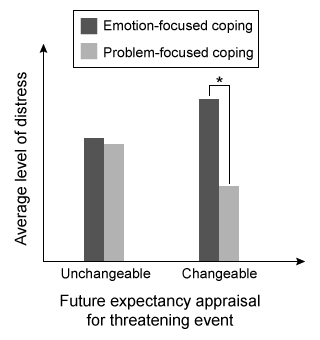 Figure 2 Average level of distress by coping strategy (emotion-focused vs. problem-focused) and future expectancy appraisal for the threatening event (Note: * indicates p < .05.)
-Based on Figure 2, the most accurate conclusion is that:
A) parents of children with disabilities reported less distress overall when they viewed the future expectancy appraisal of an event as "changeable."
B) for either type of future expectancy appraisal, problem-focused coping resulted in lower levels of distress than emotion-focused coping.
C) whether one coping strategy resulted in lower distress than the other depended on the future expectancy appraisal of the event.
D) using a problem-focused coping strategy for an "unchangeable" future expectancy appraisal resulted in increased levels of distress compared to baseline.
Correct Answer:

Verified
Correct Answer:
Verified
Q54: Passage<br>The last several decades have seen a
Q55: A researcher wants to train a mouse
Q56: Which scenario best illustrates dishabituation? An intensive
Q57: Passage<br>Epidemiologists now consider obesity to be a
Q58: Which of the following is true regarding
Q60: Passage<br>During the 19th century, the industrial revolution
Q61: Passage<br>Both institutional and interpersonal factors contribute to
Q62: Passage<br>Psychotic disorders are characterized by a loss
Q63: Passage<br>Post-traumatic stress disorder (PTSD) and generalized anxiety
Q64: Symptoms of a myocardial infarction can differ