Multiple Choice
Passage
During the 19th century, the industrial revolution led to advances in health care in the United States that resulted in declines in the death rate followed by population growth. Around 1860, the U.S. birth rate also began to steadily decline until reaching its current plateau of about two births per woman during her lifetime. Since 1860, the U.S. birth rate has significantly increased during only one period: the post-World War II era known as the baby boom."Baby boomers," the generation of Americans born roughly between 1946 and 1964, are living longer than any prior generation, and their aging has evolving social and historical significance. By 2030, it is estimated that there will be about 61 million baby boomers in their eighties. In 1950, there were approximately seven times more producers (people age 15-64) than elderly (people age 65 and over) ; by 2030 there are projected to be less than three times more producers than elderly. Providing medical and social care to this aging cohort will have a major negative impact on the American economy due to the costs associated with health care and basic social services.Also impacting the U.S. population distribution is the fact that younger Americans (referred to as "millennials," born roughly between 1982 and 2004) are delaying marriage and children more so than any preceding generation, resulting in declining U.S. fertility rates. Figure 1 compares the U.S. population pyramid in 2000 to a projected population pyramid in 2030.
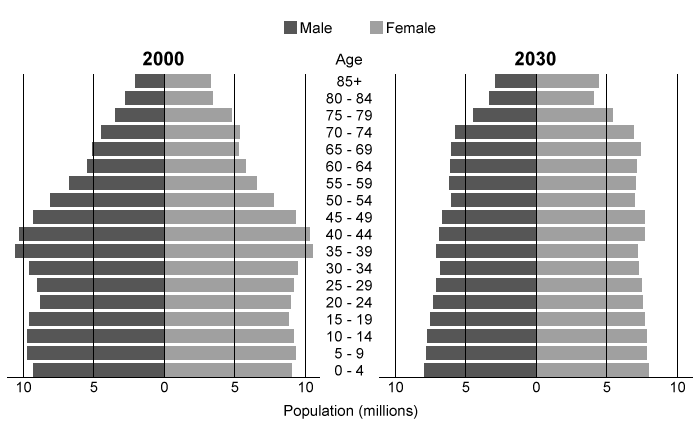 Figure 1 United States population pyramid from 2000 and a projected population pyramid for 2030
-Based on Figure 1, which of the following is predicted to decrease by 2030?
A) Life expectancy
B) Mortality rate
C) Population size
D) Median age
Correct Answer:

Verified
Correct Answer:
Verified
Q55: A researcher wants to train a mouse
Q56: Which scenario best illustrates dishabituation? An intensive
Q57: Passage<br>Epidemiologists now consider obesity to be a
Q58: Which of the following is true regarding
Q59: Passage<br>The diagnosis of a child with a
Q61: Passage<br>Both institutional and interpersonal factors contribute to
Q62: Passage<br>Psychotic disorders are characterized by a loss
Q63: Passage<br>Post-traumatic stress disorder (PTSD) and generalized anxiety
Q64: Symptoms of a myocardial infarction can differ
Q65: Passage<br>Psychophysiology examines the relationship between the properties