



 Chat with AI
Exam 5: Obstetrics & Gynecology

Exam 1: Medicine2 k Questions
Exam 2: Pediatric723 Questions
Exam 3: Psychiatry336 Questions
Exam 4: Surgery563 Questions
Exam 5: Obstetrics & Gynecology469 Questions
Select questions type


A 40-year-old woman comes to the emergency department due to abdominal pain for the past 2 weeks. The pain has become worse over the past day and is not relieved by ibuprofen. The patient has a fever but no nausea, vomiting, diarrhea, or dysuria. She has no chronic medical conditions or previous surgeries. Her last menstrual period was 2 weeks ago; menses are regular and last 5 days, with painful cramping and heavy bleeding on the first day. The patient is sexually active with a male partner and uses condoms for contraception. She does not use tobacco, alcohol, or illicit drugs. Temperature is 38.8 C (101.8 F), blood pressure is 100/60 mm Hg, and pulse is 92/min. The abdomen has diffuse tenderness to deep palpation that is worse in the right lower quadrant. There is no rebound or guarding. Pelvic examination reveals a small, mobile, tender uterus and an enlarged, tender right adnexal mass. Leukocyte count is 22,000/mm3. Urine pregnancy test is negative. Pelvic ultrasonography reveals a large, thick-walled, multiloculated mass filled with debris obliterating the right adnexa. Which of the following is the most likely diagnosis in this patient?
(Multiple Choice)
4.8/5  (89)
(89) A 32-year-old woman, gravida 5 para 4, comes to the office for follow-up of breast biopsy that confirmed high-grade malignant features. Nine weeks ago, the patient was incidentally found to have a breast mass during a pregnancy visit. The pregnancy ended in a miscarriage. She is coping with the new diagnosis and otherwise has been feeling well with no vaginal bleeding or abdominal pain. Family history is significant for ovarian cancer in her mother, who died at age 50. Genetic testing reveals a mutation in the BRCA2 gene. The patient is scheduled to begin chemotherapy and is advised to avoid pregnancy. She took oral contraceptives during adolescence with no side effects. Breast examination shows a well-healing biopsy scar. Which of the following is the best contraceptive option for this patient?
(Multiple Choice)
4.8/5 (84)
(84) A 28-year-old woman, gravida 3 para 2, at 30 weeks gestation is brought to the emergency department due to vaginal bleeding after a motor vehicle collision. The patient was restrained by a lap and shoulder belt, but the steering wheel struck her abdomen. Her underwear and pants are soaked with blood, and she states that she is "not sure if my water broke." Blood pressure is 90/60 mm Hg, pulse is 136/min, respirations are 22/min, and pulse oximetry is 98% on room air. Physical examination shows an alert but anxious-appearing woman with abdominal tenderness and cool extremities. On speculum examination, 100 mL of blood is evacuated from the vagina, and minimal active bleeding from the cervix is observed. Blood type is O, Rh positive. Fetal heart monitoring shows a baseline of 140/min with minimal to moderate variability; there are no late or variable decelerations. Tocometry reveals uterine contractions every 3 minutes. Intravenous fluids are started. Which of the following is the best next step in management of this patient?
(Multiple Choice)
4.9/5 (90)
(90) A 60-year-old woman comes to the clinic due to the persistent feeling of "always having to go to the bathroom." For the past 3 years, the patient has had urinary urgency followed by involuntary loss of urine 2 or 3 times per day. She has dysuria and nocturia and sometimes awakens to find her undergarments wet but she does not lose urine with coughing or sneezing. Menopause occurred at age 52 when a total laparoscopic hysterectomy with bilateral salpingo-oophorectomy was performed for endometrial adenocarcinoma. Medical history is significant for recurrent urinary tract infections during the past year. The patient is not sexually active and takes no medications. On physical examination, the vulvar skin shows reduced elasticity with labia minora retraction. The vaginal epithelium is smooth, dry, and has areas of patchy erythema. On Valsalva maneuver, there is no loss of urine. Urinalysis and postvoid residual urine testing are normal. Which of the following is the most likely cause of this patient's urinary symptoms?
(Multiple Choice)
4.8/5 (92)
(92) A 67-year-old woman, gravida 1 para 1, comes to the office for a routine health examination. The patient feels well. Her last menstrual period was at age 53 with no bleeding since. Pap test and human papillomavirus (HPV) cotesting were negative 2 years ago at age 65. All prior Pap tests were normal. The patient is sexually active in a monogamous relationship with her husband of 42 years. She has no medical conditions. The patient had an ovarian cystectomy via laparotomy at age 37 for a benign cystic teratoma. She takes no medications and does not use tobacco, alcohol, or illicit drugs. There is no family history of cancer. BMI is 25 kg/m2. Pelvic examination shows a normal cervix without lesions; a smooth, anteverted, mobile uterus; and no adnexal masses. Screening mammography was normal 6 months ago, and screening colonoscopy was normal 2 years ago. Which of the following is the most appropriate recommendation for cervical cancer screening in this patient?
(Multiple Choice)
4.9/5 (82)
(82) A 22-year-old woman comes to the emergency department due to 4 hours of severe lower abdominal cramping and heavy vaginal bleeding with passage of large clots. The patient's pain subsided after the passage of a round, pale mass while she was at home. Her bleeding currently is as heavy as a normal period and she reports some mild lower abdominal discomfort. She has no fevers, chills, or abnormal vaginal discharge. Her last menstrual period was 7 weeks ago. The patient has a history of intermittent cocaine abuse and smokes a pack of cigarettes daily. Temperature is 37 C (98.7 F), blood pressure is 120/70 mm Hg, pulse is 90/min, and respirations are 16/min. Abdominal examination shows mild tenderness over bilateral lower quadrants but no palpable masses or rigidity. Pelvic examination shows a closed cervix and a small amount of blood pooled in the vaginal vault. Urine β-hCG is positive. Transvaginal ultrasound reveals a normal uterus with an empty endometrial cavity, no adnexal masses, and scant free fluid in the posterior cul-de-sac. Which of the following is the most likely diagnosis?
(Multiple Choice)
4.7/5 (78)
(78) A 37-year-old woman, gravida 1 para 0, at 34 weeks gestation comes to the emergency department due to nausea, vomiting, and severe epigastric pain. The patient first noticed the pain after breakfast yesterday. The pain continued throughout the day and now involves the right upper quadrant. She has been taking acetaminophen with no pain relief. The patient developed nausea and recurrent vomiting 4 hours ago. The patient has not had routine prenatal care. Temperature is 37.2 C (99 F), blood pressure is 130/80 mm Hg, and pulse is 106/min. Fetal heart rate monitoring shows a baseline of 170/min with minimal variability. There are no contractions on tocodynamometer. There is tenderness to palpation over the epigastrium and right upper quadrant, with no rebound or guarding. The uterus is nontender. Laboratory results are as follows: 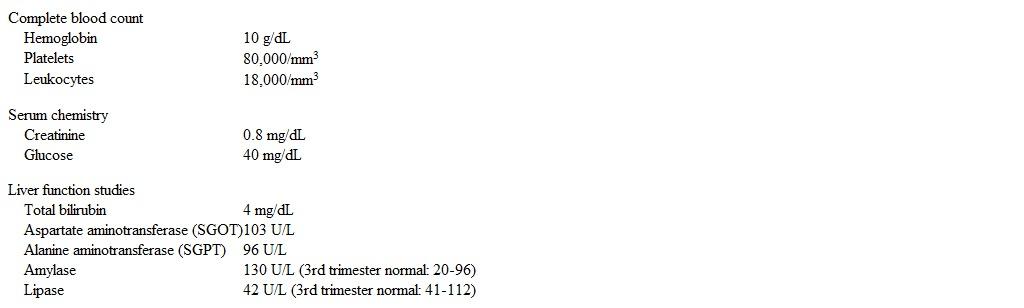 Which of the following is the most likely diagnosis in this patient?
 (Multiple Choice)
4.8/5 (77)
(77) A 32-year-old woman, gravida 3 para 3, comes to the office for a 2-week postoperative follow-up after undergoing a laparoscopic bilateral tubal ligation. The patient has no pain or abnormal discharge from the incision sites. She has no chronic medical conditions, and this was her only surgery. The patient has a regular menstrual period that occurs every 30 days. She typically has abdominal cramping that resolves with ibuprofen after the first day and 5 days of bleeding. The tubal ligation was successfully performed; however, during the procedure, multiple subcentimeter, superficial lesions were visualized over the broad ligaments, bladder, and sigmoid colon. Biopsy of a lesion reveals endometrial glands, stroma, and hemosiderin-laden macrophages. Which of the following is the best next step in management of this patient?
(Multiple Choice)
4.9/5 (88)
(88) A 40-year-old woman is evaluated on the labor and delivery unit for increasing shortness of breath and muscle weakness. Six hours ago, the patient had a spontaneous vaginal delivery at 38 weeks gestation. Immediately after delivery, she developed a blood pressure of 170/110 mm Hg with a headache and was diagnosed with preeclampsia with severe features. A magnesium sulfate infusion was initiated for seizure prophylaxis, and blood pressure improved with intermittent hypertensive therapy. Now, the patient reports difficulty breathing, flushing, and muscle weakness. She does not have chest pain or palpitations. The patient has no chronic medical conditions and has had no surgeries. Blood pressure is 144/84 mm Hg, pulse is 68/min, and respirations are 10/min. The patient appears drowsy and has difficulty keeping her eyes open. The lungs are clear to auscultation bilaterally. Deep tendon reflexes are absent. There is bilateral pitting edema up to the knees. Urine output is 50 mL over the past 3 hours. Which of the following is the best next step in management of this patient?
(Multiple Choice)
4.9/5 (73)
(73) A 29-year-old woman, gravida 1 para 1, comes to the office for a postpartum visit. Three weeks ago, the patient had a spontaneous vaginal delivery of a 4.2-kg (9-lb 2-oz) male infant after an induction of labor for gestational hypertension. The patient was treated for asymptomatic bacteriuria in the first trimester but had an otherwise uncomplicated pregnancy. Her labor lasted 30 hours, and she pushed for 4 hours. Immediately after delivery, the patient developed uterine atony that resolved with intravenous oxytocin and bimanual massage. The patient had no additional postpartum complications and went home the next day. She has had light vaginal bleeding since delivery, with no passage of clots or pelvic pain. The patient is breastfeeding exclusively, and reports fatigue due to frequent sleep interruption, but otherwise feels well. Blood pressure is 122/74 mm Hg and pulse is 82/min. BMI is 24 kg/m². Physical examination is unremarkable. Which of the following is the best next step in management of this patient?
(Multiple Choice)
4.7/5 (73)
(73) A 34-year-old woman, gravida 2 para 1, at 30 weeks gestation comes to the emergency department due to a severe, unilateral headache. The patient has a history of migraine headaches, and earlier today she developed a severe, throbbing headache on the right side of the head. She drank a can of caffeinated soda and tried to rest in a dark room, but the headache has not improved. The patient has had no nausea, vomiting, or changes in vision. She has no other chronic medical conditions, takes no daily medications, and has no known drug allergies. Temperature is 37.2 C (99 F), blood pressure is 126/82 mm Hg, and pulse is 92/min. Fetal heart rate is 150/min. Neurologic examination is normal. The remainder of the physical examination is unremarkable. Urine dipstick is negative for protein. Which of the following is the most appropriate initial pharmacotherapy for this patient?
(Multiple Choice)
4.8/5 (78)
(78) A 53-year-old woman, gravida 2 para 2, comes to the office due to right-sided pelvic pain that has worsened over the past 3 months. She has experienced bloating and hot flashes since her last menstrual period a year ago. The patient has recently become sexually active with a new partner and is not using condoms. She was diagnosed and treated for chlamydia in her 40s. She has no other medical problems and had a bilateral tubal ligation at age 35 after cesarean delivery of her second child. The patient smokes 10 cigarettes daily and drinks alcohol socially. Her temperature is 36.7 C (98 F) and blood pressure is 110/70 mm Hg. Leukocyte count is 8200/mm3. β-hCG is undetectable. Pelvic ultrasonography shows a 7-cm right ovarian mass with solid components, thick septations, and a moderate amount of peritoneal fluid. Which of the following is the most likely explanation for these findings?
(Multiple Choice)
4.9/5 (82)
(82) A 34-year-old woman is evaluated in the postpartum unit for vaginal bleeding. Two hours ago, she underwent an uncomplicated spontaneous vaginal delivery with an estimated blood loss of 250 mL. Bleeding was initially minimal, but there is now profuse vaginal bleeding, and the patient's perineal pad is soaked with blood and large clots. This was her eighth vaginal delivery; her only surgery was a dilation and curettage 4 years ago for a spontaneous abortion. The patient has chronic hypertension that has been managed throughout this pregnancy with labetalol. She has no medication allergies. Blood pressure is 148/102 mm Hg and pulse is 110/min. On pelvic examination, the uterine fundus is soft, and the lower uterine segment is distended with blood clots. Which of the following medications is contraindicated in this patient?
(Multiple Choice)
4.8/5 (69)
(69) A 38-year-old woman, gravida 3 para 3, comes to the office for evaluation of abnormal uterine bleeding. The patient had regular, monthly menses until 6 months ago, when she began to have intermenstrual spotting and has now been amenorrheic for 3 months. She has had increased abdominal bloating and cramping during the last few months but no hot flushes or weight changes. The patient has no chronic medical conditions and underwent a bilateral tubal ligation after her last delivery 2 years ago. She takes no daily medications and does not use tobacco, alcohol, or illicit drugs. Blood pressure is 124/70 mm Hg and pulse is 88/min. BMI is 29 kg/m2. There is coarse hair on the upper lip and bitemporal hair thinning. Examination reveals a large pelvic mass extending throughout the left lower quadrant, but no tenderness or ascites. The cervix appears multiparous with no active bleeding. Urine pregnancy test is negative. Which of the following is the most likely diagnosis in this patient?
(Multiple Choice)
4.9/5 (94)
(94) A 34-year-old woman comes to the office for an infertility evaluation. She stopped taking her oral contraceptives a year ago and has not conceived despite unprotected intercourse 2 or 3 times a week. Since stopping contraception, the patient has had regular menses at 28-day intervals with no intermenstrual bleeding. On her first day of menses, she typically has severe cramping that causes her to miss work. The patient has also noticed increasing chronic lower abdominal discomfort and constipation; she has taken multiple over-counter-medications with minimal improvement. Her mother was diagnosed with ovarian cancer at age 56; family history is otherwise noncontributory. Vital signs are normal. BMI is 24 kg/m2. Pelvic examination shows a mobile, enlarged uterus that is irregular and has a prominent posterior mass. A urine pregnancy test is negative. Which of the following is the best next step in evaluation of this patient?
(Multiple Choice)
4.9/5 (79)
(79) A 38-year-old woman, gravida 5 para 5, is evaluated for difficult and painful ambulation on postpartum day 1. The patient has no pain while lying down but reports sharp lower midline abdominal pain that radiates down her legs while ambulating. She has voided twice without difficulty and has no dysuria. She has passed flatus but has had no bowel movement since delivery. She has not had numbness or foot drop. The patient received epidural analgesia during labor and had a vaginal delivery of a 4400 g (9 lb 8 oz) infant that was complicated by a shoulder dystocia relieved by the McRoberts maneuver and suprapubic pressure. Temperature is 37.2 C (99 F), blood pressure is 120/80 mm Hg, pulse is 90/min, and respirations are 18/min. Neurologic examination shows normal strength, sensation, and reflexes of the lower extremities. Abdominal examination shows focal tenderness to palpation just inferior to the bladder. Pelvic examination reveals normal lochia, no vaginal masses, and a nontender uterine fundus just below the umbilicus. There is moderate edema bilaterally in the lower extremities but no pain or erythema. Which of the following is the most likely diagnosis in this patient?
(Multiple Choice)
4.9/5 (70)
(70) A 31-year-old woman, gravida 1 para 0, at 32 weeks gestation comes to the office for a routine prenatal visit. The patient reports normal fetal movements and has had no abdominal pain or vaginal bleeding. Over the past 2 weeks, she has had intermittent uncomfortable sensations in her legs, especially at bedtime and when she sits for prolonged durations like watching a movie. The patient reports no leg pain or pins and needles sensation, and the symptoms improve once she gets up and moves around. Her husband states that she frequently gets in and out of bed. Medical history is significant for depression and anxiety during adolescence after her parents' divorce. Vital signs are within normal limits. Prepregnancy BMI was 30 kg/m2, and she has gained 6.8 kg (15 lb) during this pregnancy. Physical examination shows trace lower extremity edema, but no other abnormalities are present. Which of the following is the most likely cause of this patient's current symptoms?
(Multiple Choice)
4.8/5 (88)
(88) A 1-hour-old boy is evaluated in the newborn nursery for microcephaly. He was born via spontaneous vaginal delivery to a 26-year-old woman who did not receive prenatal care. The mother has no known chronic medical conditions. On physical examination, the boy's occipitofrontal circumference is >3 standard deviations below the mean. The anterior fontanelle is closed, and the skull is partially collapsed. Cardiopulmonary examination is normal. The abdomen is soft, nontender, and has no palpable masses. Multiple contractures and a right club foot are noted. The infant has marked hypertonia. Imaging shows thin cerebral cortices and multiple intracranial calcifications within the cerebral cortex. Which of the following maternal risk factors is most commonly associated with this infant's presentation?
(Multiple Choice)
4.8/5 (79)
(79) A 21-year-old woman, gravida 1 para 0, at 36 weeks gestation comes to the labor and delivery unit for a blood pressure of 190/110 mm Hg in the office. On arrival, her blood pressure is 184/106 mm Hg. Initial laboratory results show elevated serum creatinine and transaminases. Urinalysis shows 4+ proteinuria. Nifedipine and magnesium sulfate are administered. Induction of labor is started with oxytocin. Six hours later, the patient's blood pressure is 150/90 mm Hg. Laboratory results are as follows:  Which of the following is the most likely cause of this patient's hypermagnesemia?
 (Multiple Choice)
4.9/5 (71)
(71) A 15-year-old girl is brought to the office for evaluation of short stature. The patient has always been short compared to her peers, but she recently tried out for her school's basketball team and now asks "if anything can make me taller." She has not yet undergone menarche and has never been sexually active. The patient takes no medications or oral contraceptives. Height is <3rd percentile and weight is at the 20th percentile. Blood pressure is 130/80 mm Hg and pulse is 92/min. Physical examination reveals clear lung fields and a 2/6 systolic ejection murmur heard loudest in the left infraclavicular area. The abdomen is soft and nontender. Breast development is Tanner stage 1, and pubic hair development is Tanner stage 4. Which of the following laboratory values is most likely to be present in this patient?
(Multiple Choice)
4.8/5 (95)
(95) 
Filters
- Essay(0)
- Multiple Choice(0)
- Short Answer(0)
- True False(0)
- Matching(0)