



 Chat with AI
Exam 5: Obstetrics & Gynecology

Exam 1: Medicine2 k Questions
Exam 2: Pediatric723 Questions
Exam 3: Psychiatry336 Questions
Exam 4: Surgery563 Questions
Exam 5: Obstetrics & Gynecology469 Questions
Select questions type


A 22-year-old primigravid woman at 8 weeks gestation comes to the office for her initial prenatal visit. She has no symptoms except mild nausea. She smoked a pack of cigarettes a day and drank 7-8 beers each week but quit after learning she was pregnant. The patient has a history of an allergic reaction to penicillin; she developed a generalized rash with intense itching that responded to antihistamines and corticosteroid cream. Vital signs are within normal limits. Physical examination shows no abnormalities. The screening VDRL test is positive, as is the confirmatory fluorescent treponemal antibody absorption test. Her HIV test is negative. Which of the following is the best next step in management of this patient?
(Multiple Choice)
4.7/5  (73)
(73) A 37-year-old woman, gravida 2 para 1, comes to the office to establish prenatal care. Her last menstrual period was 10 weeks ago. The patient has had some brown vaginal discharge and pelvic pressure over the past several days, but no frank blood or abdominal pain. She also reports mild nausea but no vomiting. The patient was undergoing infertility treatment and had several failed in vitro fertilization cycles before this spontaneous pregnancy. She takes a daily prenatal vitamin and does not use tobacco, alcohol, or illicit drugs. Blood pressure is 130/80 mm Hg and pulse is 92/min. Speculum examination shows thick brown discharge in the vaginal vault, but no active bleeding. A 12-week-size uterus and bilateral adnexal masses are palpated on bimanual examination. Bedside pelvic ultrasound reveals bilaterally enlarged ovaries and an enlarged uterus filled with a heterogeneous mass composed of cystic structures. A urine pregnancy test is positive. Which of the following is the best next step in management of this patient?
(Multiple Choice)
4.8/5 (75)
(75) A 22-year-old woman is brought to the emergency department by her husband for right-sided abdominal pain and vaginal bleeding. A urine pregnancy test is positive. Serial hCG levels and a transvaginal ultrasound confirm an ectopic pregnancy. The patient's vital signs are stable with a blood pressure of 106/68 mm Hg and pulse of 92/min. She is responsive, participates in her care, and reports that her pain is improving with oxycodone. When the patient is informed of the diagnosis, she begins to cry saying, "My husband and I have been trying to get pregnant for so long." The physician discusses treatment options, including medical versus surgical management, with her. The patient tearfully reports that she would like to have the surgery done "to get it over with as quickly as possible." Her medical history is unremarkable except for a psychiatric diagnosis of schizophrenia. On arrival a few hours ago, the patient said she had no psychiatric symptoms, including hallucinations. At that time, she also reported being adherent with her medications, aripiprazole and sertraline, which her husband confirms. Which of the following is the most appropriate course of action for obtaining informed consent for the patient's procedure?
(Multiple Choice)
5.0/5 (87)
(87) A 29-year-old woman, gravida 2 para 1, undergoes a repeat cesarean delivery at 37 weeks gestation after developing preeclampsia with severe features. The patient receives a magnesium sulfate bolus for seizure prophylaxis and an epidural for neuraxial anesthesia. The procedure is uncomplicated, and she has an estimated blood loss of 750 mL. In the recovery unit, the patient suddenly develops shortness of breath and severe anxiety. Blood pressure is 90/60 mm Hg, pulse is 50/min, and respirations are 10/min. Oxygen saturation is 92% on room air. On cardiac examination, there are no rubs or murmurs. The lungs are clear to auscultation bilaterally. The abdomen is soft and nontender, with a firm uterine fundus palpable at the umbilicus. Bilateral lower extremity strength is 0/5, and bilateral upper extremity strength is 3/5. There is 1+ symmetric pedal edema and patellar reflexes are 2+ bilaterally. Magnesium level is 5.2 mg/dL (therapeutic range: 4.8-8.4 mg/dL). Which of the following is the most likely diagnosis in this patient?
(Multiple Choice)
4.9/5 (77)
(77) The patient is admitted to the hospital, and an intravenous line and urinary catheter are placed. She receives corticosteroids to accelerate fetal lung maturity and magnesium sulfate for fetal neuroprotection. Three hours later, the patient develops dyspnea and has a drop in arterial oxygen saturation. Temperature is 36.7 C (98.1 F), blood pressure is 150/80 mm Hg, pulse is 112/min, and respirations are 24/min. Pulse oximetry is 91% on room air. Examination shows bibasilar crackles and use of accessory muscles for breathing. Heart sounds are tachycardic and without murmur. There is 3+ pitting edema of the lower extremities, and deep tendon reflexes are 2+ bilaterally. The remainder of the examination is normal. Urine output is 60 mL/hr. What is the most likely cause of this patient's respiratory symptoms?
(Multiple Choice)
4.9/5 (78)
(78) A 35-year-old woman comes to the office for her first prenatal visit. The patient has been married for 8 years and has tried to conceive for the past 3 years. For the past few weeks, she has experienced morning sickness and has had abdominal distension and breast fullness. Her last menstrual period was 2 months ago and a home urine pregnancy test was positive. She has no medical problems and has had no surgeries. The patient takes a prenatal vitamin daily. She does not use tobacco, alcohol, or illicit drugs. Blood pressure is 110/60 mm Hg and pulse is 72/min. BMI is 24 kg/m2. Physical examination shows a soft, nontender, tympanic abdomen with no masses. Bedside ultrasound reveals a thin endometrial stripe. Two office urine pregnancy tests are negative. Which of the following is the most likely diagnosis?
(Multiple Choice)
4.8/5 (61)
(61) A 32-year-old woman, gravida 1 para 0, comes to the office for an initial prenatal visit after a positive home pregnancy test. The patient has had some nausea and breast tenderness but no abdominal cramping or vaginal bleeding. Her last menstrual period was 9 weeks ago; prior to conception she had regular, monthly menstrual cycles with 5 or 6 days of heavy bleeding. During the first 2 days of her menses, the patient had painful cramping, particularly after stopping her oral contraceptives last year. She has no chronic medical conditions, and her only medication is a daily prenatal vitamin. The patient does not use tobacco, alcohol, or illicit drugs. Bimanual pelvic examination shows a 15-week-size, mobile uterus with an irregular contour. Urine pregnancy test is positive. Which of the following is the most likely cause of this patient's uterine size-date discrepancy?
(Multiple Choice)
4.8/5 (68)
(68) A 32-year-old primigravida at 18 weeks gestation is evaluated in the emergency department for increasing confusion and incoherence. Her husband says that she has become increasingly unsteady while standing and has fallen twice. The patient was previously seen in the emergency department for nausea and vomiting and was treated with intravenous fluids and antiemetics. Although she continues to take oral antiemetics, she has had persistent vomiting and has lost 7 kg (15.4 lb) of her prepregnancy weight. Blood pressure is 110/60 mm Hg and pulse is 98/min. Fetal heart tones are 155/min. Physical examination shows nystagmus but no scleral icterus. Pupils are equal and reactive to light and accommodation. Abdominal examination shows epigastric pain but no rebound or involuntary guarding. The patient has trace pedal edema over her bilateral lower extremities and bilaterally absent ankle reflexes. Laboratory results are as follows: 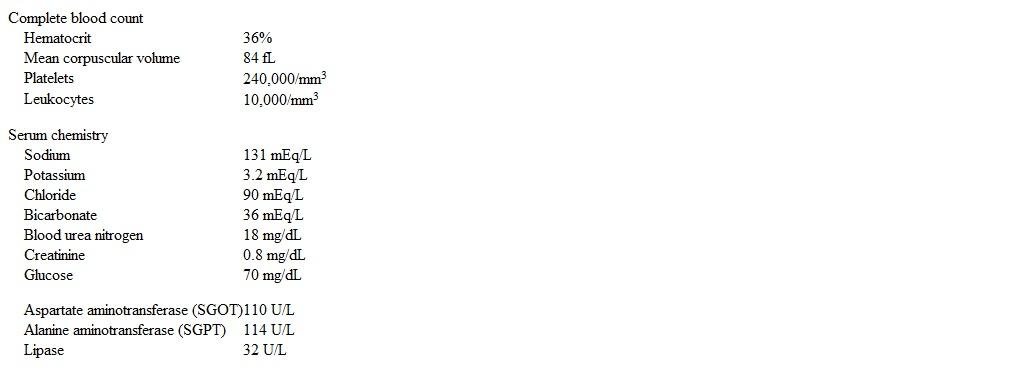 Which of the following is the most likely diagnosis in this patient?
 (Multiple Choice)
4.9/5 (80)
(80) A 30-year-old woman, gravida 1 para 1, comes to the office for evaluation of blood-tinged breast milk. The patient had an uncomplicated vaginal delivery 2 months ago and has been exclusively pumping her breast milk. She initially had bilateral breast pain with letdown and bloody-appearing milk due to nipple trauma that resolved with a lactation consultation and supportive measures. However, for the past 2 weeks, the patient has had intermittent blood-tinged milk from the right breast but no fever, chills, or breast pain. She has no chronic medical conditions, and her only medication is a progestin-only oral contraceptive. Temperature is 36.7 C (98.1 F) and pulse is 88/min. On examination, there is mild, diffuse breast tenderness and engorgement bilaterally. A firm density is palpable within the right breast at the 9 o'clock position, but no fluctuance or surrounding erythema is present. There is no axillary or clavicular lymphadenopathy. Which of the following is the best next step in management of this patient?
(Multiple Choice)
4.7/5 (88)
(88) A 52-year-old woman comes to the office because she has not been sleeping well. For the past year, the patient has had no difficulty falling asleep, but has frequent sleep interruption and often awakens with her sheets soaked in sweat. She now has worsening fatigue that is affecting her ability to focus at work. The patient has not been sexually active in the last 6 months due to vaginal dryness and painful intercourse. She has no chronic medical conditions, and her only procedure has been a laparoscopic hysterectomy in her 40s for symptomatic uterine leiomyomata. The patient does not use tobacco, alcohol, or illicit drugs. Blood pressure is 116/78 mm Hg and pulse is 70/min. BMI is 24 kg/m2. Pelvic examination shows pale, thin vulvovaginal tissues and a narrow vaginal introitus. The vaginal cuff is intact and without lesions. The remainder of the physical examination is normal. Which of the following is the most appropriate therapy for this patient's symptoms?
(Multiple Choice)
4.9/5 (79)
(79) A 16-year-old girl comes to the office due to not having started her menstrual period. The patient says that all her friends have started their periods and she is concerned that she is "behind." She has had no nipple discharge or change in vision or weight. The patient has no chronic medical conditions and takes no daily medications. She recently became sexually active and uses condoms for contraception. Height is at the 70th percentile and weight is at the 40th percentile for age. Vital signs are normal. On physical examination, there is sexual maturity rating (Tanner) stage 4 breast development with minimal axillary and pubic hair. The external genitalia are normal and the vagina is 3 cm in length; the cervix is not visible. No uterus, cervix, or ovaries are palpated on bimanual examination. Laboratory studies include a negative pregnancy test and a testosterone level of 400 ng/dL (normal: 15-75 [female]; 300-1,000 [male]). Which of the following is the most likely diagnosis in this patient?
(Multiple Choice)
4.7/5 (76)
(76) A 36-year-old woman, gravida 2 para 1, at 35 weeks gestation comes to the labor and delivery unit due to vaginal bleeding and constant back pain for the past hour. The patient has a history of chronic hypertension that has been well controlled with labetalol throughout the pregnancy. Prenatal laboratory tests and ultrasounds have been normal. She does not use tobacco, alcohol, or illicit drugs. Temperature is 37.1 C (98.8 F), blood pressure is 104/70 mm Hg, and pulse is 118/min. Physical examination shows a smooth, firm, and distended uterus with a fundal height of 38 cm. Speculum examination reveals a small amount of bleeding and a closed cervix. The first 10 minutes of fetal monitoring show a baseline heart rate of 160/min, minimal variability, and 3 late decelerations. Uterine contractions are observed every 1-2 minutes. Which of the following is the most likely diagnosis in this patient?
(Multiple Choice)
4.8/5 (66)
(66) A 28-year-old woman, gravida 1 para 1, comes to the office for evaluation of fecal incontinence. Last week, the patient underwent spontaneous vaginal delivery of a 5-kg (11-lb) infant that was complicated by a third-degree perineal laceration. Since delivery, the patient has had episodes of fecal and flatal incontinence throughout the day. She also has had 1-2 soft bowel movements per day with no diarrhea or hematochezia. The patient has no chronic medical conditions and did not have incontinence during her pregnancy. Temperature is 36.7 C (98 F), blood pressure is 120/70 mm Hg, and pulse is 76/min. On examination, the perineum appears edematous, but there is no induration or erythema. The laceration repair appears intact. Anal sphincter tone is weak and has asymmetric contraction. There is a moderate amount of stool in the rectal vault. On speculum examination, there is normal lochia from the cervix with no abnormal or malodorous discharge. Vaginal walls are intact with no lacerations or defects. Which of the following is the best next step in management of this patient?
(Multiple Choice)
4.9/5 (83)
(83) A 28-year-old woman, gravida 0 para 0, comes to the office with her husband, age 38, for evaluation of infertility. The couple has not conceived despite frequent intercourse without contraception for over a year. Menarche was at age 13. The patient's menstrual cycles are irregular, and her last period was 8 weeks ago. She has no nipple discharge. She had trichomoniasis as a teenager. Sexually transmitted infection testing at her most recent annual examination was negative. Her husband had a normal semen analysis. The patient takes a daily prenatal vitamin and does not use tobacco, alcohol, or illicit drugs. BMI is 28 kg/m2. Blood pressure is 130/80 mm Hg and pulse is 84/min. Heart and lung examination is normal. The abdomen is soft and nontender, with no palpable masses. Pelvic examination shows normal external genitalia and a mobile uterus without adnexal masses. Urine pregnancy test is negative. Serum TSH and prolactin levels are normal. Free testosterone levels are elevated. Which of the following is the most likely cause of this couple's infertility?
(Multiple Choice)
4.8/5 (67)
(67) A 21-year-old woman is evaluated for nausea, vomiting, and a severe headache. The patient developed a headache last night after getting out of bed and walking to the newborn nursery. Her headache has not improved with acetaminophen or ibuprofen, and the only thing that makes it better is lying down and sleeping. Now she has a severe headache, nausea, and vomiting whenever she gets out of bed. The patient has had no dizziness, changes in vision, or loss of consciousness. She had a spontaneous vaginal delivery 2 days ago after an induction of labor for gestational hypertension. She had an epidural placed for analgesia that was removed immediately after delivery. Temperature is 37.2 C (99 F), blood pressure is 136/88 mm Hg, and pulse is 108/min. The patient has neck stiffness and is unable to sit up due to severe nausea. There is no papilledema, and the pupils are equal and reactive. Bilateral lower extremities have pitting edema to the knees. Deep tendon reflexes are 2+. Which of the following is the most likely diagnosis in this patient?
(Multiple Choice)
4.8/5 (77)
(77) A 21-year-old woman is brought to the emergency department due to continuous vomiting, diarrhea, and high fever for a day. The patient also has a severe headache that is unrelieved by acetaminophen. She has no hematemesis or hematochezia. The patient spent the last 3 months in Southeast Asia and returned yesterday on an international flight. She has no chronic medical conditions or previous surgeries. The patient does not use tobacco or illicit drugs. She is currently on the fifth day of her menstrual period and has had to use both tampons and pads due to heavy bleeding. Temperature is 39.4 C (103 F), blood pressure is 80/40 mm Hg, and pulse is 124/min. Physical examination reveals a diaphoretic woman with dry mucous membranes. There is no nuchal rigidity. An erythematous macular rash covers the entire body, including the palms and soles. Which of the following microorganisms is most likely responsible for this patient's symptoms?
(Multiple Choice)
4.9/5 (89)
(89) A 22-year-old woman, gravida 1 para 0, comes to the office after a positive home pregnancy test. Her last menstrual period was approximately 9 weeks ago. The patient recently moved from out of town to start graduate school and does not have a local health care provider. She has no medical history and takes no medications. She does not use tobacco, alcohol, or illicit drugs. Pelvic examination shows an anteverted, enlarged uterus. Ultrasound confirms a 9-week intrauterine gestation with normal cardiac activity. When the patient sees the results of the ultrasound, she requests a termination of pregnancy. The office does not offer pregnancy termination services due to religious beliefs. What is the best response to this patient?
(Multiple Choice)
4.9/5 (67)
(67) A 30-year-old woman, gravida 1 para 0, at 26 weeks gestation comes to the office for a routine prenatal visit. She has had no contractions, vaginal bleeding, or leakage of fluid. Fetal movement is normal. The patient has no chronic medical conditions, and her only medications are a prenatal vitamin and iron supplement. Prepregnancy BMI was 18 kg/m2. She has gained less than the recommended 0.5 kg (1 lb) per week. Vital signs are normal. Fetal heart rate is 150/min. Fundal height is 24 cm. Ultrasound reveals a fetus measuring in the 25th percentile for gestational age. This patient is at increased risk for which of the following pregnancy-related complications?
(Multiple Choice)
4.8/5 (84)
(84) A 36-year-old woman, gravida 1 para 0, at 38 weeks gestation is brought to the emergency department due to sudden vaginal bleeding and severe lower abdominal pain. The patient had a prenatal course notable for diet-controlled gestational diabetes mellitus. An ultrasound at 20 weeks gestation showed normal fetal anatomy and a fundal placenta. The patient has a 5-pack-year smoking history and has been trying to quit. Temperature is 37 C (98.6 F), blood pressure is 158/96 mm Hg, and pulse is 112/min. Physical examination shows uterine tenderness and moderate vaginal bleeding. Digital cervical examination shows cervical dilation at 3 cm with the fetus in vertex presentation at 0 station. Fetal heart tracing shows a heart rate of 140/min with accelerations and moderate variability. Contractions occur every 2 minutes and last for 20 seconds. Urinalysis shows 3+ protein. This patient is at greatest risk of developing which of the following complications?
(Multiple Choice)
4.9/5 (79)
(79) A 33-year-old woman, gravida 3 para 0 aborta 2, at 28 weeks gestation comes to the office for a routine prenatal visit. The patient has had no contractions, vaginal bleeding, or leakage of fluid. Fetal movement is normal. Her pregnancy is complicated by type 1 diabetes mellitus that has become increasingly difficult to control with her insulin regimen. During the past month, most of the patient's postprandial blood glucose levels have been above 200 mg/dL. An anatomy ultrasound at 20 weeks gestation was normal; a follow-up growth ultrasound at 24 weeks gestation was at the 30th percentile. Blood pressure is 124/82 mm Hg and pulse is 88/min. Fundal height is 24 cm. Nonstress test is reactive and reassuring. Ultrasound reveals a cephalic fetus measuring at the 4th percentile for gestational age and an amniotic fluid index of 3 cm (normal: >5 cm). Which of the following is the best next step in management?
(Multiple Choice)
4.7/5 (87)
(87) 
Filters
- Essay(0)
- Multiple Choice(0)
- Short Answer(0)
- True False(0)
- Matching(0)