



 Chat with AI
Exam 19: Earnings and Discrimination

Exam 1: Ten Principles of Economics455 Questions
Exam 2: Thinking Like an Economist643 Questions
Exam 3: Interdependence and the Gains From Trade547 Questions
Exam 4: The Market Forces of Supply and Demand693 Questions
Exam 5: Elasticity and Its Application626 Questions
Exam 6: Supply, Demand, and Government Policies668 Questions
Exam 7: Consumers, Producers, and the Efficiency of Markets547 Questions
Exam 8: Applications: the Costs of Taxation509 Questions
Exam 9: Application: International Trade521 Questions
Exam 10: Externalities543 Questions
Exam 11: Public Goods and Common Resources452 Questions
Exam 12: The Design of the Tax System664 Questions
Exam 13: The Costs of Production649 Questions
Exam 14: Firms in Competitive Markets604 Questions
Exam 15: Monopoly662 Questions
Exam 16: Monopolistic Competition649 Questions
Exam 17: Oligopoly522 Questions
Exam 18: The Markets for the Factors of Production592 Questions
Exam 19: Earnings and Discrimination511 Questions
Exam 20: Income Inequality and Poverty478 Questions
Exam 21: The Theory of Consumer Choice570 Questions
Exam 22: Frontiers in Microeconomics461 Questions
Exam 23: Measuring a Nation S Income547 Questions
Exam 24: Measuring the Cost of Living565 Questions
Exam 25: Production and Growth527 Questions
Exam 26: Saving, Investment, and the Financial System637 Questions
Exam 27: Tools of Finance534 Questions
Exam 28: Unemployment and Its Natural Rate701 Questions
Exam 29: The Monetary System540 Questions
Exam 30: Money Growth and Inflation504 Questions
Exam 31: Open-Economy Macroeconomics: Basic Concepts540 Questions
Exam 32: A Macroeconomic Theory of the Open Economy511 Questions
Exam 33: Aggregate Demand and Aggregate Supply572 Questions
Exam 34: The Influence of Monetary and Fiscal Policy on Aggregate Demand523 Questions
Exam 35: The Short-Run Tradeoff Between Inflation and Unemployment536 Questions
Exam 36: Six Debates Over Macroeconomic Policy354 Questions
Select questions type


Which of the following statements is true of wages, educational attainment, and gender?
(Multiple Choice)
4.8/5  (73)
(73) List the productivity factors that may explain the differences in pay between men and women in similar occupations. Do any of these factors arise as a result of cultural or social traditions? If so, describe how changes in social relationships will affect the pay gap over time.
(Essay)
4.9/5 (86)
(86) Empirical work that does not account for differences in the productivity of workers
(Multiple Choice)
4.9/5 (71)
(71) Major league baseball players get paid more than minor league baseball players because of
(Multiple Choice)
4.9/5 (76)
(76) The accumulation of investments in people, such as education and on-the-job training, is known as
(Multiple Choice)
4.9/5 (75)
(75) The statement "the rich get richer and the poor get poorer" is evident in the fact that
(Multiple Choice)
4.7/5 (73)
(73) Workers with more human capital on average earn substantially higher pay than workers with less human capital in
(Multiple Choice)
4.8/5 (80)
(80) One of the problems with calculating the true amount of discrimination that takes place in the market for labor is
(Multiple Choice)
4.8/5 (79)
(79) Economists who attempt to explain the increasing earnings gap between skilled and unskilled workers offer two main hypotheses:
(Multiple Choice)
4.9/5 (78)
(78) Between 1975 and 2011, the wage gap between men with a high school education and men with a college education increased. In particular, in 2011 men with a college degree earned about
(Multiple Choice)
4.7/5 (74)
(74) Air-traffic controllers get paid high wages given their level of education. They also get frequent breaks and may only work a few days a week. Which of the following could explain their high wage?
(Multiple Choice)
4.8/5 (67)
(67) Jake and Harry each have 130 hours of college credit from Impressive University. Each has 30 hours of economics. Jake has a bachelor's degree, while Harry is 3 credits short of required physical education classes and therefore does not have a degree. Each of them has one year of experience as a market analyst for ABC Company. Assuming that the physical education class would not enhance Harry's job performance, if Jake earns a higher salary than Harry, the ABC Company may subscribe to the
(Multiple Choice)
4.9/5 (72)
(72) Scenario 19-5
Jason works part-time at a grocery store after school. Jason has worked at the store for two years but still hasn't received a wage increase, even though newer employees have received raises. Jason has threatened his employer with a lawsuit if he doesn't get a raise in the next few weeks. Jason believes he is a victim of labor-market discrimination.
-Refer to Scenario 19-5. In a competitive market for grocery store employees, why might Jason's wage differential persist?
(Multiple Choice)
4.7/5 (78)
(78) Evidence of discrimination is most apparent when one compares wages among broad groups.
(True/False)
4.9/5 (80)
(80) Discrimination is an emotionally charged issue that is impossible to study objectively.
(True/False)
4.9/5 (79)
(79) Figure 19-7 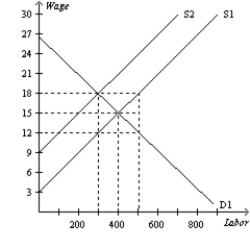 -Refer to Figure 19-7. The figure shows labor demand and labor supply in a non-unionized labor market. Suppose the current labor demand is D1 and the current labor supply is S1. If a firm in this market decided to pay its workers $18 per hour to increase the productivity of its workers, this firm would be paying a(n)
 (Short Answer)
4.9/5 (73)
(73) Suppose that Philip is the best contractor in town, and he makes $400,000 a year. Suppose that Julia Roberts is the best and highest paid actress in Hollywood, and she makes $13 million per movie. Both are the best in their respective fields of work. One reason for the significant difference in incomes has to do with the nature of the service each offers. Philip's contracting services
(Multiple Choice)
4.8/5 (81)
(81) 
Filters
- Essay(0)
- Multiple Choice(0)
- Short Answer(0)
- True False(0)
- Matching(0)