



 Chat with AI
Exam 19: Earnings and Discrimination

Exam 1: Ten Principles of Economics455 Questions
Exam 2: Thinking Like an Economist643 Questions
Exam 3: Interdependence and the Gains From Trade547 Questions
Exam 4: The Market Forces of Supply and Demand693 Questions
Exam 5: Elasticity and Its Application626 Questions
Exam 6: Supply, Demand, and Government Policies668 Questions
Exam 7: Consumers, Producers, and the Efficiency of Markets547 Questions
Exam 8: Applications: the Costs of Taxation509 Questions
Exam 9: Application: International Trade521 Questions
Exam 10: Externalities543 Questions
Exam 11: Public Goods and Common Resources452 Questions
Exam 12: The Design of the Tax System664 Questions
Exam 13: The Costs of Production649 Questions
Exam 14: Firms in Competitive Markets604 Questions
Exam 15: Monopoly662 Questions
Exam 16: Monopolistic Competition649 Questions
Exam 17: Oligopoly522 Questions
Exam 18: The Markets for the Factors of Production592 Questions
Exam 19: Earnings and Discrimination511 Questions
Exam 20: Income Inequality and Poverty478 Questions
Exam 21: The Theory of Consumer Choice570 Questions
Exam 22: Frontiers in Microeconomics461 Questions
Exam 23: Measuring a Nation S Income547 Questions
Exam 24: Measuring the Cost of Living565 Questions
Exam 25: Production and Growth527 Questions
Exam 26: Saving, Investment, and the Financial System637 Questions
Exam 27: Tools of Finance534 Questions
Exam 28: Unemployment and Its Natural Rate701 Questions
Exam 29: The Monetary System540 Questions
Exam 30: Money Growth and Inflation504 Questions
Exam 31: Open-Economy Macroeconomics: Basic Concepts540 Questions
Exam 32: A Macroeconomic Theory of the Open Economy511 Questions
Exam 33: Aggregate Demand and Aggregate Supply572 Questions
Exam 34: The Influence of Monetary and Fiscal Policy on Aggregate Demand523 Questions
Exam 35: The Short-Run Tradeoff Between Inflation and Unemployment536 Questions
Exam 36: Six Debates Over Macroeconomic Policy354 Questions
Select questions type


Discrimination occurs when the marketplace offers different opportunities to similar individuals who differ only by
(Multiple Choice)
4.9/5  (77)
(77) Attributing the gender wage gap to ongoing discrimination by employers will likely be incorrect because
(Multiple Choice)
4.8/5 (82)
(82) John has financial assets totaling $1.5 million, and he plans to use these assets to start his own business. Since John owns these funds and will not need to borrow to start his business, these assets are considered human capital.
(True/False)
4.9/5 (68)
(68) Nurses who work in hospitals often are required to work on weekends, whereas nurses who work in doctors' offices generally only work Monday through Friday. Hospital nurses who must work on weekends are usually paid more than nurses working in doctors' offices for the same work even if they have the same skills and education. This difference in pay is attributed to
(Multiple Choice)
4.8/5 (83)
(83) If we were to observe above-equilibrium wages in a particular labor market, then a possible explanation might be that
(Multiple Choice)
4.9/5 (81)
(81) Discrimination occurs when the marketplace offers different opportunities to similar individuals who differ only by
(Multiple Choice)
4.8/5 (76)
(76) Figure 19-6  -Refer to Figure 19-6. This figure depicts labor demand and supply for the widget industry. The equilibrium market wage is $15. If a labor union forms within the widget industry and subsequently negotiates an hourly wage of $20.00, then there will be an
 (Multiple Choice)
4.9/5 (81)
(81) Figure 19-1 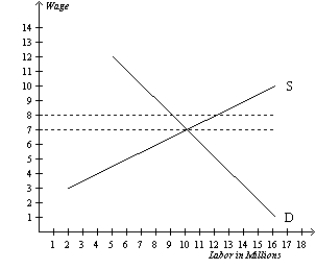 -Refer to Figure 19-1. Suppose the local labor market was in equilibrium to begin with but then the largest local employer decided to change its compensation scheme to $8 as shown. Which of the following compensation schemes could the graph be illustrating?
 (Multiple Choice)
4.8/5 (75)
(75) Which of the following moves the wage above its equilibrium value?
(Multiple Choice)
4.8/5 (88)
(88) Hunter is an ambitious, competitive person who has always tried to be the best at everything he does. Consider the following job options facing Hunter and choose the option that will likely afford him the highest wage.
(Multiple Choice)
4.9/5 (78)
(78) Over the last several years, the earnings gap between workers with college degrees and workers with high school degrees has
(Multiple Choice)
4.9/5 (63)
(63) Since measurable factors such as years of experience and years of education explain less than half of the variation in wages, ability, effort, and chance must play a significant role in determining wages.
(True/False)
4.8/5 (72)
(72) Suppose that a college student receives an offer for a summer internship with a stock brokerage firm. Unfortunately for the student, the internship is unpaid. Is it ever economically beneficial to accept an unpaid job?
(Multiple Choice)
4.8/5 (80)
(80) Which of the following is an example of a compensating differential?
(Multiple Choice)
4.8/5 (79)
(79) Firms that operate in competitive product markets and choose to practice discrimination in hiring workers
(Multiple Choice)
4.7/5 (78)
(78) Which of the following would tend to lessen the wage gap between a country's skilled and unskilled workers?
(Multiple Choice)
4.8/5 (91)
(91) Given that the median male is better paid than the median female, which of the following is a valid explanation for wage differences?
(Multiple Choice)
4.8/5 (73)
(73) Over the past several years, the earnings gap between high-skilled and low-skilled workers has
(i)narrowed because the demand for unskilled labor has risen over time relative to the demand for skilled labor.
(ii)widened because the demand for skilled labor has risen over time relative to the demand for unskilled labor.
(iii)narrowed because the supply of unskilled labor has risen over time relative to the supply of skilled labor.
(iv)widened because the supply of skilled labor has risen over time relative to the supply of unskilled labor.
(Multiple Choice)
4.9/5 (76)
(76) 
Filters
- Essay(0)
- Multiple Choice(0)
- Short Answer(0)
- True False(0)
- Matching(0)