



 Chat with AI
Exam 19: Earnings and Discrimination

Exam 1: Ten Principles of Economics455 Questions
Exam 2: Thinking Like an Economist643 Questions
Exam 3: Interdependence and the Gains From Trade547 Questions
Exam 4: The Market Forces of Supply and Demand693 Questions
Exam 5: Elasticity and Its Application626 Questions
Exam 6: Supply, Demand, and Government Policies668 Questions
Exam 7: Consumers, Producers, and the Efficiency of Markets547 Questions
Exam 8: Applications: the Costs of Taxation509 Questions
Exam 9: Application: International Trade521 Questions
Exam 10: Externalities543 Questions
Exam 11: Public Goods and Common Resources452 Questions
Exam 12: The Design of the Tax System664 Questions
Exam 13: The Costs of Production649 Questions
Exam 14: Firms in Competitive Markets604 Questions
Exam 15: Monopoly662 Questions
Exam 16: Monopolistic Competition649 Questions
Exam 17: Oligopoly522 Questions
Exam 18: The Markets for the Factors of Production592 Questions
Exam 19: Earnings and Discrimination511 Questions
Exam 20: Income Inequality and Poverty478 Questions
Exam 21: The Theory of Consumer Choice570 Questions
Exam 22: Frontiers in Microeconomics461 Questions
Exam 23: Measuring a Nation S Income547 Questions
Exam 24: Measuring the Cost of Living565 Questions
Exam 25: Production and Growth527 Questions
Exam 26: Saving, Investment, and the Financial System637 Questions
Exam 27: Tools of Finance534 Questions
Exam 28: Unemployment and Its Natural Rate701 Questions
Exam 29: The Monetary System540 Questions
Exam 30: Money Growth and Inflation504 Questions
Exam 31: Open-Economy Macroeconomics: Basic Concepts540 Questions
Exam 32: A Macroeconomic Theory of the Open Economy511 Questions
Exam 33: Aggregate Demand and Aggregate Supply572 Questions
Exam 34: The Influence of Monetary and Fiscal Policy on Aggregate Demand523 Questions
Exam 35: The Short-Run Tradeoff Between Inflation and Unemployment536 Questions
Exam 36: Six Debates Over Macroeconomic Policy354 Questions
Select questions type


Figure 19-6 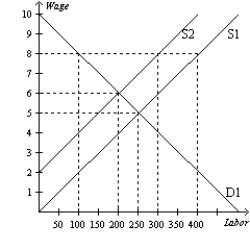 -Refer to Figure 19-6. Given demand, D1, and supply, S1, how much more do workers earn per hour if the supply curve shifts to S2?
 (Short Answer)
4.8/5  (84)
(84) Which of the following is the most important contributor to human capital?
(Multiple Choice)
4.9/5 (77)
(77) Economists argue competitive markets provide a "natural remedy" to discriminatory wage practices. Which of the following is widely recognized as a potential limit to the effectiveness of that natural remedy?
(Multiple Choice)
4.9/5 (83)
(83) In 1913, the Ford Motor Company decided to pay its employees $5 a day. This wage was significantly higher than what any other organization offered. Henry Ford believed that this wage would make his employees happier, increase their productivity, and lower employee turnover. Economists would say that Mr. Ford offered his employees
(Multiple Choice)
4.8/5 (85)
(85) Many studies of wage discrimination have been conducted on professional sports teams. This industry is easier to study than others because the professional teams have many objective measures of
(Short Answer)
4.8/5 (81)
(81) Scenario 19-5
Jason works part-time at a grocery store after school. Jason has worked at the store for two years but still hasn't received a wage increase, even though newer employees have received raises. Jason has threatened his employer with a lawsuit if he doesn't get a raise in the next few weeks. Jason believes he is a victim of labor-market discrimination.
-Refer to Scenario 19-5. Why might an economist be skeptical of Jason's discrimination complaint?
(Multiple Choice)
4.9/5 (85)
(85) Adam and Bob are identical twins who attended grammar school through high school together. Adam got a job after high school, and Bob got a job after graduating from college. Adam earns $36,000 a year, and Bob earns $69,000 a year. Select the best explanation for this wage difference.
(Multiple Choice)
4.8/5 (70)
(70) A natural correction to employer discrimination in market economies is the
(Multiple Choice)
5.0/5 (84)
(84) Efficiency wages will raise the quantity of labor supplied to the market.
(True/False)
4.9/5 (72)
(72) Scenario 19-6
Suppose that in the competitive market for auto repair, firms prefer to hire men rather than women. Assume that the women applying for positions have the same skills, experience, and work ethic as the men. As a result of this discrimination, the demand for women is lower than it otherwise would be.
-Refer to Scenario 19-6. What conclusion can you draw about women's wages compared to men's wages in this industry?
(Short Answer)
4.9/5 (83)
(83) Which of the following is an example of labor-market discrimination? You may assume that worker A and worker B have identical characteristics except for the ones listed. A firm offers a higher salary to worker A than worker B because worker A
(Multiple Choice)
4.8/5 (84)
(84) Jay was just drafted by a professional baseball team, and was offered a record-breaking contract because of his potential. This is an example of
(Multiple Choice)
4.7/5 (69)
(69) A compensating differential refers to a difference in wages that arises from nonmonetary characteristics.
(True/False)
4.8/5 (65)
(65) Figure 19-2 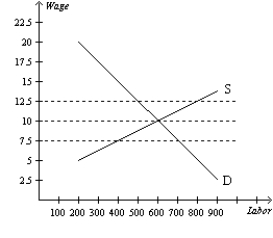 -Refer to Figure 19-2. This figure depicts labor demand and supply in a nonunionized labor market. The original equilibrium is at $10. If a labor union subsequently establishes a union shop and negotiates an hourly wage of $12.50, then employment is
 (Multiple Choice)
4.8/5 (88)
(88) Callie has just graduated from Hairs-R-Us Beauty School with a license to cut hair. She can earn $15 an hour styling hair at the local hair salon or $20 an hour styling hair at the local funeral home. The higher wage offered by the funeral home is an example of
(Multiple Choice)
4.9/5 (86)
(86) It is argued that competitive markets provide a "natural remedy" to discriminatory wage practices. Which of the following is widely recognized as a potential limit to the potency of that natural remedy?
(Multiple Choice)
4.8/5 (67)
(67) Scenario 19-1
Ferris B., a student at a community college, is considering what he should do for summer employment. Two recruiters show up at his school in search of summer workers. Recruiter A is looking for lifeguards to patrol the beach at an exclusive island resort in the Caribbean. Recruiter B is looking for workers to staff positions at a summer youth camp.
-Refer to Scenario 19-1. Ferris is carefully considering the options that each recruiter presents. On the basis of knowledge obtained in his economics class, Ferris concludes that
(Multiple Choice)
4.9/5 (80)
(80) The theory of education that states firms use educational attainment as a way of sorting between high-ability and low-ability workers is called
(Short Answer)
4.9/5 (67)
(67) 
Filters
- Essay(0)
- Multiple Choice(0)
- Short Answer(0)
- True False(0)
- Matching(0)