



 Chat with AI
Exam 19: Earnings and Discrimination

Exam 1: Ten Principles of Economics455 Questions
Exam 2: Thinking Like an Economist643 Questions
Exam 3: Interdependence and the Gains From Trade547 Questions
Exam 4: The Market Forces of Supply and Demand693 Questions
Exam 5: Elasticity and Its Application626 Questions
Exam 6: Supply, Demand, and Government Policies668 Questions
Exam 7: Consumers, Producers, and the Efficiency of Markets547 Questions
Exam 8: Applications: the Costs of Taxation509 Questions
Exam 9: Application: International Trade521 Questions
Exam 10: Externalities543 Questions
Exam 11: Public Goods and Common Resources452 Questions
Exam 12: The Design of the Tax System664 Questions
Exam 13: The Costs of Production649 Questions
Exam 14: Firms in Competitive Markets604 Questions
Exam 15: Monopoly662 Questions
Exam 16: Monopolistic Competition649 Questions
Exam 17: Oligopoly522 Questions
Exam 18: The Markets for the Factors of Production592 Questions
Exam 19: Earnings and Discrimination511 Questions
Exam 20: Income Inequality and Poverty478 Questions
Exam 21: The Theory of Consumer Choice570 Questions
Exam 22: Frontiers in Microeconomics461 Questions
Exam 23: Measuring a Nation S Income547 Questions
Exam 24: Measuring the Cost of Living565 Questions
Exam 25: Production and Growth527 Questions
Exam 26: Saving, Investment, and the Financial System637 Questions
Exam 27: Tools of Finance534 Questions
Exam 28: Unemployment and Its Natural Rate701 Questions
Exam 29: The Monetary System540 Questions
Exam 30: Money Growth and Inflation504 Questions
Exam 31: Open-Economy Macroeconomics: Basic Concepts540 Questions
Exam 32: A Macroeconomic Theory of the Open Economy511 Questions
Exam 33: Aggregate Demand and Aggregate Supply572 Questions
Exam 34: The Influence of Monetary and Fiscal Policy on Aggregate Demand523 Questions
Exam 35: The Short-Run Tradeoff Between Inflation and Unemployment536 Questions
Exam 36: Six Debates Over Macroeconomic Policy354 Questions
Select questions type


Empirical evidence suggests that ability, effort, and chance are not likely to be significant contributors to wage differences.
(True/False)
5.0/5  (87)
(87) Figure 19-3
The manufacturing labor market. 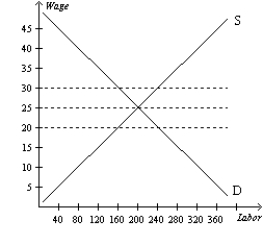 -Refer to Figure 19-3. Suppose the manufacturing labor market, which is non-unionized, is in equilibrium at a wage equal to $25. Suppose now that the AFL-CIO (a labor organization) organizes the workers in the manufacturing market and negotiates a wage of $30 per hour. Because of the union,
 (Multiple Choice)
4.7/5 (75)
(75) Figure 19-5 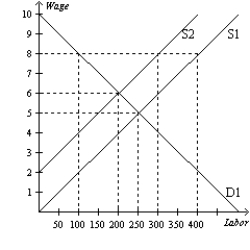 -Refer to Figure 19-5. Given demand for labor, D1, and supply of labor, S2, which of the following could be considered an efficiency wage?
 (Multiple Choice)
4.9/5 (72)
(72) In the early twentieth century, streetcars in many southern cities were segregated by race. This racial segregation was the result of
(Multiple Choice)
4.8/5 (85)
(85) Higher levels of human capital are correlated with higher earnings because firms are willing to pay more for better-educated workers who have higher marginal productivities.
(True/False)
4.8/5 (73)
(73) Which theory is supportive of the idea that increasing educational levels for all workers would raise all workers' productivity and therefore their wages?
(Multiple Choice)
4.8/5 (79)
(79) A plumber who specializes in cleaning plugged sewer lines is typically paid a higher wage than a plumber who works on installing water systems in new residential housing. Which of the following would push the wages of plumbers who work on sewer lines higher?
(Multiple Choice)
4.8/5 (77)
(77) A recent study of the determinants of wages for clerical staff at a state university found that years of schooling, years of experience, age and job characteristics only explained about one-half of the difference in wages. Describe other factors that may be important in explaining wages differences for clerical staff.
(Essay)
4.9/5 (78)
(78) The wage difference between jobs that require education and those that don't
(Multiple Choice)
4.8/5 (89)
(89) Why do economists study sports teams when looking for evidence of labor-market discrimination?
(Multiple Choice)
4.8/5 (70)
(70) Many kindergarten teachers have advanced education degrees, yet they have lower average earnings than other individuals with similar education levels. A potential explanation for the differences in earnings is that kindergarten teachers
(Multiple Choice)
4.9/5 (69)
(69) Studies of professional sports teams suggest that, in sports, racial discrimination in previous decades was
(Multiple Choice)
4.9/5 (76)
(76) Economists are skeptical that discrimination is employer driven because
(Multiple Choice)
4.9/5 (81)
(81) Which of the following examples best describes the signaling theory of education?
(Multiple Choice)
4.9/5 (78)
(78) Is measuring the effect of discrimination on wages relatively easy or relatively difficult? Explain?
(Essay)
4.9/5 (76)
(76) 
Filters
- Essay(0)
- Multiple Choice(0)
- Short Answer(0)
- True False(0)
- Matching(0)