



 Chat with AI
Exam 19: Earnings and Discrimination

Exam 1: Ten Principles of Economics455 Questions
Exam 2: Thinking Like an Economist643 Questions
Exam 3: Interdependence and the Gains From Trade547 Questions
Exam 4: The Market Forces of Supply and Demand693 Questions
Exam 5: Elasticity and Its Application626 Questions
Exam 6: Supply, Demand, and Government Policies668 Questions
Exam 7: Consumers, Producers, and the Efficiency of Markets547 Questions
Exam 8: Applications: the Costs of Taxation509 Questions
Exam 9: Application: International Trade521 Questions
Exam 10: Externalities543 Questions
Exam 11: Public Goods and Common Resources452 Questions
Exam 12: The Design of the Tax System664 Questions
Exam 13: The Costs of Production649 Questions
Exam 14: Firms in Competitive Markets604 Questions
Exam 15: Monopoly662 Questions
Exam 16: Monopolistic Competition649 Questions
Exam 17: Oligopoly522 Questions
Exam 18: The Markets for the Factors of Production592 Questions
Exam 19: Earnings and Discrimination511 Questions
Exam 20: Income Inequality and Poverty478 Questions
Exam 21: The Theory of Consumer Choice570 Questions
Exam 22: Frontiers in Microeconomics461 Questions
Exam 23: Measuring a Nation S Income547 Questions
Exam 24: Measuring the Cost of Living565 Questions
Exam 25: Production and Growth527 Questions
Exam 26: Saving, Investment, and the Financial System637 Questions
Exam 27: Tools of Finance534 Questions
Exam 28: Unemployment and Its Natural Rate701 Questions
Exam 29: The Monetary System540 Questions
Exam 30: Money Growth and Inflation504 Questions
Exam 31: Open-Economy Macroeconomics: Basic Concepts540 Questions
Exam 32: A Macroeconomic Theory of the Open Economy511 Questions
Exam 33: Aggregate Demand and Aggregate Supply572 Questions
Exam 34: The Influence of Monetary and Fiscal Policy on Aggregate Demand523 Questions
Exam 35: The Short-Run Tradeoff Between Inflation and Unemployment536 Questions
Exam 36: Six Debates Over Macroeconomic Policy354 Questions
Select questions type


Al and Steve are both reporters at the same newspaper. Al is black and Steve is white. Al earns less than Steve. Which of the following can explain why Al earns less?
(Multiple Choice)
4.9/5  (77)
(77) Some economists suggest that increased international trade with countries that have a greater proportion of unskilled workers has led to an expanding wage gap between high-skill and low-skill workers in the United States.
(True/False)
4.7/5 (79)
(79) Studies show that white women earn approximately 25% less than white men. From this data alone, one should not conclude that white women are victims of discrimination. Name two other factors that could explain the difference in wages.
(Essay)
4.8/5 (68)
(68) Scenario 19-7
Mark works full time at a large accounting firm. Mark has been at the firm for four years but has not been given a promotion, even though newer employees have already been promoted. Mark believes he is a victim of labor-market discrimination, and threatens to hire a lawyer to sue the company.
-Refer to Scenario 19-7. Which of the following would strengthen Mark's case against his employer?
(Multiple Choice)
4.8/5 (69)
(69) Economists who attempt to explain the increasing earnings gap between skilled and unskilled workers in the United States offer two main hypotheses. Both hypotheses
(Multiple Choice)
4.8/5 (66)
(66) Suppose that a company hires recent college graduates for two types of jobs, sales people and credit analysts. The hours worked and skill levels are the same for both positions. The sales people must "cold call," which many people find to be unpleasant. When comparing the salaries of the two positions, it is likely that the company pays the
(Multiple Choice)
4.8/5 (96)
(96) Which of the following statements can be called a productivity-revealing theory?
(Multiple Choice)
4.9/5 (87)
(87) Which of the following is not an example of capital used in production?
(Multiple Choice)
4.9/5 (84)
(84) Jen is a waitress, and she gets paid an additional $2.00 per hour for agreeing to work on Valentine's Day. Jamie is also a waitress, but she did not work on Valentine's Day and hence did not get the extra $2.00 per hour. This difference in pay is an example of differences in human capital.
(True/False)
4.8/5 (75)
(75) Scenario 19-5
Jason works part-time at a grocery store after school. Jason has worked at the store for two years but still hasn't received a wage increase, even though newer employees have received raises. Jason has threatened his employer with a lawsuit if he doesn't get a raise in the next few weeks. Jason believes he is a victim of labor-market discrimination.
-Refer to Scenario 19-5. Which of the following statements would weaken Jason's case against his employer?
(Multiple Choice)
4.8/5 (82)
(82) Which of the following is an example of a compensating differential?
(Multiple Choice)
4.8/5 (81)
(81) Scenario 19-2
Travis, a student at a community college, is considering what he should do for summer employment. Two recruiters show up at his school in search of summer workers. Recruiter A is looking for workers to help a disaster relief agency distribute food aid in Africa. Recruiter B is looking for custodial help to clean motel rooms in a motel located near the entrance to a famous national park.
-Refer to Scenario 19-2. Travis is carefully considering the options that each recruiter presents. On the basis of knowledge obtained in his economics class, Travis concludes that
(Multiple Choice)
4.8/5 (85)
(85) Assume men, on balance, have lower amounts of human capital than women have. Then we would expect
(Multiple Choice)
4.9/5 (72)
(72) Which of the following is an example of customer discrimination?
(Multiple Choice)
4.9/5 (81)
(81) Figure 19-5 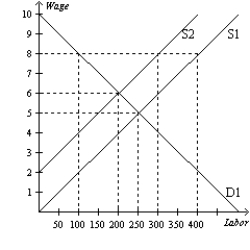 -Refer to Figure 19-5. Given demand for labor, D1, and supply of labor, S1, what is the quantity demanded of labor if a minimum wage of $8 per hour is imposed on this market?
 (Multiple Choice)
4.7/5 (82)
(82) Why would a wage differential due to discrimination in hiring be unlikely to persist in a competitive labor market?
(Multiple Choice)
4.8/5 (81)
(81) The statement that "night shift workers make a higher wage than day shift workers" is likely to reflect the fact that
(Multiple Choice)
4.9/5 (84)
(84) List three reasons why wages could be set above the equilibrium wage.
(Essay)
4.8/5 (72)
(72) Workers whose skills become obsolete as a result of technological change are often paid a lower wage as a result of
(Multiple Choice)
4.8/5 (73)
(73) 
Filters
- Essay(0)
- Multiple Choice(0)
- Short Answer(0)
- True False(0)
- Matching(0)