



 Chat with AI
Exam 19: Earnings and Discrimination

Exam 1: Ten Principles of Economics455 Questions
Exam 2: Thinking Like an Economist643 Questions
Exam 3: Interdependence and the Gains From Trade547 Questions
Exam 4: The Market Forces of Supply and Demand693 Questions
Exam 5: Elasticity and Its Application626 Questions
Exam 6: Supply, Demand, and Government Policies668 Questions
Exam 7: Consumers, Producers, and the Efficiency of Markets547 Questions
Exam 8: Applications: the Costs of Taxation509 Questions
Exam 9: Application: International Trade521 Questions
Exam 10: Externalities543 Questions
Exam 11: Public Goods and Common Resources452 Questions
Exam 12: The Design of the Tax System664 Questions
Exam 13: The Costs of Production649 Questions
Exam 14: Firms in Competitive Markets604 Questions
Exam 15: Monopoly662 Questions
Exam 16: Monopolistic Competition649 Questions
Exam 17: Oligopoly522 Questions
Exam 18: The Markets for the Factors of Production592 Questions
Exam 19: Earnings and Discrimination511 Questions
Exam 20: Income Inequality and Poverty478 Questions
Exam 21: The Theory of Consumer Choice570 Questions
Exam 22: Frontiers in Microeconomics461 Questions
Exam 23: Measuring a Nation S Income547 Questions
Exam 24: Measuring the Cost of Living565 Questions
Exam 25: Production and Growth527 Questions
Exam 26: Saving, Investment, and the Financial System637 Questions
Exam 27: Tools of Finance534 Questions
Exam 28: Unemployment and Its Natural Rate701 Questions
Exam 29: The Monetary System540 Questions
Exam 30: Money Growth and Inflation504 Questions
Exam 31: Open-Economy Macroeconomics: Basic Concepts540 Questions
Exam 32: A Macroeconomic Theory of the Open Economy511 Questions
Exam 33: Aggregate Demand and Aggregate Supply572 Questions
Exam 34: The Influence of Monetary and Fiscal Policy on Aggregate Demand523 Questions
Exam 35: The Short-Run Tradeoff Between Inflation and Unemployment536 Questions
Exam 36: Six Debates Over Macroeconomic Policy354 Questions
Select questions type


Which of the following helps to explain the differences in earnings in the United States?
(Multiple Choice)
4.9/5  (64)
(64) Why can superstar athletes and movie stars earn multimillion dollar salaries but superstar electricians and professors cannot?
(Multiple Choice)
4.9/5 (80)
(80) Figure 19-6 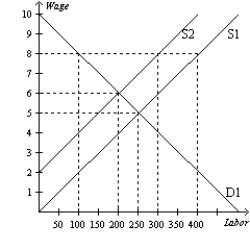 -Refer to Figure 19-6. Given demand, D1, and supply, S1, if wages adjust to balance labor supply and labor demand, what are the wage and quantity of labor?
 (Short Answer)
4.8/5 (79)
(79) What is the term for offering different opportunities to similar individuals who differ only by race, ethnic group, sex, age, or other personal characteristics?
(Short Answer)
4.9/5 (76)
(76) A compensation scheme that pays salespeople a percentage of the sales they make is attempting to reward
(Multiple Choice)
4.8/5 (80)
(80) Who among the following individuals most likely experiences the largest nonmonetary reward as a supplier of labor? Assume all of the four individuals have the same level of education and work the same number of hours per week.
(Multiple Choice)
4.9/5 (76)
(76) Suppose that an employer can hire workers with brown hair and workers with blonde hair. Each type of worker has the same productivity. Which of the following is correct if the employer discriminates by hiring only workers with brown hair?
(Multiple Choice)
4.9/5 (64)
(64) In order to explain the changing gap in earnings between skilled and unskilled workers in recent years, economists have proposed two hypotheses. One hypothesis emphasizes
(Multiple Choice)
4.8/5 (83)
(83) Other things equal, when the supply of workers is low, one would predict that market wages would be
(Multiple Choice)
4.8/5 (77)
(77) Studies of wages by labor economists indicate that measurable variables such as age, job characteristics, years of education, and years of experience account for
(Multiple Choice)
4.8/5 (69)
(69) Scenario 19-7
Mark works full time at a large accounting firm. Mark has been at the firm for four years but has not been given a promotion, even though newer employees have already been promoted. Mark believes he is a victim of labor-market discrimination, and threatens to hire a lawyer to sue the company.
-Refer to Scenario 19-7. Which of the following would weaken Mark's case against his employer?
(Multiple Choice)
4.9/5 (76)
(76) It is illegal in the United States for firms to pay different employees different wages for doing the same job.
(True/False)
4.8/5 (77)
(77) Evidence of differences in average wages of women compared to men
(Multiple Choice)
4.8/5 (74)
(74) By definition, there is discrimination when the marketplace offers different opportunities to similar individuals who differ only by
(Multiple Choice)
4.7/5 (83)
(83) Figure 19-6  -Refer to Figure 19-6. This figure depicts labor demand and supply for the widget industry. The equilibrium market wage is $15. Suppose a labor union forms and subsequently negotiates an hourly wage of $20.00. Which of the following statements about the impact of the union's formation on labor hours demanded is true?
 (Multiple Choice)
4.9/5 (71)
(71) When robots are used to replace workers on a factory production line, the wage gap between skilled and unskilled workers
(Multiple Choice)
4.9/5 (82)
(82) 
Filters
- Essay(0)
- Multiple Choice(0)
- Short Answer(0)
- True False(0)
- Matching(0)