



 Chat with AI
Exam 19: Earnings and Discrimination

Exam 1: Ten Principles of Economics455 Questions
Exam 2: Thinking Like an Economist643 Questions
Exam 3: Interdependence and the Gains From Trade547 Questions
Exam 4: The Market Forces of Supply and Demand693 Questions
Exam 5: Elasticity and Its Application626 Questions
Exam 6: Supply, Demand, and Government Policies668 Questions
Exam 7: Consumers, Producers, and the Efficiency of Markets547 Questions
Exam 8: Applications: the Costs of Taxation509 Questions
Exam 9: Application: International Trade521 Questions
Exam 10: Externalities543 Questions
Exam 11: Public Goods and Common Resources452 Questions
Exam 12: The Design of the Tax System664 Questions
Exam 13: The Costs of Production649 Questions
Exam 14: Firms in Competitive Markets604 Questions
Exam 15: Monopoly662 Questions
Exam 16: Monopolistic Competition649 Questions
Exam 17: Oligopoly522 Questions
Exam 18: The Markets for the Factors of Production592 Questions
Exam 19: Earnings and Discrimination511 Questions
Exam 20: Income Inequality and Poverty478 Questions
Exam 21: The Theory of Consumer Choice570 Questions
Exam 22: Frontiers in Microeconomics461 Questions
Exam 23: Measuring a Nation S Income547 Questions
Exam 24: Measuring the Cost of Living565 Questions
Exam 25: Production and Growth527 Questions
Exam 26: Saving, Investment, and the Financial System637 Questions
Exam 27: Tools of Finance534 Questions
Exam 28: Unemployment and Its Natural Rate701 Questions
Exam 29: The Monetary System540 Questions
Exam 30: Money Growth and Inflation504 Questions
Exam 31: Open-Economy Macroeconomics: Basic Concepts540 Questions
Exam 32: A Macroeconomic Theory of the Open Economy511 Questions
Exam 33: Aggregate Demand and Aggregate Supply572 Questions
Exam 34: The Influence of Monetary and Fiscal Policy on Aggregate Demand523 Questions
Exam 35: The Short-Run Tradeoff Between Inflation and Unemployment536 Questions
Exam 36: Six Debates Over Macroeconomic Policy354 Questions
Select questions type


Which of the following is an example of labor-market discrimination? You may assume that worker A and worker B have identical characteristics except for the ones listed. A firm offers a higher salary to worker A than worker B because worker A
(Multiple Choice)
4.7/5  (93)
(93) Some economists are skeptical of the argument that employers are responsible for discriminatory wage differences. They argue that market economies provide a natural remedy to employer discrimination, and that remedy is
(Multiple Choice)
4.8/5 (86)
(86) Which of the following is an example of customer discrimination?
(Multiple Choice)
4.8/5 (82)
(82) Wages of doctors tend to be higher than wages of bankers. Which of the following is a compensating differential explaining the difference in wages?
(Multiple Choice)
4.8/5 (71)
(71) If unskilled labor is relatively plentiful and cheap in many foreign countries, then as the United States expands its trade with these foreign countries, the domestic demand for
(Multiple Choice)
4.8/5 (81)
(81) Which theory would support the idea that education does not enhance productivity and therefore raising all workers' educational levels would not affect wages?
(Multiple Choice)
4.9/5 (84)
(84) Figure 19-5 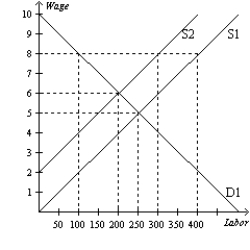 -Refer to Figure 19-5. Given demand for labor, D1, and supply of labor, S2, what is the surplus of labor if a minimum wage of $8 per hour is imposed on this market?
 (Multiple Choice)
4.9/5 (79)
(79) The difference in wages that results from nonmonetary characteristics of different jobs is called the
(Short Answer)
4.8/5 (63)
(63) Compensating differentials are differences in wages related to the characteristics of a job.
(True/False)
5.0/5 (88)
(88) The economic theory of labor markets suggests that wages are determined by labor supply and labor demand.
(True/False)
4.9/5 (88)
(88) Economists found evidence of discrimination in each of the following markets except
(Multiple Choice)
4.7/5 (69)
(69) A difference in wages that reflects differences in the nonpay features of two jobs is called
(Multiple Choice)
4.9/5 (87)
(87) Sally and Harry both work at the local factory producing cars. Sally earns $22 per hour working the day shift, and Harry earns $25 per hour working the night shift. Sally and Harry do the same job, have the same experience, and have the same level of education. This means that the
(Multiple Choice)
4.8/5 (79)
(79) One reason why better-looking workers may have higher earnings is that physical attractiveness may enhance a worker's productivity for certain jobs, especially for those workers who deal with the public.
(True/False)
4.7/5 (78)
(78) 
Filters
- Essay(0)
- Multiple Choice(0)
- Short Answer(0)
- True False(0)
- Matching(0)