



 Chat with AI
Exam 19: Earnings and Discrimination

Exam 1: Ten Principles of Economics455 Questions
Exam 2: Thinking Like an Economist643 Questions
Exam 3: Interdependence and the Gains From Trade547 Questions
Exam 4: The Market Forces of Supply and Demand693 Questions
Exam 5: Elasticity and Its Application626 Questions
Exam 6: Supply, Demand, and Government Policies668 Questions
Exam 7: Consumers, Producers, and the Efficiency of Markets547 Questions
Exam 8: Applications: the Costs of Taxation509 Questions
Exam 9: Application: International Trade521 Questions
Exam 10: Externalities543 Questions
Exam 11: Public Goods and Common Resources452 Questions
Exam 12: The Design of the Tax System664 Questions
Exam 13: The Costs of Production649 Questions
Exam 14: Firms in Competitive Markets604 Questions
Exam 15: Monopoly662 Questions
Exam 16: Monopolistic Competition649 Questions
Exam 17: Oligopoly522 Questions
Exam 18: The Markets for the Factors of Production592 Questions
Exam 19: Earnings and Discrimination511 Questions
Exam 20: Income Inequality and Poverty478 Questions
Exam 21: The Theory of Consumer Choice570 Questions
Exam 22: Frontiers in Microeconomics461 Questions
Exam 23: Measuring a Nation S Income547 Questions
Exam 24: Measuring the Cost of Living565 Questions
Exam 25: Production and Growth527 Questions
Exam 26: Saving, Investment, and the Financial System637 Questions
Exam 27: Tools of Finance534 Questions
Exam 28: Unemployment and Its Natural Rate701 Questions
Exam 29: The Monetary System540 Questions
Exam 30: Money Growth and Inflation504 Questions
Exam 31: Open-Economy Macroeconomics: Basic Concepts540 Questions
Exam 32: A Macroeconomic Theory of the Open Economy511 Questions
Exam 33: Aggregate Demand and Aggregate Supply572 Questions
Exam 34: The Influence of Monetary and Fiscal Policy on Aggregate Demand523 Questions
Exam 35: The Short-Run Tradeoff Between Inflation and Unemployment536 Questions
Exam 36: Six Debates Over Macroeconomic Policy354 Questions
Select questions type


Scenario 19-6
The after-school tutoring industry is competitive, and so is the labor market for after-school tutors. Suppose male and female tutors have equal experience and skill. Currently, some tutoring centers are biased and will only hire male tutors, while unbiased tutoring centers desire to hire the cheapest tutors and do not care about their genders. As a result, the equilibrium wage for male tutors is higher than that of female tutors.
-Refer to Scenario 19-6. Long run competition in the after-school tutoring market is consistent with which of the following statements, assuming consumers do not discriminate between male and female tutors?
(Multiple Choice)
4.9/5  (76)
(76) Figure 19-2 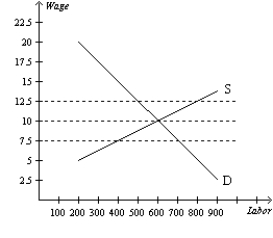 -Refer to Figure 19-2. This figure depicts labor demand and supply in a nonunionized labor market. The original equilibrium wage is $10. If a labor union subsequently establishes a union shop and negotiates an hourly wage of $12.50, then there will be an excess
 (Multiple Choice)
4.9/5 (98)
(98) Explain the role that consumers play in perpetuating discrimination in labor markets.
(Essay)
4.9/5 (68)
(68) Scenario 19-2
Travis, a student at a community college, is considering what he should do for summer employment. Two recruiters show up at his school in search of summer workers. Recruiter A is looking for workers to help a disaster relief agency distribute food aid in Africa. Recruiter B is looking for custodial help to clean motel rooms in a motel located near the entrance to a famous national park.
-Refer to Scenario 19-2. Travis is carefully considering the options that each recruiter presents. On the basis of knowledge obtained in his economics class, Travis concludes that
(Multiple Choice)
4.9/5 (81)
(81) Marcia is a white 23-year-old female, and Joan is a black 23-year-old female. Both Marcia and Joan were economics majors, and they graduated from the same college in the same year with the same GPA. Marcia and Joan both got identical jobs at a brokerage firm after graduating from college. They both work equally hard. Marcia earns $38,000 a year, and Joan earns $30,000 a year. Select the best explanation for this wage difference.
(Multiple Choice)
4.8/5 (86)
(86) According to evidence provided by the U.S. government, the median black
(Multiple Choice)
4.8/5 (82)
(82) A company has two locations where it employs workers doing the same job and working the same hours. Other things the same most workers would prefer to live in location A, but location A has a higher cost of living than location B.
(Multiple Choice)
4.8/5 (73)
(73) In the United States, the earnings gap between workers with college degrees and workers with high school degrees
(Multiple Choice)
4.9/5 (68)
(68) White women earn an average of 25% less than white men. A labor economist who wants to investigate whether the differences in earnings indicate labor-market discrimination against women should consider whether white men and women have similar
(i)years of work experience.
(ii)educational attainments.
(iii)occupations.
(iv)child care responsibilities.
(Multiple Choice)
4.9/5 (86)
(86) If, as some economists believe, changes in technology over recent decades have brought about changes in labor markets, then those changes likely have resulted in
(Multiple Choice)
4.8/5 (84)
(84) Scenario 19-6
The after-school tutoring industry is competitive, and so is the labor market for after-school tutors. Suppose male and female tutors have equal experience and skill. Currently, some tutoring centers are biased and will only hire male tutors, while unbiased tutoring centers desire to hire the cheapest tutors and do not care about their genders. As a result, the equilibrium wage for male tutors is higher than that of female tutors.
-Refer to Scenario 19-6. If consumers do not discriminate between biased and unbiased tutoring centers, then
(Multiple Choice)
4.8/5 (84)
(84) About what proportion of the variation of wages across workers is explained by factors that can be measured? What are the other factors that explain wage differences but are difficult to measure?
(Essay)
5.0/5 (58)
(58) Consumers are often a primary source of discrimination in labor markets.
(True/False)
4.9/5 (67)
(67) Scenario 19-2
Travis, a student at a community college, is considering what he should do for summer employment. Two recruiters show up at his school in search of summer workers. Recruiter A is looking for workers to help a disaster relief agency distribute food aid in Africa. Recruiter B is looking for custodial help to clean motel rooms in a motel located near the entrance to a famous national park.
-Refer to Scenario 19-2. Travis is carefully considering the options that each recruiter presents. On the basis of knowledge obtained in his economics class, Travis concludes that
(Multiple Choice)
4.9/5 (74)
(74) A cutting-edge biotech firm is hiring recent college graduates. To attract the very best applicants and to increase worker effort the firm is paying a wage 20% higher than the market wage for entry level employees in this industry. What is the term for the wage paid in this example?
(Short Answer)
4.9/5 (96)
(96) Which of the following is not an example of a compensating differential?
(Multiple Choice)
4.9/5 (92)
(92) Matthew just graduated from culinary school. He can earn $40,000 a year working for the same local bakery he has worked at since before starting culinary school, or accept a job offer he received after graduation from a high-end restaurant paying $70,000 a year. The higher salary is a result of
(Multiple Choice)
4.9/5 (88)
(88) 
Filters
- Essay(0)
- Multiple Choice(0)
- Short Answer(0)
- True False(0)
- Matching(0)