



 Chat with AI
Exam 19: Earnings and Discrimination

Exam 1: Ten Principles of Economics455 Questions
Exam 2: Thinking Like an Economist643 Questions
Exam 3: Interdependence and the Gains From Trade547 Questions
Exam 4: The Market Forces of Supply and Demand693 Questions
Exam 5: Elasticity and Its Application626 Questions
Exam 6: Supply, Demand, and Government Policies668 Questions
Exam 7: Consumers, Producers, and the Efficiency of Markets547 Questions
Exam 8: Applications: the Costs of Taxation509 Questions
Exam 9: Application: International Trade521 Questions
Exam 10: Externalities543 Questions
Exam 11: Public Goods and Common Resources452 Questions
Exam 12: The Design of the Tax System664 Questions
Exam 13: The Costs of Production649 Questions
Exam 14: Firms in Competitive Markets604 Questions
Exam 15: Monopoly662 Questions
Exam 16: Monopolistic Competition649 Questions
Exam 17: Oligopoly522 Questions
Exam 18: The Markets for the Factors of Production592 Questions
Exam 19: Earnings and Discrimination511 Questions
Exam 20: Income Inequality and Poverty478 Questions
Exam 21: The Theory of Consumer Choice570 Questions
Exam 22: Frontiers in Microeconomics461 Questions
Exam 23: Measuring a Nation S Income547 Questions
Exam 24: Measuring the Cost of Living565 Questions
Exam 25: Production and Growth527 Questions
Exam 26: Saving, Investment, and the Financial System637 Questions
Exam 27: Tools of Finance534 Questions
Exam 28: Unemployment and Its Natural Rate701 Questions
Exam 29: The Monetary System540 Questions
Exam 30: Money Growth and Inflation504 Questions
Exam 31: Open-Economy Macroeconomics: Basic Concepts540 Questions
Exam 32: A Macroeconomic Theory of the Open Economy511 Questions
Exam 33: Aggregate Demand and Aggregate Supply572 Questions
Exam 34: The Influence of Monetary and Fiscal Policy on Aggregate Demand523 Questions
Exam 35: The Short-Run Tradeoff Between Inflation and Unemployment536 Questions
Exam 36: Six Debates Over Macroeconomic Policy354 Questions
Select questions type


Figure 19-7 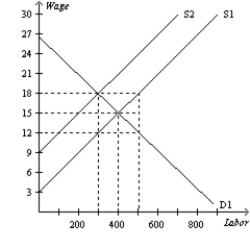 -Refer to Figure 19-7. The figure shows labor demand and labor supply in a non-unionized labor market. If the current labor demand is D1 and the current labor supply is S1, when a minimum wage of $18 per hour is imposed in this market, how many unemployed workers result?
 (Short Answer)
4.9/5  (76)
(76) One example of labor-market discrimination is that firms may be less likely to interview job-market candidates whose names suggest that they are members of a racial minority.
(True/False)
4.9/5 (76)
(76) It is likely that, if we could measure the quality as well as the quantity of education,
(Multiple Choice)
5.0/5 (74)
(74) Which of the following explains why soccer players make millions of dollars in Europe but do not in the United States?
(Multiple Choice)
4.9/5 (80)
(80) In what way do competitive markets have a "natural remedy" for discriminatory hiring practices?
(Multiple Choice)
4.8/5 (84)
(84) Which of the following statements accurately explains the superstar phenomenon in wages?
(Multiple Choice)
4.9/5 (74)
(74) The superstar phenomenon explains why professional athletes earn more than amateur athletes.
(True/False)
4.8/5 (78)
(78) If an employer pays a man a higher wage than a woman, the employer
(Multiple Choice)
4.9/5 (82)
(82) Over the past several years, the earnings gap between high-skilled and low-skilled workers has widened because
(i)international trade has altered the relative demand for skilled and unskilled labor.
(ii)changes in technology have altered the relative demand for skilled and unskilled labor.
(iii)the return to education for men has decreased, whereas the return to education for women has increased.
(Multiple Choice)
4.9/5 (89)
(89) Offering different opportunities to similar individuals who differ only by race, ethnic group, sex, age, or other personal characteristics is called
(Multiple Choice)
4.8/5 (74)
(74) Construction work is much riskier than working as a server at a restaurant. As a result, we'd expect a difference in wages between the two jobs. The difference is known as
(Multiple Choice)
5.0/5 (81)
(81) When the supply of workers is plentiful, one would predict that market wages would be
(Multiple Choice)
4.9/5 (88)
(88) Increases in international trade and technological change have been offered as explanations for the
(Multiple Choice)
4.9/5 (80)
(80) Nancy and Sheila are both loan officers who graduated from the same university with bachelors' degrees in economics, and achieved similar performance reviews. Nancy started working one year before Sheila. If Nancy earns a higher annual salary than Sheila because she has more experience, the employer is
(Multiple Choice)
4.9/5 (85)
(85) The differences in the desirability of different jobs within a company could give rise to a compensating differential between workers.
(True/False)
4.9/5 (71)
(71) 
Filters
- Essay(0)
- Multiple Choice(0)
- Short Answer(0)
- True False(0)
- Matching(0)