



 Chat with AI
Exam 19: Earnings and Discrimination

Exam 1: Ten Principles of Economics455 Questions
Exam 2: Thinking Like an Economist643 Questions
Exam 3: Interdependence and the Gains From Trade547 Questions
Exam 4: The Market Forces of Supply and Demand693 Questions
Exam 5: Elasticity and Its Application626 Questions
Exam 6: Supply, Demand, and Government Policies668 Questions
Exam 7: Consumers, Producers, and the Efficiency of Markets547 Questions
Exam 8: Applications: the Costs of Taxation509 Questions
Exam 9: Application: International Trade521 Questions
Exam 10: Externalities543 Questions
Exam 11: Public Goods and Common Resources452 Questions
Exam 12: The Design of the Tax System664 Questions
Exam 13: The Costs of Production649 Questions
Exam 14: Firms in Competitive Markets604 Questions
Exam 15: Monopoly662 Questions
Exam 16: Monopolistic Competition649 Questions
Exam 17: Oligopoly522 Questions
Exam 18: The Markets for the Factors of Production592 Questions
Exam 19: Earnings and Discrimination511 Questions
Exam 20: Income Inequality and Poverty478 Questions
Exam 21: The Theory of Consumer Choice570 Questions
Exam 22: Frontiers in Microeconomics461 Questions
Exam 23: Measuring a Nation S Income547 Questions
Exam 24: Measuring the Cost of Living565 Questions
Exam 25: Production and Growth527 Questions
Exam 26: Saving, Investment, and the Financial System637 Questions
Exam 27: Tools of Finance534 Questions
Exam 28: Unemployment and Its Natural Rate701 Questions
Exam 29: The Monetary System540 Questions
Exam 30: Money Growth and Inflation504 Questions
Exam 31: Open-Economy Macroeconomics: Basic Concepts540 Questions
Exam 32: A Macroeconomic Theory of the Open Economy511 Questions
Exam 33: Aggregate Demand and Aggregate Supply572 Questions
Exam 34: The Influence of Monetary and Fiscal Policy on Aggregate Demand523 Questions
Exam 35: The Short-Run Tradeoff Between Inflation and Unemployment536 Questions
Exam 36: Six Debates Over Macroeconomic Policy354 Questions
Select questions type


Many economists believe that competitive, market economies provide a natural antidote to employer discrimination known as the
(Short Answer)
4.8/5  (84)
(84) Regarding wage differences among various groups of workers - blacks and whites, men and women, etc. - most economists believe that
(Multiple Choice)
4.8/5 (84)
(84) Explain the theory that education acts as a signaling device. How does this contrast with the theory of education as an investment in human capital?
(Essay)
4.8/5 (70)
(70) Figure 19-6 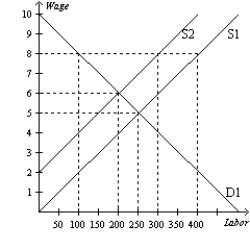 -Refer to Figure 19-6. Given demand, D1, and supply, S2, how many fewer people are employed if a minimum wage of $8 per hour is imposed on this market as compared to allowing wages to adjust to balance labor demand and labor supply?
 (Short Answer)
4.9/5 (92)
(92) Allen and Ellen both work at Burger Ranch. Allen is paid more than Ellen. Which of the following could explain why Allen is paid more?
(Multiple Choice)
5.0/5 (84)
(84) According to the Hamermesh and Biddle study, people deemed more attractive than average earn
(Multiple Choice)
4.8/5 (80)
(80) Education and on-the-job training are sources of human capital.
(True/False)
5.0/5 (72)
(72) Figure 19-1 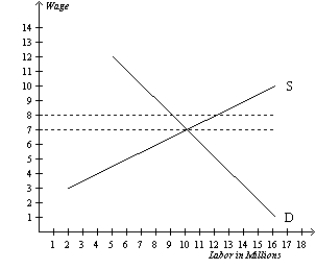 -Refer to Figure 19-1. What is the change in employment of having the minimum wage at $8 instead of $7?
 (Multiple Choice)
4.9/5 (85)
(85) Which of the following is an example of discrimination in the labor market?
(Multiple Choice)
4.9/5 (80)
(80) 
Filters
- Essay(0)
- Multiple Choice(0)
- Short Answer(0)
- True False(0)
- Matching(0)