



 Chat with AI
Exam 19: Earnings and Discrimination

Exam 1: Ten Principles of Economics455 Questions
Exam 2: Thinking Like an Economist643 Questions
Exam 3: Interdependence and the Gains From Trade547 Questions
Exam 4: The Market Forces of Supply and Demand693 Questions
Exam 5: Elasticity and Its Application626 Questions
Exam 6: Supply, Demand, and Government Policies668 Questions
Exam 7: Consumers, Producers, and the Efficiency of Markets547 Questions
Exam 8: Applications: the Costs of Taxation509 Questions
Exam 9: Application: International Trade521 Questions
Exam 10: Externalities543 Questions
Exam 11: Public Goods and Common Resources452 Questions
Exam 12: The Design of the Tax System664 Questions
Exam 13: The Costs of Production649 Questions
Exam 14: Firms in Competitive Markets604 Questions
Exam 15: Monopoly662 Questions
Exam 16: Monopolistic Competition649 Questions
Exam 17: Oligopoly522 Questions
Exam 18: The Markets for the Factors of Production592 Questions
Exam 19: Earnings and Discrimination511 Questions
Exam 20: Income Inequality and Poverty478 Questions
Exam 21: The Theory of Consumer Choice570 Questions
Exam 22: Frontiers in Microeconomics461 Questions
Exam 23: Measuring a Nation S Income547 Questions
Exam 24: Measuring the Cost of Living565 Questions
Exam 25: Production and Growth527 Questions
Exam 26: Saving, Investment, and the Financial System637 Questions
Exam 27: Tools of Finance534 Questions
Exam 28: Unemployment and Its Natural Rate701 Questions
Exam 29: The Monetary System540 Questions
Exam 30: Money Growth and Inflation504 Questions
Exam 31: Open-Economy Macroeconomics: Basic Concepts540 Questions
Exam 32: A Macroeconomic Theory of the Open Economy511 Questions
Exam 33: Aggregate Demand and Aggregate Supply572 Questions
Exam 34: The Influence of Monetary and Fiscal Policy on Aggregate Demand523 Questions
Exam 35: The Short-Run Tradeoff Between Inflation and Unemployment536 Questions
Exam 36: Six Debates Over Macroeconomic Policy354 Questions
Select questions type


Experimental evidence indicates women choose less competitive environments than men.
(True/False)
4.8/5  (75)
(75) Studies of discrimination in baseball suggest that black players
(Multiple Choice)
4.8/5 (88)
(88) Which of the following does not affect the wages a worker earns?
(Multiple Choice)
4.9/5 (69)
(69) Coal mining is a dangerous and dirty job. Suppose someone developed new machinery that made coal mining safer and cleaner; at the same time, suppose it made coal miners more productive. We would expect that the wages of coal miners would
(Multiple Choice)
4.7/5 (77)
(77) Some economists hypothesize that international trade has altered the relative demand for skilled and unskilled labor, changing the gap in earnings between these two groups. Which of the following statements best describes this hypothesis?
(Multiple Choice)
5.0/5 (84)
(84) Men and women tend to choose different types of occupations, and so
(Multiple Choice)
4.7/5 (69)
(69) A 1990 study of the market for collectable baseball cards suggested
(Multiple Choice)
4.9/5 (80)
(80) Differences in human capital among workers can often be attributed to social or political processes rather than economic processes.
(True/False)
4.9/5 (87)
(87) Evaluate the following statement: "The gender pay gap provides evidence of widespread, severe, ongoing discrimination by employers and fellow workers."
(Essay)
4.7/5 (80)
(80) How does the theory of efficiency wages explain above-equilibrium wages?
(Multiple Choice)
5.0/5 (79)
(79) People who grew up in the western part of Aquilonia have an accent distinct from people who grew up in the eastern part of the country. People from the west also receive lower wages than people from the east. From this information alone, we can conclude that it is possible that
(Multiple Choice)
4.9/5 (99)
(99) It is increasingly clear that technological change is the only explanation for an expanding wage gap between high-skill and low-skill workers.
(True/False)
4.9/5 (75)
(75) A study by labor economists Hamermesh and Biddle found that
(Multiple Choice)
4.7/5 (94)
(94) Which of the following comparisons best illustrates a compensating differential?
(Multiple Choice)
4.8/5 (77)
(77) Labor-market discrimination based solely on age is illegal in the United States.
(True/False)
4.9/5 (87)
(87) Which term do economists use to refer to a difference in wages that arises from nonmonetary characteristics of different jobs?
(Multiple Choice)
4.9/5 (67)
(67) A manager of a small firm who believes in the signaling theory of education would encourage her employees to obtain additional education to raise their on-the-job productivity.
(True/False)
4.8/5 (75)
(75) Table 19-2 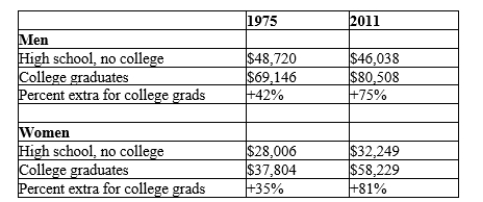 Source: US Census Bureau and Mankiw's calculations
-Refer to Table 19-2. In 2011, on average how much more income would a man with a college degree earn than a man with a high school degree?
Source: US Census Bureau and Mankiw's calculations
-Refer to Table 19-2. In 2011, on average how much more income would a man with a college degree earn than a man with a high school degree? (Short Answer)
4.8/5 (74)
(74) Other things equal, one would predict that market wages would be relatively high when
(Multiple Choice)
4.9/5 (81)
(81) Which of the following sets of circumstances is likely to provide the best evidence in support of the theory of efficiency wages?
(Multiple Choice)
4.8/5 (72)
(72) 
Filters
- Essay(0)
- Multiple Choice(0)
- Short Answer(0)
- True False(0)
- Matching(0)