



 Chat with AI
Exam 19: Earnings and Discrimination

Exam 1: Ten Principles of Economics455 Questions
Exam 2: Thinking Like an Economist643 Questions
Exam 3: Interdependence and the Gains From Trade547 Questions
Exam 4: The Market Forces of Supply and Demand693 Questions
Exam 5: Elasticity and Its Application626 Questions
Exam 6: Supply, Demand, and Government Policies668 Questions
Exam 7: Consumers, Producers, and the Efficiency of Markets547 Questions
Exam 8: Applications: the Costs of Taxation509 Questions
Exam 9: Application: International Trade521 Questions
Exam 10: Externalities543 Questions
Exam 11: Public Goods and Common Resources452 Questions
Exam 12: The Design of the Tax System664 Questions
Exam 13: The Costs of Production649 Questions
Exam 14: Firms in Competitive Markets604 Questions
Exam 15: Monopoly662 Questions
Exam 16: Monopolistic Competition649 Questions
Exam 17: Oligopoly522 Questions
Exam 18: The Markets for the Factors of Production592 Questions
Exam 19: Earnings and Discrimination511 Questions
Exam 20: Income Inequality and Poverty478 Questions
Exam 21: The Theory of Consumer Choice570 Questions
Exam 22: Frontiers in Microeconomics461 Questions
Exam 23: Measuring a Nation S Income547 Questions
Exam 24: Measuring the Cost of Living565 Questions
Exam 25: Production and Growth527 Questions
Exam 26: Saving, Investment, and the Financial System637 Questions
Exam 27: Tools of Finance534 Questions
Exam 28: Unemployment and Its Natural Rate701 Questions
Exam 29: The Monetary System540 Questions
Exam 30: Money Growth and Inflation504 Questions
Exam 31: Open-Economy Macroeconomics: Basic Concepts540 Questions
Exam 32: A Macroeconomic Theory of the Open Economy511 Questions
Exam 33: Aggregate Demand and Aggregate Supply572 Questions
Exam 34: The Influence of Monetary and Fiscal Policy on Aggregate Demand523 Questions
Exam 35: The Short-Run Tradeoff Between Inflation and Unemployment536 Questions
Exam 36: Six Debates Over Macroeconomic Policy354 Questions
Select questions type


Politicians often point to wage differentials as evidence of labor-market discrimination against ethnic minorities and women; however, economists argue against this approach because people differ in the amount of human capital they have and the kinds of work they are willing and able to do.
(True/False)
4.8/5  (69)
(69) Among male workers over age 25, about what percent has a college degree? What is this percentage for black male workers over age 25?
(Short Answer)
4.8/5 (86)
(86) Which of the following factors does not affect the value of a worker's marginal product?
(Multiple Choice)
4.8/5 (83)
(83) Suppose that the country of Libraria made a concerted effort to increase the educational level of its people. If this effort had no effect on the wages of its workers, one might consider this as evidence in support of
(Multiple Choice)
4.9/5 (76)
(76) Assuming that all other things are equal, including the wage, which of the following statements is correct?
(Multiple Choice)
4.9/5 (73)
(73) Figure 19-1 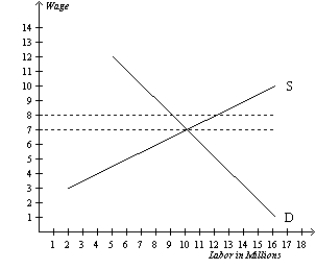 -Refer to Figure 19-1. If the minimum wage in this market is $8, then
 (Multiple Choice)
4.7/5 (81)
(81) Sometimes wages are set above the equilibrium level when firms pay
(Multiple Choice)
4.9/5 (90)
(90) The signaling theory of education suggests that when people earn a college degree they do not become more productive, but they do signal their high ability to prospective employers.
(True/False)
4.8/5 (74)
(74) Name two occupations that have the two characteristics required for the superstar phenomenon.
(Short Answer)
4.7/5 (69)
(69) Which of the following is the most likely outcome of raising the minimum wage?
(Multiple Choice)
4.9/5 (79)
(79) Politicians often point to wage differentials as evidence of labor market discrimination against ethnic minorities and women. Economists, however, argue against this approach because
(Multiple Choice)
4.8/5 (71)
(71) Which of the following theories would suggest that attending school does not improve productivity but that high-ability people are more likely to stay in school?
(Multiple Choice)
4.8/5 (76)
(76) Which of the following would be considered an investment in human capital?
(Multiple Choice)
4.8/5 (82)
(82) Economists typically explain occupational differences between men and women through preferences, ability, and discrimination. What additional factor did economists Muriel Niederle and Lise Vesterlund add to this list?
(Short Answer)
5.0/5 (80)
(80) In the early 20th century, streetcars in many southern cities required that white passengers sit in the front of the car while black passengers sat in the back. The firms that ran the streetcars were
(Multiple Choice)
4.9/5 (77)
(77) Dan and Dave are both college graduates. Dan is a patrolman and Dave is a detective in the same police precinct. While Dan's job is inherently more dangerous than Dave's, Dave passed a difficult exam to gain promotion to detective. Dave earns more than Dan because
(Multiple Choice)
4.8/5 (82)
(82) When discrimination occurs as a result of employer prejudice, discriminating firms do not maximize profits.
(True/False)
4.8/5 (75)
(75) A college degree makes a person more productive according to
(Multiple Choice)
4.8/5 (81)
(81) 
Filters
- Essay(0)
- Multiple Choice(0)
- Short Answer(0)
- True False(0)
- Matching(0)