



 Chat with AI
Exam 19: Earnings and Discrimination

Exam 1: Ten Principles of Economics455 Questions
Exam 2: Thinking Like an Economist643 Questions
Exam 3: Interdependence and the Gains From Trade547 Questions
Exam 4: The Market Forces of Supply and Demand693 Questions
Exam 5: Elasticity and Its Application626 Questions
Exam 6: Supply, Demand, and Government Policies668 Questions
Exam 7: Consumers, Producers, and the Efficiency of Markets547 Questions
Exam 8: Applications: the Costs of Taxation509 Questions
Exam 9: Application: International Trade521 Questions
Exam 10: Externalities543 Questions
Exam 11: Public Goods and Common Resources452 Questions
Exam 12: The Design of the Tax System664 Questions
Exam 13: The Costs of Production649 Questions
Exam 14: Firms in Competitive Markets604 Questions
Exam 15: Monopoly662 Questions
Exam 16: Monopolistic Competition649 Questions
Exam 17: Oligopoly522 Questions
Exam 18: The Markets for the Factors of Production592 Questions
Exam 19: Earnings and Discrimination511 Questions
Exam 20: Income Inequality and Poverty478 Questions
Exam 21: The Theory of Consumer Choice570 Questions
Exam 22: Frontiers in Microeconomics461 Questions
Exam 23: Measuring a Nation S Income547 Questions
Exam 24: Measuring the Cost of Living565 Questions
Exam 25: Production and Growth527 Questions
Exam 26: Saving, Investment, and the Financial System637 Questions
Exam 27: Tools of Finance534 Questions
Exam 28: Unemployment and Its Natural Rate701 Questions
Exam 29: The Monetary System540 Questions
Exam 30: Money Growth and Inflation504 Questions
Exam 31: Open-Economy Macroeconomics: Basic Concepts540 Questions
Exam 32: A Macroeconomic Theory of the Open Economy511 Questions
Exam 33: Aggregate Demand and Aggregate Supply572 Questions
Exam 34: The Influence of Monetary and Fiscal Policy on Aggregate Demand523 Questions
Exam 35: The Short-Run Tradeoff Between Inflation and Unemployment536 Questions
Exam 36: Six Debates Over Macroeconomic Policy354 Questions
Select questions type


Which theory states that education is correlated with natural ability?
(Short Answer)
4.7/5  (71)
(71) Figure 19-4 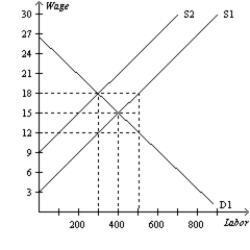 -Refer to Figure 19-4. If a union is successful in reducing supply from S1 to S2, the wage will
 (Multiple Choice)
4.8/5 (66)
(66) The job of night watchman at the Punxsutawny Phil Groundhog museum is known to have a high wage. Which of the following would push the night watchman's wage higher?
(Multiple Choice)
4.7/5 (83)
(83) A study conducted by economists Marianne Bertrand and Sendhil Mullainathan found evidence of labor-market discrimination based on which of the following findings?
(Multiple Choice)
4.9/5 (91)
(91) Figure 19-5 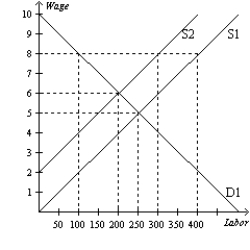 -Refer to Figure 19-5. Given demand for labor, D1, and supply of labor, S1, what is the surplus of labor if a minimum wage of $8 per hour is imposed on this market?
 (Multiple Choice)
4.7/5 (90)
(90) Lucy and Lincoln are salespeople working for the same company with equal skills, ability, and experience. Both are paid a small base salary but the majority of their compensation is in the form of a commission, which is a percentage of the sales they make. Lucy earns more each year than Lincoln. What can you conclude about Lucy and Lincoln?
(Essay)
4.9/5 (92)
(92) Economists would argue that the gender wage gap is narrowing because of efficiency wages.
(True/False)
4.8/5 (83)
(83) The theory of efficiency wages challenges the assumption that
(Multiple Choice)
4.9/5 (89)
(89) The most popular movie stars have high incomes for a number of reasons. One such reason is
(Multiple Choice)
4.8/5 (79)
(79) Streetcar owners in the early 20th century were against segregation for profit maximizing reasons.
(True/False)
4.8/5 (71)
(71) According to economists Hamermesh and Biddle, how much more do people who are deemed more attractive than average earn?
(Short Answer)
4.7/5 (74)
(74) Economists have found evidence that differences in wages can be explained by
(Multiple Choice)
4.8/5 (86)
(86) Why is a construction worker never likely to earn as much as a famous athlete?
(Multiple Choice)
4.8/5 (84)
(84) Evidence from a study of the market for baseball players using 1960s data
(Multiple Choice)
4.8/5 (80)
(80) Which of the following is an example of a compensating differential?
(Multiple Choice)
4.8/5 (80)
(80) Scenario 19-4
Assume that the labor market for barbers is competitive and that it is differentiated into two groups: barbers who are bald (or going bald) and those who have a full head of hair. Assume that the barbers in this market have identical hair-cutting ability, regardless of whether they are bald or not. Currently the equilibrium wage in the bald barber market is lower than that in the nonbald market. Further assume that the market for haircuts is competitive.
-Refer to Scenario 19-4. Competition in the market for haircuts is consistent with which of the following statements?
(Multiple Choice)
4.8/5 (81)
(81) 
Filters
- Essay(0)
- Multiple Choice(0)
- Short Answer(0)
- True False(0)
- Matching(0)