



 Chat with AI
Exam 19: Earnings and Discrimination

Exam 1: Ten Principles of Economics455 Questions
Exam 2: Thinking Like an Economist643 Questions
Exam 3: Interdependence and the Gains From Trade547 Questions
Exam 4: The Market Forces of Supply and Demand693 Questions
Exam 5: Elasticity and Its Application626 Questions
Exam 6: Supply, Demand, and Government Policies668 Questions
Exam 7: Consumers, Producers, and the Efficiency of Markets547 Questions
Exam 8: Applications: the Costs of Taxation509 Questions
Exam 9: Application: International Trade521 Questions
Exam 10: Externalities543 Questions
Exam 11: Public Goods and Common Resources452 Questions
Exam 12: The Design of the Tax System664 Questions
Exam 13: The Costs of Production649 Questions
Exam 14: Firms in Competitive Markets604 Questions
Exam 15: Monopoly662 Questions
Exam 16: Monopolistic Competition649 Questions
Exam 17: Oligopoly522 Questions
Exam 18: The Markets for the Factors of Production592 Questions
Exam 19: Earnings and Discrimination511 Questions
Exam 20: Income Inequality and Poverty478 Questions
Exam 21: The Theory of Consumer Choice570 Questions
Exam 22: Frontiers in Microeconomics461 Questions
Exam 23: Measuring a Nation S Income547 Questions
Exam 24: Measuring the Cost of Living565 Questions
Exam 25: Production and Growth527 Questions
Exam 26: Saving, Investment, and the Financial System637 Questions
Exam 27: Tools of Finance534 Questions
Exam 28: Unemployment and Its Natural Rate701 Questions
Exam 29: The Monetary System540 Questions
Exam 30: Money Growth and Inflation504 Questions
Exam 31: Open-Economy Macroeconomics: Basic Concepts540 Questions
Exam 32: A Macroeconomic Theory of the Open Economy511 Questions
Exam 33: Aggregate Demand and Aggregate Supply572 Questions
Exam 34: The Influence of Monetary and Fiscal Policy on Aggregate Demand523 Questions
Exam 35: The Short-Run Tradeoff Between Inflation and Unemployment536 Questions
Exam 36: Six Debates Over Macroeconomic Policy354 Questions
Select questions type


Which of the following statements does not accurately describe the market for labor?
(Multiple Choice)
4.9/5  (70)
(70) Tom and Eric went to trade school at the same time. Each graduated with an associate's degree. They have received similar performance evaluations. Eric's employer is not a good business manager, and the sales manager lost a major deal. Because of the decrease in profits, the employees did not receive raises last year. Tom's employer is a savvy business manager and the sales manager is experienced and works hard. If Tom has higher earnings than Eric, the difference is most likely a function of
(Multiple Choice)
4.8/5 (81)
(81) Which of the following does not explain the "beauty premium" differences in wages?
(Multiple Choice)
4.7/5 (83)
(83) According to evidence provided by the U.S. government, the median black
(Multiple Choice)
4.8/5 (72)
(72) If a good is produced with technology that allows the best producer to supply every customer at a low cost and every customer in the market wants to enjoy the good supplied by the best producer, the best producer will be called a
(Short Answer)
4.8/5 (84)
(84) Scenario 19-4
Assume that the labor market for barbers is competitive and that it is differentiated into two groups: barbers who are bald (or going bald) and those who have a full head of hair. Assume that the barbers in this market have identical hair-cutting ability, regardless of whether they are bald or not. Currently the equilibrium wage in the bald barber market is lower than that in the nonbald market. Further assume that the market for haircuts is competitive.
-Refer to Scenario 19-4. If consumers do not discriminate between bald barbers and barbers with hair, then
(Multiple Choice)
4.8/5 (90)
(90) The example of segregated streetcars in the southern United States in the early twentieth century is one example of
(Multiple Choice)
4.9/5 (76)
(76) Factory workers who work the day shift earn less per hour than similarly-skilled factory workers who work the night shift. The difference in pay is attributed to
(Multiple Choice)
4.9/5 (73)
(73) Scenario 19-6
The after-school tutoring industry is competitive, and so is the labor market for after-school tutors. Suppose male and female tutors have equal experience and skill. Currently, some tutoring centers are biased and will only hire male tutors, while unbiased tutoring centers desire to hire the cheapest tutors and do not care about their genders. As a result, the equilibrium wage for male tutors is higher than that of female tutors.
-Refer to Scenario 19-6. If consumers do not discriminate between male and female tutors, then
(Multiple Choice)
4.9/5 (81)
(81) Figure 19-5 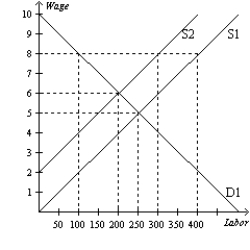 -Refer to Figure 19-5. Given demand for labor, D1, and supply of labor, S1, what are the equilibrium wage and quantity of labor?
 (Multiple Choice)
4.9/5 (68)
(68) Most wage differences can be understood while maintaining the assumption of equilibrium in the labor market. We deviate from that assumption, however, when we consider
(Multiple Choice)
4.9/5 (74)
(74) Maria has just graduated from Princeton University and has applied for a job at a major bank. The bank decides to offer Maria a job because they perceive her degree from Princeton to be an indication of her high-ability. To which of the following views of education does the bank subscribe?
(Multiple Choice)
4.7/5 (84)
(84) The changing gap in wages between unskilled and skilled workers is most likely related to a larger increase in demand for unskilled occupations relative to skilled occupations.
(True/False)
4.8/5 (69)
(69) Scenario 19-3
In the small town of Hamilton, Montana, there is a local hardware store called Eddy's Hardware. There are only two types of workers who apply for jobs at Eddy's Hardware: cowboys and farm boys. Local politicians have received numerous complaints that Eddy's Hardware is practicing wage discrimination against farm boys. Eddy's Hardware denies the complaint and says the store is only trying to maximize profit.
-Refer to Scenario 19-3. Which of the following statements would weaken the discrimination complaint against Eddy's Hardware?
(Multiple Choice)
4.8/5 (78)
(78) Which of the following is not an explanation for why better educated workers earn more, on average, than less educated workers?
(Multiple Choice)
4.7/5 (85)
(85) Figure 19-6 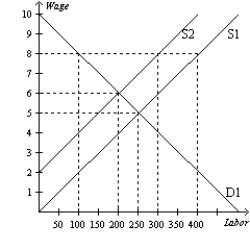 -Refer to Figure 19-6. Given demand, D1, and supply, S1, how many workers are unemployed if a minimum wage of $8 per hour is imposed on this market?
 (Short Answer)
4.8/5 (74)
(74) Which of the following variables related to a worker's wage are the most difficult to measure?
(Multiple Choice)
4.8/5 (86)
(86) Table 19-2  Source: US Census Bureau and Mankiw's calculations
-Refer to Table 19-2. What conclusion can you draw about the changes in the gaps in earnings between skilled and unskilled workers between 1975 and 2011?
Source: US Census Bureau and Mankiw's calculations
-Refer to Table 19-2. What conclusion can you draw about the changes in the gaps in earnings between skilled and unskilled workers between 1975 and 2011? (Essay)
4.8/5 (81)
(81) 
Filters
- Essay(0)
- Multiple Choice(0)
- Short Answer(0)
- True False(0)
- Matching(0)