



 Chat with AI
Exam 19: Earnings and Discrimination

Exam 1: Ten Principles of Economics455 Questions
Exam 2: Thinking Like an Economist643 Questions
Exam 3: Interdependence and the Gains From Trade547 Questions
Exam 4: The Market Forces of Supply and Demand693 Questions
Exam 5: Elasticity and Its Application626 Questions
Exam 6: Supply, Demand, and Government Policies668 Questions
Exam 7: Consumers, Producers, and the Efficiency of Markets547 Questions
Exam 8: Applications: the Costs of Taxation509 Questions
Exam 9: Application: International Trade521 Questions
Exam 10: Externalities543 Questions
Exam 11: Public Goods and Common Resources452 Questions
Exam 12: The Design of the Tax System664 Questions
Exam 13: The Costs of Production649 Questions
Exam 14: Firms in Competitive Markets604 Questions
Exam 15: Monopoly662 Questions
Exam 16: Monopolistic Competition649 Questions
Exam 17: Oligopoly522 Questions
Exam 18: The Markets for the Factors of Production592 Questions
Exam 19: Earnings and Discrimination511 Questions
Exam 20: Income Inequality and Poverty478 Questions
Exam 21: The Theory of Consumer Choice570 Questions
Exam 22: Frontiers in Microeconomics461 Questions
Exam 23: Measuring a Nation S Income547 Questions
Exam 24: Measuring the Cost of Living565 Questions
Exam 25: Production and Growth527 Questions
Exam 26: Saving, Investment, and the Financial System637 Questions
Exam 27: Tools of Finance534 Questions
Exam 28: Unemployment and Its Natural Rate701 Questions
Exam 29: The Monetary System540 Questions
Exam 30: Money Growth and Inflation504 Questions
Exam 31: Open-Economy Macroeconomics: Basic Concepts540 Questions
Exam 32: A Macroeconomic Theory of the Open Economy511 Questions
Exam 33: Aggregate Demand and Aggregate Supply572 Questions
Exam 34: The Influence of Monetary and Fiscal Policy on Aggregate Demand523 Questions
Exam 35: The Short-Run Tradeoff Between Inflation and Unemployment536 Questions
Exam 36: Six Debates Over Macroeconomic Policy354 Questions
Select questions type


George and Susan work at the same brewery. George works in advertising. Susan works as a forewoman in the bottling plant. George is paid more than Susan.
(Multiple Choice)
5.0/5  (80)
(80) Table 19-2 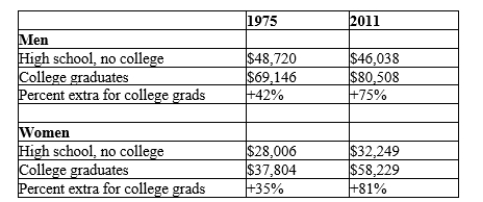 Source: US Census Bureau and Mankiw's calculations
-Refer to Table 19-2. What are two possible hypotheses to explain the changes in relative demand for high-skilled workers and low-skilled workers in recent years?
Source: US Census Bureau and Mankiw's calculations
-Refer to Table 19-2. What are two possible hypotheses to explain the changes in relative demand for high-skilled workers and low-skilled workers in recent years? (Essay)
4.7/5 (83)
(83) On average professors of finance earn more than professors of economics. Other things the same, what does this imply about the supply of each type of professor?
(Essay)
4.9/5 (86)
(86) In the early twentieth century, racial segregation of streetcars in the southern cities was largely opposed by
(Multiple Choice)
4.9/5 (85)
(85) Harry is 40 and black. Dan is 40 and white. Both work as plumbers, but Harry earns more.
(Multiple Choice)
4.8/5 (76)
(76) Which of the following is an example of human capital for a college economics professor?
(Multiple Choice)
4.8/5 (76)
(76) The fact that wage differentials continue to exist across different groups of workers leads economists to believe that
(Multiple Choice)
4.8/5 (77)
(77) The case study of segregated street cars in southern cities illustrates which of the following?
(Multiple Choice)
4.8/5 (79)
(79) Discrimination by a manager in the hiring process may be consistent with the decision to maximize profits if
(Multiple Choice)
4.9/5 (83)
(83) If men, on average, earn 20 percent more than women in a particular occupation,
(Multiple Choice)
4.8/5 (85)
(85) Explain the role of job experience in explaining the differences between the average wages of men and women.
(Essay)
4.8/5 (77)
(77) If a worker is indifferent between a job with a wage of $10 per hour and a job with a wage of $12 per hour, then the
(Multiple Choice)
4.7/5 (81)
(81) The fact that movie star Angelina Jolie's salary is much higher than the salary earned by the world's best nurse can best be explained by the
(Multiple Choice)
5.0/5 (77)
(77) Of the theories listed below, which do the best job of explaining why educated people are paid more than uneducated people?
(Multiple Choice)
4.8/5 (75)
(75) A competitive market may be consistent with a discriminatory wage differential if
(Multiple Choice)
4.8/5 (83)
(83) John is an Asian 23-year-old male, and Ken is an Asian 43-year-old male. Both John and Ken are economics majors, and they graduated from the same college with the same GPA - John in 2006 and Ken in 1986. John and Ken are both financial advisers at the same brokerage firm. John earns $52,000 a year, and Ken earns $88,000 a year. Select the best explanation for this wage difference.
(Multiple Choice)
5.0/5 (80)
(80) If firms are competitive, then labor-market discrimination
(Multiple Choice)
4.8/5 (81)
(81) Above-equilibrium wages caused by efficiency wages will most likely result in
(Multiple Choice)
4.7/5 (83)
(83) In the early 20th century, segregation of street cars made streetcar companies
(Multiple Choice)
4.7/5 (87)
(87) 
Filters
- Essay(0)
- Multiple Choice(0)
- Short Answer(0)
- True False(0)
- Matching(0)