



 Chat with AI
Exam 19: Earnings and Discrimination

Exam 1: Ten Principles of Economics455 Questions
Exam 2: Thinking Like an Economist643 Questions
Exam 3: Interdependence and the Gains From Trade547 Questions
Exam 4: The Market Forces of Supply and Demand693 Questions
Exam 5: Elasticity and Its Application626 Questions
Exam 6: Supply, Demand, and Government Policies668 Questions
Exam 7: Consumers, Producers, and the Efficiency of Markets547 Questions
Exam 8: Applications: the Costs of Taxation509 Questions
Exam 9: Application: International Trade521 Questions
Exam 10: Externalities543 Questions
Exam 11: Public Goods and Common Resources452 Questions
Exam 12: The Design of the Tax System664 Questions
Exam 13: The Costs of Production649 Questions
Exam 14: Firms in Competitive Markets604 Questions
Exam 15: Monopoly662 Questions
Exam 16: Monopolistic Competition649 Questions
Exam 17: Oligopoly522 Questions
Exam 18: The Markets for the Factors of Production592 Questions
Exam 19: Earnings and Discrimination511 Questions
Exam 20: Income Inequality and Poverty478 Questions
Exam 21: The Theory of Consumer Choice570 Questions
Exam 22: Frontiers in Microeconomics461 Questions
Exam 23: Measuring a Nation S Income547 Questions
Exam 24: Measuring the Cost of Living565 Questions
Exam 25: Production and Growth527 Questions
Exam 26: Saving, Investment, and the Financial System637 Questions
Exam 27: Tools of Finance534 Questions
Exam 28: Unemployment and Its Natural Rate701 Questions
Exam 29: The Monetary System540 Questions
Exam 30: Money Growth and Inflation504 Questions
Exam 31: Open-Economy Macroeconomics: Basic Concepts540 Questions
Exam 32: A Macroeconomic Theory of the Open Economy511 Questions
Exam 33: Aggregate Demand and Aggregate Supply572 Questions
Exam 34: The Influence of Monetary and Fiscal Policy on Aggregate Demand523 Questions
Exam 35: The Short-Run Tradeoff Between Inflation and Unemployment536 Questions
Exam 36: Six Debates Over Macroeconomic Policy354 Questions
Select questions type


Superstars earn high incomes due to their ability to satisfy the demands of millions of people at once.
(True/False)
4.7/5  (85)
(85) According to research by Bertrand and Mullainathan, which job applicants, those with "white" names or those with "black" names, received more calls from interested employers? What percent more?
(Short Answer)
4.9/5 (79)
(79) Over the past several years, the earnings gap between high-skilled and low-skilled workers has
(Multiple Choice)
4.8/5 (71)
(71) As a result of their experiment economists Muriel Niederle and Lise Vesterlund found that
(Multiple Choice)
5.0/5 (78)
(78) In discussing discrimination and the wage differences that exist between men and women and between blacks and whites, it has been said that "the disease is political even if the symptom is economic." What does this mean?
(Multiple Choice)
4.8/5 (80)
(80) Technology is an important factor in explaining the high incomes of some athletes primarily because
(Multiple Choice)
4.9/5 (75)
(75) According to the signaling theory of education, better-educated workers
(Multiple Choice)
4.9/5 (77)
(77) In the experiment conducted by economists Muriel Niederle and Lise Vesterlund
(Multiple Choice)
4.7/5 (77)
(77) Superstars arise in markets in which every customer in the market is able to enjoy the good supplied by the
(Short Answer)
4.7/5 (94)
(94) It is likely that efficiency wages will decrease employee effort.
(True/False)
4.8/5 (73)
(73) Explain why the following situation is likely to persist: soccer players in Europe are the highest paid athletes and in the US they are among the lowest paid athletes.
(Essay)
4.9/5 (78)
(78) Nancy and Sheila are both loan officers who started working for their current employer during the same year, graduated from the same university with bachelors' degrees in economics, and achieved similar performance reviews. Nancy earned a master's degree last year. If Nancy earns a higher annual salary than Sheila because she has more formal education, the employer is
(Multiple Choice)
4.8/5 (83)
(83) Which of the following is not an example of human capital for a college economics professor?
(Multiple Choice)
4.7/5 (82)
(82) When an employer pays the cost of educating a worker, it is likely that the employer
(Multiple Choice)
4.7/5 (68)
(68) Which of the following is not a consequence of above-equilibrium wages in a labor market?
(Multiple Choice)
4.8/5 (82)
(82) Most of the time, a profit motive eliminates discriminatory behavior from a market; however, a discriminatory wage gap can persist even if the firm owners only care about profit if there is
(Short Answer)
4.7/5 (93)
(93) Which of the following can be used to help explain wage differences among different groups of workers?
(Multiple Choice)
4.8/5 (84)
(84) Evidence of differences in the average wages of black workers compared to white workers
(Multiple Choice)
4.8/5 (84)
(84) Which of these instances would constitute labor-market discrimination? Courtney and Nicole are identical in all of their labor-market characteristics except that Courtney earns a higher salary than Nicole because
(Multiple Choice)
4.7/5 (89)
(89) Figure 19-7 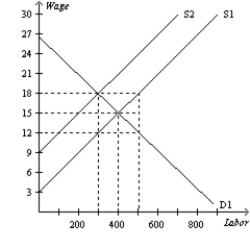 -Refer to Figure 19-7. The figure shows labor demand and labor supply in a non-unionized labor market. If the current labor demand is D1 and the current labor supply is S1, what is the equilibrium wage and quantity of labor?
 (Short Answer)
4.8/5 (75)
(75) 
Filters
- Essay(0)
- Multiple Choice(0)
- Short Answer(0)
- True False(0)
- Matching(0)