



 Chat with AI
Exam 19: Earnings and Discrimination

Exam 1: Ten Principles of Economics455 Questions
Exam 2: Thinking Like an Economist643 Questions
Exam 3: Interdependence and the Gains From Trade547 Questions
Exam 4: The Market Forces of Supply and Demand693 Questions
Exam 5: Elasticity and Its Application626 Questions
Exam 6: Supply, Demand, and Government Policies668 Questions
Exam 7: Consumers, Producers, and the Efficiency of Markets547 Questions
Exam 8: Applications: the Costs of Taxation509 Questions
Exam 9: Application: International Trade521 Questions
Exam 10: Externalities543 Questions
Exam 11: Public Goods and Common Resources452 Questions
Exam 12: The Design of the Tax System664 Questions
Exam 13: The Costs of Production649 Questions
Exam 14: Firms in Competitive Markets604 Questions
Exam 15: Monopoly662 Questions
Exam 16: Monopolistic Competition649 Questions
Exam 17: Oligopoly522 Questions
Exam 18: The Markets for the Factors of Production592 Questions
Exam 19: Earnings and Discrimination511 Questions
Exam 20: Income Inequality and Poverty478 Questions
Exam 21: The Theory of Consumer Choice570 Questions
Exam 22: Frontiers in Microeconomics461 Questions
Exam 23: Measuring a Nation S Income547 Questions
Exam 24: Measuring the Cost of Living565 Questions
Exam 25: Production and Growth527 Questions
Exam 26: Saving, Investment, and the Financial System637 Questions
Exam 27: Tools of Finance534 Questions
Exam 28: Unemployment and Its Natural Rate701 Questions
Exam 29: The Monetary System540 Questions
Exam 30: Money Growth and Inflation504 Questions
Exam 31: Open-Economy Macroeconomics: Basic Concepts540 Questions
Exam 32: A Macroeconomic Theory of the Open Economy511 Questions
Exam 33: Aggregate Demand and Aggregate Supply572 Questions
Exam 34: The Influence of Monetary and Fiscal Policy on Aggregate Demand523 Questions
Exam 35: The Short-Run Tradeoff Between Inflation and Unemployment536 Questions
Exam 36: Six Debates Over Macroeconomic Policy354 Questions
Select questions type


Tiffany has just graduated from Stanford University and has applied for a job as an engineer at a manufacturing plant. The manufacturer decides to offer Tiffany a job because it perceives she's gained valuable skills while at Stanford. To which of the following views of education does the manufacturer subscribe?
(Multiple Choice)
4.7/5  (74)
(74) Differences in human capital among groups of workers is possibly a reflection of past discrimination.
(True/False)
5.0/5 (78)
(78) In recent years, the ratio of earnings of the typical U.S. college graduate to the earnings of the typical high school graduate without additional education has
(Multiple Choice)
5.0/5 (81)
(81) Jobs that involve pleasant work, as opposed to jobs that involve unpleasant work, usually pay
(Multiple Choice)
4.7/5 (81)
(81) A difference in wages between a highly-educated worker and a less-educated worker
(Multiple Choice)
4.8/5 (82)
(82) Which of the following is not an interpretation of the "beauty premium"?
(Multiple Choice)
4.8/5 (67)
(67) Figure 19-6 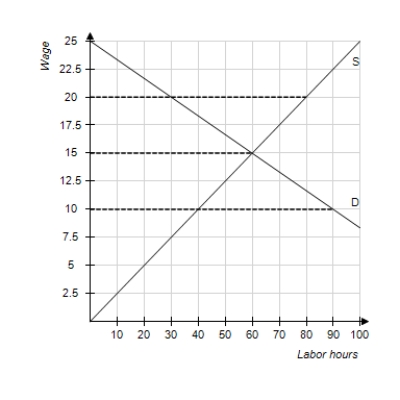 -Refer to Figure 19-6. This figure depicts labor demand and supply for the widget industry. The equilibrium market wage is $15. Suppose a labor union forms and subsequently negotiates an hourly wage of $25.00. Which of the following statements is true?
 (Multiple Choice)
4.8/5 (78)
(78) The National Collegiate Athletic Association (NCAA) has long argued that nationally-prominent college athletes are compensated with an investment in human capital that far exceeds the monetary reward of playing professional sports. Examine this argument in light of your knowledge of human capital theory and the economic theory of labor markets.
(Essay)
4.9/5 (72)
(72) Unions are often able to sustain wages above the equilibrium wage because they can threaten to
(Short Answer)
4.9/5 (77)
(77) Gerald earns a higher salary than his brother Peter because Gerald went to law school and is a lawyer, whereas Peter dropped out of college to work as a mechanic. The difference in salary illustrates a compensating differential.
(True/False)
4.9/5 (93)
(93) Human capital refers to the physical tools and equipment that workers use on their jobs to enhance their productivity.
(True/False)
4.9/5 (81)
(81) The difference in wages paid to major-league baseball players and minor-league baseball players is most likely due to
(Multiple Choice)
4.9/5 (84)
(84) Which of the following scenarios would serve to decrease the demand for unskilled labor in the U.S.?
(Multiple Choice)
4.8/5 (86)
(86) In recent years, the amount of international trade in which the United States engages has increased. Which of the following accurately describes the effect(s) on labor demanded by firms in the United States?
(Multiple Choice)
4.7/5 (71)
(71) Which theory states that education makes workers more productive?
(Short Answer)
4.7/5 (59)
(59) In recent years, the amount of international trade in which the United States engages has
(Multiple Choice)
4.9/5 (88)
(88) The fact that doctors are paid more than economics professors is an example of a compensating differential.
(True/False)
4.8/5 (70)
(70) A recent law school graduate is considering two offers to practice law, one in New York and one in Illinois. The New York bar exam is very difficult to pass compared with Illinois's exam. Assuming all other things equal, the attorney would expect
(Multiple Choice)
4.8/5 (90)
(90) 
Filters
- Essay(0)
- Multiple Choice(0)
- Short Answer(0)
- True False(0)
- Matching(0)