



 Chat with AI
Exam 17: Oligopoly

Exam 1: Ten Principles of Economics439 Questions
Exam 2: Thinking Like an Economist617 Questions
Exam 3: Interdependence and the Gains From Trade527 Questions
Exam 4: The Market Forces of Supply and Demand698 Questions
Exam 5: Elasticity and Its Application595 Questions
Exam 6: Supply, Demand, and Government Policies644 Questions
Exam 7: Consumers, Producers, and the Efficiency of Markets549 Questions
Exam 8: Application: The Costs of Taxation511 Questions
Exam 9: Application: International Trade493 Questions
Exam 10: Externalities524 Questions
Exam 11: Public Goods and Common Resources433 Questions
Exam 12: The Design of the Tax System551 Questions
Exam 13: The Costs of Production420 Questions
Exam 14: Firms in Competitive Markets543 Questions
Exam 15: Monopoly637 Questions
Exam 16: Monopolistic Competition587 Questions
Exam 17: Oligopoly496 Questions
Exam 18: The Markets for the Factors of Production564 Questions
Exam 19: Earnings and Discrimination490 Questions
Exam 20: Income Inequality and Poverty457 Questions
Exam 21: The Theory of Consumer Choice440 Questions
Exam 22: Frontiers of Microeconomics441 Questions
Select questions type


Table 17-31
Imagine a small town in a remote area where only two residents, Maria and Miguel, own dairies that produce milk that is safe to drink. Each week Maria and Miguel work together to decide how many gallons of milk to produce. They bring milk to town and sell it at whatever price the market will bear. To keep things simple, suppose that Maria and Miguel can produce as much milk as they want without cost so that the marginal cost is zero. The weekly town demand schedule and total revenue schedule for milk is shown in the table below:
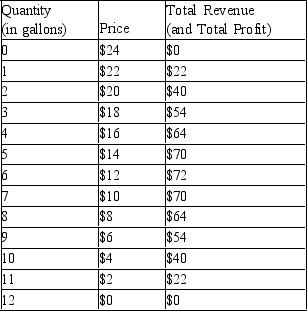 -Refer to Table 17-31. Discuss the difference between the monopoly outcome and the Nash equilibrium.
 (Essay)
4.8/5  (73)
(73) Table 17-18
This table shows a game played between two firms, Firm A and Firm B. In this game each firm must decide how much output (Q) to produce: 10 units or 12 units. The profit for each firm is given in the table as (Profit for Firm A, Profit for Firm B).
 -Refer to Table 17-18. If these two firms play this game repeatedly, the likely outcome will be
 (Multiple Choice)
4.9/5 (75)
(75) Oligopolies can end up looking like competitive markets if the number of firms is
(Multiple Choice)
4.8/5 (73)
(73) An equilibrium in which each firm in an oligopoly maximizes profit, given the actions of its rivals, is called
(Multiple Choice)
5.0/5 (90)
(90) Table 17-33
Suppose that Robert and Howard own the only two movie studios in California. Each producer must choose between a low budget and a high budget strategy for his next film. The economic profit from each strategy is indicated in the table below:
Howard
Low budget High budget
 -Refer to Table 17-33. Is there a Nash equilibrium? If so, describe it.
 (Essay)
4.7/5 (94)
(94) Figure 17-1  -Refer to Figure 17-1. Suppose this market is served by a duopoly in which each firm faces the marginal cost curve shown in the diagram. The marginal revenue curve that a monopolist would face in this market is also shown. Which of the following statements is true?
 (Multiple Choice)
4.8/5 (74)
(74) Table 17-28
Suppose that two firms determine that each could lower its costs and increase its profits if both reduced their advertising budgets. But in order for the plan to work, each firm must agree to refrain from advertising. Each firm believes that advertising works by increasing the demand for the firm's product, but each firm also believes that if neither firm advertises, the cost savings will outweigh the lost sales. The table below lists each firm's individual profits:
Firm A
Breaks agreement Maintains agreement
and advertises and does not advertise
 -Refer to Table 17-28. Which of the following statement(s) correctly characterizes the outcome of this game?
 (Multiple Choice)
5.0/5 (79)
(79) If the output effect is larger than the price effect, an individual firm will production.
(Short Answer)
4.8/5 (85)
(85) When all firms choose their best strategy given the strategies that all the other firms have chosen, the result is a Nash equilibrium.
(True/False)
4.7/5 (81)
(81) In the U.S. government's 1998 suit against the Microsoft Corporation, a central issue was whether Microsoft should be allowed to integrate its Internet browser into its Windows operating system. Microsoft responded that
(Multiple Choice)
4.9/5 (82)
(82) Like monopolists, oligopolists are aware that an increase in the quantity of output always
(Multiple Choice)
4.7/5 (85)
(85) For a firm, strategic interactions with other firms in the market become more important as the number of firms in the market becomes larger.
(True/False)
4.7/5 (80)
(80) Scenario 17-3.
Consider two countries, Kinglandia and Rovinastan, that are engaged in an arms race. Each country must decide whether to build new weapons or to disarm existing weapons. Each country prefers to have more arms than the other because a large arsenal gives it more influence in world affairs. But each country also prefers to live in a world safe from the other country's weapons. The following table shows the possible outcomes for each decision combination. The numbers in each cell represent the country's ranking of the outcome (10 = best outcome, 1 = worst outcome).
 -Refer to Scenario 17-3. Suppose the two countries agreed to disarm existing weapons. In reality these two countries may have a hard time keeping this agreement due to which of the following reasons? (i) Even though Kinglandia has no incentive to cheat on the agreement, Rovinastan has an incentive to cheat on the agreement.
(ii) Much like the prisoners' dilemma, both countries are better off reneging on the
Agreement and building new weapons.
(iii) Both countries want to increase their world power by building new weapons.
-Refer to Scenario 17-3. Suppose the two countries agreed to disarm existing weapons. In reality these two countries may have a hard time keeping this agreement due to which of the following reasons? (i) Even though Kinglandia has no incentive to cheat on the agreement, Rovinastan has an incentive to cheat on the agreement.
(ii) Much like the prisoners' dilemma, both countries are better off reneging on the
Agreement and building new weapons.
(iii) Both countries want to increase their world power by building new weapons. (Multiple Choice)
4.9/5 (74)
(74) Table 17-9
The table shows the demand schedule for a particular product.
 -Refer to Table 17-9. Suppose the market for this product is served by two firms that have formed a cartel. What price will the cartel charge in this market if the marginal cost of production is $4?
 (Multiple Choice)
4.9/5 (79)
(79) The Sherman Antitrust Act states that if a person can prove that he was damaged by an illegal arrangement to restrain trade, he could sue and recover three times the damages he sustained.
(True/False)
4.9/5 (71)
(71) Table 17-18
This table shows a game played between two firms, Firm A and Firm B. In this game each firm must decide how much output (Q) to produce: 10 units or 12 units. The profit for each firm is given in the table as (Profit for Firm A, Profit for Firm B).
-Refer to Table 17-18. The Nash equilibrium for this game is
-Refer to Table 17-18. The Nash equilibrium for this game is (Multiple Choice)
4.8/5 (72)
(72) Much of the research on game theory in recent decades was driven by attempts to analyze actions of players during
(Multiple Choice)
4.8/5 (66)
(66) 
Filters
- Essay(0)
- Multiple Choice(0)
- Short Answer(0)
- True False(0)
- Matching(0)