



 Chat with AI
Exam 17: Oligopoly

Exam 1: Ten Principles of Economics439 Questions
Exam 2: Thinking Like an Economist617 Questions
Exam 3: Interdependence and the Gains From Trade527 Questions
Exam 4: The Market Forces of Supply and Demand698 Questions
Exam 5: Elasticity and Its Application595 Questions
Exam 6: Supply, Demand, and Government Policies644 Questions
Exam 7: Consumers, Producers, and the Efficiency of Markets549 Questions
Exam 8: Application: The Costs of Taxation511 Questions
Exam 9: Application: International Trade493 Questions
Exam 10: Externalities524 Questions
Exam 11: Public Goods and Common Resources433 Questions
Exam 12: The Design of the Tax System551 Questions
Exam 13: The Costs of Production420 Questions
Exam 14: Firms in Competitive Markets543 Questions
Exam 15: Monopoly637 Questions
Exam 16: Monopolistic Competition587 Questions
Exam 17: Oligopoly496 Questions
Exam 18: The Markets for the Factors of Production564 Questions
Exam 19: Earnings and Discrimination490 Questions
Exam 20: Income Inequality and Poverty457 Questions
Exam 21: The Theory of Consumer Choice440 Questions
Exam 22: Frontiers of Microeconomics441 Questions
Select questions type


Table 17-20
Nadia and Maddie are two college roommates who both prefer a clean common space in their dorm room, but neither enjoys cleaning. The roommates must each make a decision to either clean or not clean the dorm room's common space. The payoff table for this situation is provided below, where the higher a player's payoff number, the better off that player is. The payoffs in each cell are shown as (payoff for Nadia, payoff for Maddie).
 -Refer to Table 17-20. What is the Nash Equilibrium in this dorm room cleaning game?
Free
(Multiple Choice)
4.8/5  (81)
(81) Correct Answer: Verified
D
Table 17-14
This table shows a game played between two players, A and B. The payoffs in the table are shown as (Payoff to A, Payoff to B).
 -Refer to Table 17-14. Which of the following statements about this game is true?
Free
(Multiple Choice)
4.8/5 (72)
(72) Correct Answer:Verified
VerifiedB
Table 17-23
Two bottled beverage manufacturers (Firm A and Firm B) determine that they could lower their costs, and thus increase their profits, if they reduced their advertising budgets. But for the plan to work, each firm must agree to refrain from advertising. Each firm believes that advertising works by increasing the demand for the firm's product, but each firm also believes that if neither firm advertises, the costs savings will outweigh the lost sales. Listed in the table below are the individual profits for each firm.
 -Refer to Table 17-23. Suppose that the two firms, A and B, make an agreement to withhold any advertising for one month to lower each firm's costs and raise each firm's profits. If the firms reach the Nash equilibrium,
Free
(Multiple Choice)
4.8/5 (96)
(96) Correct Answer:Verified
VerifiedD
Table 17-6
Imagine a small town in which only two residents, Kunal and Naj, own wells that produce safe drinking water. Each week Kunal and Naj work together to decide how many gallons of water to pump, to bring the water to town, and to sell it at whatever price the market will bear. Assume Kunal and Naj can pump as much water as they want without cost so that the marginal cost of water equals zero.
The weekly town demand schedule and total revenue schedule for water are shown in the table below.
 -Refer to Table 17-6. Suppose the town enacts new antitrust laws that prohibit Kunal and Naj from operating as a monopolist. What will quantity of water will each of them produce once the Nash equilibrium is reached?
 (Multiple Choice)
4.7/5 (83)
(83) Table 17-3
Imagine a small town in a remote area where only two residents, Maria and Miguel, own dairies that produce milk that is safe to drink. Each week Maria and Miguel work together to decide how many gallons of milk to produce. They bring milk to town and sell it at whatever price the market will bear. To keep things simple, suppose that Maria and Miguel can produce as much milk as they want without cost so that the marginal cost is zero. The weekly town demand schedule and total revenue schedule for milk is shown in the table below:
 -Refer to Table 17-3. If this market for milk were perfectly competitive instead of monopolistic, how many gallons of milk would be produced and sold?
 (Multiple Choice)
4.8/5 (82)
(82) The problems faced by oligopolies with three or more members are entirely different from the problems faced by duopolies.
(True/False)
4.9/5 (71)
(71) Assume that demand for a product that is produced at zero marginal cost is reflected in the table below.
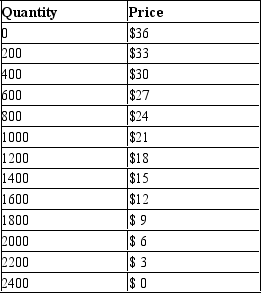 a. What is the profit-maximizing level of production for a group of oligopolistic firms that operate as a cartel?
b. Assume that this market is characterized by a duopoly in which collusive agreements are illegal.
What market price and quantity will be associated with a Nash equilibrium?
<sub
a. What is the profit-maximizing level of production for a group of oligopolistic firms that operate as a cartel?
b. Assume that this market is characterized by a duopoly in which collusive agreements are illegal.
What market price and quantity will be associated with a Nash equilibrium?
<sub (Essay)
4.9/5 (70)
(70) In a typical cartel agreement, the cartel maximizes profit when it
(Multiple Choice)
4.8/5 (86)
(86) If two firms comprise the entire soft drink market, the market would be a(n)
(Multiple Choice)
4.9/5 (82)
(82) A situation in which firms choose their best strategy given the strategies chosen by the other firms in the market is called
(Multiple Choice)
4.8/5 (79)
(79) Table 17-32
Suppose that Angelina and Brad own the only two professional photography stores in town. Each must choose between a low price and a high price for senior photo packages. The annual economic profit from each strategy is indicated in the table below:
Angelina
Low price High price
 -Refer to Table 17-32. Does Angelina have a dominant strategy? If so, describe it.
 (Essay)
4.8/5 (75)
(75) Table 17-17
This table shows a game played between two firms, Firm A and Firm B. In this game each firm must decide how much output (Q) to produce: 2 units or 3 units. The profit for each firm is given in the table as (Profit for Firm A, Profit for Firm B).
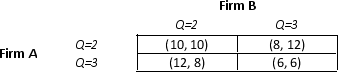 -Refer to Table 17-17. In this game,
 (Multiple Choice)
4.8/5 (66)
(66) As the number of firms in an oligopoly becomes very large, the price effect disappears.
(True/False)
4.9/5 (77)
(77) In the prisoners' dilemma game, confessing is a dominant strategy for each of the two prisoners.
(True/False)
4.8/5 (92)
(92) Table 17-19
Consider a small town that has two grocery stores from which residents can choose to buy a loaf of bread. The store owners each must make a decision to set a high bread price or a low bread price. The payoff table, showing profit per week, is provided below. The profit in each cell is shown as (Store 1, Store 2).
 -Refer to Table 17-19. If grocery store 1 sets a low price, what price should grocery store 2 set? And what will grocery store 2's payoff equal?
 (Multiple Choice)
4.7/5 (72)
(72) Even when allowed to collude, firms in an oligopoly may choose to cheat on their agreements with the rest of the cartel. Why?
(Essay)
4.9/5 (75)
(75) In a duopoly if the firms have agreed to jointly maximize profits, then each firm can increase its current profits by producing more.
(True/False)
4.7/5 (91)
(91) Table 17-10
The table shows the demand schedule for a particular product.
 -Refer to Table 17-10. Suppose the market for this product is served by two firms who have formed a cartel and are colluding to set the price and quantity in this market. If the marginal cost to produce this product is constant at $40 per unit, then what price will the cartel set in this market?
 (Multiple Choice)
4.9/5 (95)
(95) Which of the following questions about predatory pricing remains unresolved?
(Multiple Choice)
4.8/5 (90)
(90) 
Filters
- Essay(0)
- Multiple Choice(0)
- Short Answer(0)
- True False(0)
- Matching(0)