



 Chat with AI
Exam 17: Oligopoly

Exam 1: Ten Principles of Economics439 Questions
Exam 2: Thinking Like an Economist617 Questions
Exam 3: Interdependence and the Gains From Trade527 Questions
Exam 4: The Market Forces of Supply and Demand698 Questions
Exam 5: Elasticity and Its Application595 Questions
Exam 6: Supply, Demand, and Government Policies644 Questions
Exam 7: Consumers, Producers, and the Efficiency of Markets549 Questions
Exam 8: Application: The Costs of Taxation511 Questions
Exam 9: Application: International Trade493 Questions
Exam 10: Externalities524 Questions
Exam 11: Public Goods and Common Resources433 Questions
Exam 12: The Design of the Tax System551 Questions
Exam 13: The Costs of Production420 Questions
Exam 14: Firms in Competitive Markets543 Questions
Exam 15: Monopoly637 Questions
Exam 16: Monopolistic Competition587 Questions
Exam 17: Oligopoly496 Questions
Exam 18: The Markets for the Factors of Production564 Questions
Exam 19: Earnings and Discrimination490 Questions
Exam 20: Income Inequality and Poverty457 Questions
Exam 21: The Theory of Consumer Choice440 Questions
Exam 22: Frontiers of Microeconomics441 Questions
Select questions type


Explain the practice of resale price maintenance and discuss why it is controversial.
(Essay)
4.8/5  (84)
(84) Table 17-12
The table shows the town of Driveaway's demand schedule for gasoline. Assume the town's gasoline seller(s) incurs a cost of $2 for each gallon sold, with no fixed cost.
 -Refer to Table 17-12. Suppose we observe that the price of a gallon of gasoline in Driveaway is $2. Given this observation, which of the following scenarios is most likely?
 (Multiple Choice)
4.8/5 (82)
(82) Scenario 17-6
Assume that a local telecommunications company sells high speed internet access and cable television. The company's only two customers are Taylor and Tim. Taylor is willing to pay $50 per month for high speed internet access and $50 per month for cable television. Tim is willing to pay only $20 per month for high speed internet access, but is willing to pay $70 per month for cable television. Assume that the telecommunications company can provide each of these products at zero marginal cost.
-Refer to Scenario 17-6. How much additional profit can the telecommunications company earn by switching to the use of a tying strategy to price high speed internet access and cable television rather than pricing these goods separately?
(Short Answer)
4.9/5 (79)
(79) In a duopoly situation, the logic of self-interest results in a total output level that
(Multiple Choice)
4.8/5 (67)
(67) Which of the controversial business practices, resale price maintenance, predatory pricing, or tying, was a part of a long-running antitrust lawsuit against Microsoft and why?
(Essay)
4.8/5 (85)
(85) Table 17-9
The table shows the demand schedule for a particular product.
 -Refer to Table 17-9. If the marginal cost of production in this market is $4, what is the socially efficient quantity of output?
 (Multiple Choice)
4.8/5 (87)
(87) Scenario 17-3.
Consider two countries, Kinglandia and Rovinastan, that are engaged in an arms race. Each country must decide whether to build new weapons or to disarm existing weapons. Each country prefers to have more arms than the other because a large arsenal gives it more influence in world affairs. But each country also prefers to live in a world safe from the other country's weapons. The following table shows the possible outcomes for each decision combination. The numbers in each cell represent the country's ranking of the outcome (10 = best outcome, 1 = worst outcome).
 -Refer to Scenario 17-3. Building new weapons is a dominant strategy for
 (Multiple Choice)
4.8/5 (82)
(82) Table 17-3
Imagine a small town in a remote area where only two residents, Maria and Miguel, own dairies that produce milk that is safe to drink. Each week Maria and Miguel work together to decide how many gallons of milk to produce. They bring milk to town and sell it at whatever price the market will bear. To keep things simple, suppose that Maria and Miguel can produce as much milk as they want without cost so that the marginal cost is zero. The weekly town demand schedule and total revenue schedule for milk is shown in the table below:
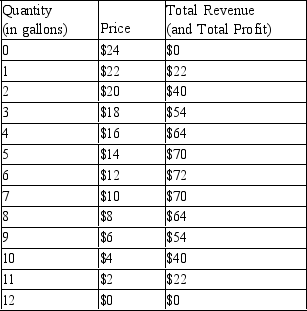 -Refer to Table 17-3. Suppose that Maria and Miguel work together in order to operate as a profit-maximizing monopolist. What price will they charge for milk?
 (Multiple Choice)
4.9/5 (74)
(74) The paradoxical nature of oligopoly can be demonstrated by the fact that, even though the monopoly outcome is best for the oligopolists,
(Multiple Choice)
4.8/5 (62)
(62) Table 17-33
Suppose that Robert and Howard own the only two movie studios in California. Each producer must choose between a low budget and a high budget strategy for his next film. The economic profit from each strategy is indicated in the table below:
Howard
Low budget High budget
 -Refer to Table 17-33. Does Howard have a dominant strategy? If so, describe it.
 (Essay)
4.8/5 (87)
(87) . What happens when the prisoners' dilemma game is repeated numerous times in an oligopoly market? (i) The firms may well reach the monopoly outcome.
(ii) The firms may well reach the competitive outcome.
(iii) Buyers of the oligopolists' product will likely be worse off as a result.
(Multiple Choice)
5.0/5 (76)
(76) Table 17-20
Nadia and Maddie are two college roommates who both prefer a clean common space in their dorm room, but neither enjoys cleaning. The roommates must each make a decision to either clean or not clean the dorm room's common space. The payoff table for this situation is provided below, where the higher a player's payoff number, the better off that player is. The payoffs in each cell are shown as (payoff for Nadia, payoff for Maddie).
 -Refer to Table 17-20. If Nadia chooses to not clean, then Maddie will
 (Multiple Choice)
4.7/5 (81)
(81) Table 17-28
Suppose that two firms determine that each could lower its costs and increase its profits if both reduced their advertising budgets. But in order for the plan to work, each firm must agree to refrain from advertising. Each firm believes that advertising works by increasing the demand for the firm's product, but each firm also believes that if neither firm advertises, the cost savings will outweigh the lost sales. The table below lists each firm's individual profits:
Firm A
Breaks agreement Maintains agreement
and advertises and does not advertise
 -Refer to Table 17-28. Does either Firm A or Firm B have a dominant strategy?
 (Multiple Choice)
4.9/5 (81)
(81) In the prisoners' dilemma game, one prisoner is always better off confessing, no matter what the other prisoner does.
(True/False)
4.9/5 (77)
(77) Table 17-9
The table shows the demand schedule for a particular product.
-Refer to Table 17-9. Suppose the market for this product is served by two firms that have formed a cartel. If the marginal cost of production is $4 and the fixed cost is $6, the combined profit of the cartel will be
-Refer to Table 17-9. Suppose the market for this product is served by two firms that have formed a cartel. If the marginal cost of production is $4 and the fixed cost is $6, the combined profit of the cartel will be (Multiple Choice)
4.8/5 (72)
(72) Oligopolies produce more when they collude then when they do not.
(True/False)
4.8/5 (65)
(65) The practice of requiring someone to buy two or more items together, rather than separately, is called
(Multiple Choice)
5.0/5 (73)
(73) The equilibrium price in a market characterized by oligopoly is
(Multiple Choice)
4.7/5 (79)
(79) 
Filters
- Essay(0)
- Multiple Choice(0)
- Short Answer(0)
- True False(0)
- Matching(0)