



 Chat with AI
Exam 14: Firms in Competitive Markets

Exam 1: Ten Principles of Economics439 Questions
Exam 2: Thinking Like an Economist617 Questions
Exam 3: Interdependence and the Gains From Trade527 Questions
Exam 4: The Market Forces of Supply and Demand698 Questions
Exam 5: Elasticity and Its Application595 Questions
Exam 6: Supply, Demand, and Government Policies644 Questions
Exam 7: Consumers, Producers, and the Efficiency of Markets549 Questions
Exam 8: Application: The Costs of Taxation511 Questions
Exam 9: Application: International Trade493 Questions
Exam 10: Externalities524 Questions
Exam 11: Public Goods and Common Resources433 Questions
Exam 12: The Design of the Tax System551 Questions
Exam 13: The Costs of Production420 Questions
Exam 14: Firms in Competitive Markets543 Questions
Exam 15: Monopoly637 Questions
Exam 16: Monopolistic Competition587 Questions
Exam 17: Oligopoly496 Questions
Exam 18: The Markets for the Factors of Production564 Questions
Exam 19: Earnings and Discrimination490 Questions
Exam 20: Income Inequality and Poverty457 Questions
Exam 21: The Theory of Consumer Choice440 Questions
Exam 22: Frontiers of Microeconomics441 Questions
Select questions type


Susan quit her job as a teacher, which paid her $36,000 per year, in order to start her own catering business. She spent $12,000 of her savings, which had been earning 10 percent interest per year, on equipment for her business. She also borrowed $12,000 from her bank at 10 percent interest, which she also spent on equipment. For the past several months she has spent $1,000 per month on ingredients and other variable costs. Also for the past several months she has taken in $3,500 in monthly revenue. In the short run, Susan should

Free
(Multiple Choice)
4.7/5  (77)
(77) Correct Answer: Verified
B
Which of the following firms is the closest to being a perfectly competitive firm?
Free
(Multiple Choice)
4.9/5 (73)
(73) Correct Answer:Verified
VerifiedD
Suppose that a firm in a competitive market is currently maximizing its short-run profit at an output of 50 units. If the current price is $9, the marginal cost of the 50th unit is $9, and the average total cost of producing 50 units is $4, what is the firm's profit?
Free
(Multiple Choice)
4.8/5 (96)
(96) Correct Answer:Verified
VerifiedC
Figure 14-1
Suppose that a firm in a competitive market has the following cost curves:  -Refer to Figure 14-1. If the market price rises above $6.30, the firm will earn
 (Multiple Choice)
4.9/5 (89)
(89) Suppose a firm in a competitive market produces and sells 150 units of output and earns $1,800 in total revenue from the sales. If the firm increases its output to 200 units, total revenue will be
(Multiple Choice)
4.9/5 (74)
(74) Scenario 14-4
The information below applies to a competitive firm that sells its output for $40 per unit.
-When the firm produces and sells 150 units of output, its average total cost is $24.50.
-When the firm produces and sells 151 units of output, its average total cost is $24.55.
-Refer to Scenario 14-4. When the firm produces 150 units of output, its total cost is
(Multiple Choice)
4.8/5 (81)
(81) When firms in a competitive market have different costs, it is likely that
(Multiple Choice)
4.9/5 (89)
(89) Scenario 14-4
The information below applies to a competitive firm that sells its output for $40 per unit.
-When the firm produces and sells 150 units of output, its average total cost is $24.50.
-When the firm produces and sells 151 units of output, its average total cost is $24.55.
-Refer to Scenario 14-4. Suppose the firm is currently producing and selling 150 units of output. Should the firm increase its output to 151 units?
(Multiple Choice)
4.9/5 (89)
(89) Profit-maximizing firms enter a competitive market when existing firms in that market have
(Multiple Choice)
4.9/5 (78)
(78) Consider a competitive market with a large number of identical firms. The firms in this market do not use any resources that are available only in limited quantities. In long-run equilibrium, market price is determined by
(Multiple Choice)
5.0/5 (84)
(84) Which of these types of costs can be ignored when an individual or a firm is making decisions?
(Multiple Choice)
4.7/5 (85)
(85) For a certain firm, the 100th unit of output that the firm produces has a marginal revenue of $7 and a marginal cost of $10. It follows that the
(Multiple Choice)
4.9/5 (75)
(75) Use a graph to demonstrate the circumstances that would prevail in a competitive market where firms are earning economic profits. Can this scenario be maintained in the long run? Explain your answer.
(Essay)
4.8/5 (77)
(77) Which of the following expressions is correct for a competitive firm?
(Multiple Choice)
5.0/5 (86)
(86) When a competitive market experiences an increase in demand that increases production costs for existing firms and potential new entrants, which of the following is most likely to arise?
(Multiple Choice)
4.9/5 (72)
(72) In a competitive market the current price is $5. The typical firm in the market has ATC = $5.00 and AVC = $4.50.
(Multiple Choice)
5.0/5 (78)
(78) Mrs. Smith operates a business in a competitive market. The current market price is $8.10. At her profit- maximizing level of production, the average variable cost is $8.00, and the average total cost is $8.25. Mrs. Smith should
(Multiple Choice)
4.9/5 (74)
(74) One of the defining characteristics of a perfectly competitive market is
(Multiple Choice)
4.7/5 (75)
(75) Table 14-3
The table represents a demand curve faced by a firm in a competitive market.
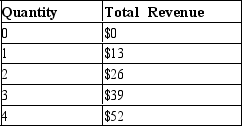 -Refer to Table 14-3. For this firm, the marginal revenue is
 (Multiple Choice)
4.7/5 (79)
(79) Whenever a perfectly competitive firm chooses to change its level of output, its marginal revenue
(Multiple Choice)
4.8/5 (78)
(78) 
Filters
- Essay(0)
- Multiple Choice(0)
- Short Answer(0)
- True False(0)
- Matching(0)