



 Chat with AI
Exam 14: Firms in Competitive Markets

Exam 1: Ten Principles of Economics439 Questions
Exam 2: Thinking Like an Economist617 Questions
Exam 3: Interdependence and the Gains From Trade527 Questions
Exam 4: The Market Forces of Supply and Demand698 Questions
Exam 5: Elasticity and Its Application595 Questions
Exam 6: Supply, Demand, and Government Policies644 Questions
Exam 7: Consumers, Producers, and the Efficiency of Markets549 Questions
Exam 8: Application: The Costs of Taxation511 Questions
Exam 9: Application: International Trade493 Questions
Exam 10: Externalities524 Questions
Exam 11: Public Goods and Common Resources433 Questions
Exam 12: The Design of the Tax System551 Questions
Exam 13: The Costs of Production420 Questions
Exam 14: Firms in Competitive Markets543 Questions
Exam 15: Monopoly637 Questions
Exam 16: Monopolistic Competition587 Questions
Exam 17: Oligopoly496 Questions
Exam 18: The Markets for the Factors of Production564 Questions
Exam 19: Earnings and Discrimination490 Questions
Exam 20: Income Inequality and Poverty457 Questions
Exam 21: The Theory of Consumer Choice440 Questions
Exam 22: Frontiers of Microeconomics441 Questions
Select questions type


In the long run, each firm in a competitive industry earns
(Multiple Choice)
4.9/5  (77)
(77) Figure 14-5
Suppose a firm operating in a competitive market has the following cost curves:  -Refer to Figure 14-5. Firms would be encouraged to enter this market for all prices that exceed
 (Multiple Choice)
4.8/5 (83)
(83) Figure 14-13
Suppose a firm in a competitive industry has the following cost curves:  -Refer to Figure 14-13. If the price is $4.50 in the short run, what will happen in the long run?
 (Multiple Choice)
4.9/5 (67)
(67) If a competitive firm is selling 500 units of its product at a price of $8 per unit and earning a positive profit, then
(Multiple Choice)
4.8/5 (73)
(73) Figure 14-5
Suppose a firm operating in a competitive market has the following cost curves:
-Refer to Figure 14-5. When market price is P2, a profit-maximizing firm's losses can be represented by the area
-Refer to Figure 14-5. When market price is P2, a profit-maximizing firm's losses can be represented by the area (Multiple Choice)
4.9/5 (65)
(65) Use a graph to demonstrate the circumstances that would prevail in a perfectly competitive market where firms are experiencing economic losses. Identify costs, revenue, and the economic losses on your graph. Using your graph, determine whether an individual firm will shut down in the short run, or choose to remain in the market. Explain your answer.
(Essay)
4.9/5 (82)
(82) Figure 14-7  -Refer to Figure 14-7. In the short run, the firm's maximum profit (or minimum loss) is the same at which of the following pairs of prices?
 (Multiple Choice)
4.8/5 (83)
(83) A competitive firm's short-run supply curve is part of which of the following curves?
(Multiple Choice)
4.8/5 (82)
(82) Which of the following statements regarding a competitive market is not correct?
(Multiple Choice)
4.8/5 (81)
(81) Table 14-12
Bill's Birdhouses
 -Refer to Table 14-12. What is the marginal revenue from selling the 5th unit?
 (Multiple Choice)
4.8/5 (96)
(96) A firm in a competitive market has the following cost structure: 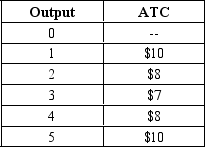 If the firm's fixed cost of production is $3, and the market price is $10, how many units should the firm produce to maximize profit?
 (Multiple Choice)
4.8/5 (82)
(82) Which of the following is not a characteristic of a perfectly competitive market?
(Multiple Choice)
4.9/5 (75)
(75) In the short run for a particular market, there are 300 firms. Each firm has a marginal cost of $30 when it produces 200 units of output. One point on the market supply curve is
(Multiple Choice)
4.8/5 (79)
(79) Because there are many sellers in a competitive market, individual firms are unable to maximize profits.
(True/False)
4.8/5 (72)
(72) Consider a competitive market with 50 identical firms. Suppose the market demand is given by the equation QD = 200 - 10P and the market supply is given by the equation QS = 10P. In addition, suppose the following table shows the marginal cost of production for various levels of output for firms in this market. 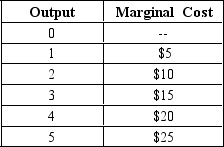 How many units should a firm in this market produce to maximize profit?
 (Multiple Choice)
4.8/5 (77)
(77) Scenario 14-4
The information below applies to a competitive firm that sells its output for $40 per unit.
-When the firm produces and sells 150 units of output, its average total cost is $24.50.
-When the firm produces and sells 151 units of output, its average total cost is $24.55.
-Refer to Scenario 14-4. Let Q represent the quantity of output. Which of the following magnitudes has the same value at Q = 150 and at Q = 151?
(Multiple Choice)
4.8/5 (73)
(73) If firms are competitive and profit maximizing, the price of a good equals the
(Multiple Choice)
4.8/5 (75)
(75) Roger owns a small health store that sells vitamins in a perfectly competitive market. If vitamins sell for $12 per bottle and the average total cost per bottle is $11.50 at the profit-maximizing output level, then in the long run
(Multiple Choice)
4.7/5 (75)
(75) Suppose a profit-maximizing firm in a competitive market produces rubber bands. When the market price for rubber bands falls below the minimum of its average total cost, but still lies above the minimum of average variable cost, in the short run the firm will
(Multiple Choice)
4.8/5 (78)
(78) 
Filters
- Essay(0)
- Multiple Choice(0)
- Short Answer(0)
- True False(0)
- Matching(0)