



 Chat with AI
Exam 16: Monopolistic Competition

Exam 1: Ten Principles of Economics439 Questions
Exam 2: Thinking Like an Economist617 Questions
Exam 3: Interdependence and the Gains From Trade527 Questions
Exam 4: The Market Forces of Supply and Demand698 Questions
Exam 5: Elasticity and Its Application595 Questions
Exam 6: Supply, Demand, and Government Policies644 Questions
Exam 7: Consumers, Producers, and the Efficiency of Markets549 Questions
Exam 8: Application: The Costs of Taxation511 Questions
Exam 9: Application: International Trade493 Questions
Exam 10: Externalities524 Questions
Exam 11: Public Goods and Common Resources433 Questions
Exam 12: The Design of the Tax System551 Questions
Exam 13: The Costs of Production420 Questions
Exam 14: Firms in Competitive Markets543 Questions
Exam 15: Monopoly637 Questions
Exam 16: Monopolistic Competition587 Questions
Exam 17: Oligopoly496 Questions
Exam 18: The Markets for the Factors of Production564 Questions
Exam 19: Earnings and Discrimination490 Questions
Exam 20: Income Inequality and Poverty457 Questions
Exam 21: The Theory of Consumer Choice440 Questions
Exam 22: Frontiers of Microeconomics441 Questions
Select questions type


If firms in a monopolistically competitive market are incurring economic losses, which of the following statements describes the changes that occur as the market adjusts to the long-run equilibrium?

Free
(Multiple Choice)
4.9/5  (67)
(67) Correct Answer: Verified
D
The lower the concentration ratio, the
Free
(Multiple Choice)
4.8/5 (83)
(83) Correct Answer:Verified
VerifiedB
Entry and exit drive each firm in a monopolistically competitive market to a point of tangency between its
Free
(Multiple Choice)
4.9/5 (81)
(81) Correct Answer:Verified
VerifiedD
Most businesses advertise their products and services. Some business use SPAM emails to advertise because the cost of a mass e-mail is close to zero. Other business spend millions of dollars to advertise in a 30-second spot during the Super Bowl. Having observed this real world data, economists argue that the amount of money that a business spends on advertising is a proxy for a good or service's
(Multiple Choice)
5.0/5 (78)
(78) Regulation of a firm in a monopolistically competitive market
(Multiple Choice)
4.8/5 (86)
(86) In a long-run equilibrium, a firm in a monopolistically competitive market operates
(Multiple Choice)
4.8/5 (74)
(74) Figure 16-10
The figure is drawn for a monopolistically-competitive firm.  -Refer to Figure 16-10. The firm's maximum profit is
 (Multiple Choice)
4.9/5 (75)
(75) Monopolistic competition is an inefficient market structure because
(Multiple Choice)
4.8/5 (82)
(82) The term excess capacity refers to the fact that a firm produces a lower quantity than it would if it operated at the efficient scale.
(True/False)
4.8/5 (81)
(81) Figure 16-12 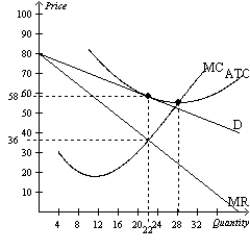 -Refer to Figure 16-12. What is the efficient scale of production?
 (Multiple Choice)
4.7/5 (80)
(80) Table 16-5
This table shows the demand schedule, marginal cost, and average total cost for a monopolistically competitive firm.
 -Refer to Table 16-5. What is this firm's total cost at the profitmaximizing quantity?
 (Multiple Choice)
4.8/5 (77)
(77) The general term for market structures that fall somewhere between monopoly and perfect competition is
(Multiple Choice)
4.9/5 (80)
(80) Scenario 16-3
Peter operates an ice cream shop in the center of Fairfield. He sells several unusual flavors of organic, homemade ice cream so he has a monopoly over his own ice cream, though he competes with many other firms selling ice cream in Fairfield for the same customers. Peter's demand and cost values for sales per day are given in the table below. (Everyone who purchases Peter's ice cream buys a double scoop cone because it's so delicious.)
 -Refer to Scenario 16-3. What price should Peter charge per double scoop ice cream cone to maximize his profit?
 (Multiple Choice)
4.7/5 (63)
(63) Figure 16-13  -Refer to Figure 16-13. Which letter represents the profit-maximizing price?
 (Short Answer)
4.9/5 (83)
(83) Product differentiation causes the seller of a good to face what type of demand curve?
(Multiple Choice)
4.7/5 (76)
(76) 
Filters
- Essay(0)
- Multiple Choice(0)
- Short Answer(0)
- True False(0)
- Matching(0)