



 Chat with AI
Exam 16: Monopolistic Competition

Exam 1: Ten Principles of Economics439 Questions
Exam 2: Thinking Like an Economist617 Questions
Exam 3: Interdependence and the Gains From Trade527 Questions
Exam 4: The Market Forces of Supply and Demand698 Questions
Exam 5: Elasticity and Its Application595 Questions
Exam 6: Supply, Demand, and Government Policies644 Questions
Exam 7: Consumers, Producers, and the Efficiency of Markets549 Questions
Exam 8: Application: The Costs of Taxation511 Questions
Exam 9: Application: International Trade493 Questions
Exam 10: Externalities524 Questions
Exam 11: Public Goods and Common Resources433 Questions
Exam 12: The Design of the Tax System551 Questions
Exam 13: The Costs of Production420 Questions
Exam 14: Firms in Competitive Markets543 Questions
Exam 15: Monopoly637 Questions
Exam 16: Monopolistic Competition587 Questions
Exam 17: Oligopoly496 Questions
Exam 18: The Markets for the Factors of Production564 Questions
Exam 19: Earnings and Discrimination490 Questions
Exam 20: Income Inequality and Poverty457 Questions
Exam 21: The Theory of Consumer Choice440 Questions
Exam 22: Frontiers of Microeconomics441 Questions
Select questions type


Piper consumes Ragu spaghetti sauce exclusively. She claims that there is a clear taste difference and that competing brands of spaghetti sauce leave an unsavory taste in her mouth. However, in a blind taste test, Piper is found to prefer generic store-brand spaghetti sauce to Ragu spaghetti sauce eight out of ten times. The results of Piper's taste test would reinforce claims by critics of brand names that
(Multiple Choice)
4.9/5  (65)
(65) Firms in monopolistically competitive markets and monopolies can earn long-run profits due to barriers to entry.
(True/False)
4.9/5 (77)
(77) Figure 16-3
This figure depicts a situation in a monopolistically competitive market.  -Refer to Figure 16-3. Which of the following will occur in the long run in this industry?
 (Multiple Choice)
4.8/5 (69)
(69) Scenario 16-1
Suppose the following are the sales for all of the firms in two different industries.
 -Refer to Scenario 16-1. Which of the following statements is correct regarding the competitiveness of these two industries?
 (Multiple Choice)
4.7/5 (97)
(97) Critics of advertising argue that advertising leads to less elastic demand for products and a larger markup of price over marginal cost.
(True/False)
5.0/5 (86)
(86) When a monopolistically competitive firm is in long-run equilibrium,
(Multiple Choice)
4.8/5 (75)
(75) The product-variety externality and the business-stealing externality are both spillover benefits of new firms entering a monopolistically competitive market.
(True/False)
5.0/5 (90)
(90) In Lee Benham's 1972 article examining the impact of advertising on the average price paid for a pair of eyeglasses, Benham found that
(Multiple Choice)
4.9/5 (61)
(61) Figure 16-8
The lines in the figures below illustrate the potential effect of entry and exit in a monopolistically competitive market on either the demand curve or the marginal cost curve of existing firms. 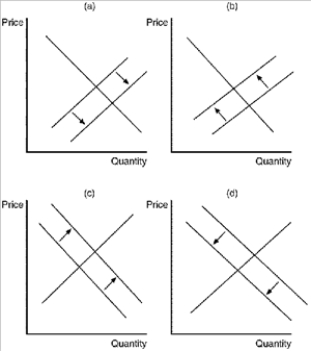 -Refer to Figure 16-8. Panel (d) illustrates the change that would occur if existing firms faced
 (Multiple Choice)
4.9/5 (91)
(91) Both monopolistic competition and oligopoly are market structures
(Multiple Choice)
4.7/5 (53)
(53) Which of the following market structures is considered a differentiated products market?
(Multiple Choice)
4.9/5 (77)
(77) AllClean knows that it produces and sells very effective laundry detergent. NotQuiteWhite knows that it produces and sells ineffective laundry detergent. According to the signaling theory of advertising,
(Multiple Choice)
4.8/5 (78)
(78) Figure 16-10
The figure is drawn for a monopolistically-competitive firm.  -Refer to Figure 16-10. Efficient scale is reached
 (Multiple Choice)
4.8/5 (77)
(77) Figure 16-2. The figure is drawn for a monopolistically competitive firm.  -Refer to Figure 16-2. Suppose that average total cost is $36 when Q=24. What is the profit-maximizing price and resulting profit?
 (Multiple Choice)
4.8/5 (86)
(86) Which of the following is not an argument made by critics of advertising?
(Multiple Choice)
4.8/5 (66)
(66) Which of the following conditions is characteristic of a monopolistically competitive firm in long-run equilibrium?
(Multiple Choice)
4.9/5 (68)
(68) Table 16-2
The following table shows the total output produced by the top six firms as well as the total industry output for each industry.
 -Refer to Table 16-2. Which industry is the most competitive?
 (Multiple Choice)
4.8/5 (99)
(99) 
Filters
- Essay(0)
- Multiple Choice(0)
- Short Answer(0)
- True False(0)
- Matching(0)