



 Chat with AI
Exam 16: Monopolistic Competition

Exam 1: Ten Principles of Economics439 Questions
Exam 2: Thinking Like an Economist617 Questions
Exam 3: Interdependence and the Gains From Trade527 Questions
Exam 4: The Market Forces of Supply and Demand698 Questions
Exam 5: Elasticity and Its Application595 Questions
Exam 6: Supply, Demand, and Government Policies644 Questions
Exam 7: Consumers, Producers, and the Efficiency of Markets549 Questions
Exam 8: Application: The Costs of Taxation511 Questions
Exam 9: Application: International Trade493 Questions
Exam 10: Externalities524 Questions
Exam 11: Public Goods and Common Resources433 Questions
Exam 12: The Design of the Tax System551 Questions
Exam 13: The Costs of Production420 Questions
Exam 14: Firms in Competitive Markets543 Questions
Exam 15: Monopoly637 Questions
Exam 16: Monopolistic Competition587 Questions
Exam 17: Oligopoly496 Questions
Exam 18: The Markets for the Factors of Production564 Questions
Exam 19: Earnings and Discrimination490 Questions
Exam 20: Income Inequality and Poverty457 Questions
Exam 21: The Theory of Consumer Choice440 Questions
Exam 22: Frontiers of Microeconomics441 Questions
Select questions type


Figure 16-7  -Refer to Figure 16-7. Suppose a firm is operating in the situation depicted in panel
 (Multiple Choice)
4.7/5  (72)
(72) Brand names are rarely used to convey information about product quality.
(True/False)
4.9/5 (76)
(76) If firms in a particular market sell similar or identical products, then the market is (i) perfectly competitive.
(ii) monopolistically competitive.
(iii) an oligopoly.
(Multiple Choice)
4.8/5 (74)
(74) Which type of market structure has the fewest number of firms?
(Short Answer)
4.8/5 (80)
(80) Entry of new firms in monopolistically competitive industries can convey a negative externality on producers because firms lose customers and profits from the entry of new competitors. This externality is called the
(Short Answer)
4.8/5 (83)
(83) A monopolistically competitive industry is characterized by
(Multiple Choice)
4.8/5 (75)
(75) Table 16-1
The following table shows the percentage of output supplied by the top eight firms in four different industries.
 -Refer to Table 16-1. What is the concentration ratio in Industry B?
 (Multiple Choice)
4.9/5 (70)
(70) Which of the following pairs illustrates the two extreme examples of market structures?
(Multiple Choice)
4.7/5 (78)
(78) Table 16-2
The following table shows the total output produced by the top six firms as well as the total industry output for each industry.
 -Refer to Table 16-2. Which industry has the highest concentration ratio?
 (Multiple Choice)
4.9/5 (90)
(90) Which of these types of firms can earn a positive economic profit in the long run?
(Multiple Choice)
5.0/5 (79)
(79) Firms in industries that have competitors but do not face so much competition that they are price takers are operating in either a(n)
(Multiple Choice)
4.9/5 (83)
(83) Scenario 16-3
Peter operates an ice cream shop in the center of Fairfield. He sells several unusual flavors of organic, homemade ice cream so he has a monopoly over his own ice cream, though he competes with many other firms selling ice cream in Fairfield for the same customers. Peter's demand and cost values for sales per day are given in the table below. (Everyone who purchases Peter's ice cream buys a double scoop cone because it's so delicious.)
 -Refer to Scenario 16-3. How many double scoop ice cream cones should Peter sell per day to maximize his profit?
 (Multiple Choice)
4.9/5 (61)
(61) Consider two industries in which firms hold the following market shares:
Industry A: 25%, 20%, 18%, 15%, 8%, 7%, 4%, 2%, 1%
Industry B: 30%, 10%, 9%, 8%, 8%, 8%, 8%, 6%, 6%, 5%, 2%
What are the concentration ratios for each industry? Which is more competitive?
(Short Answer)
4.8/5 (74)
(74) Considering perfect competition, monopolistic competition, and monopoly, which of the market structures can have positive profits in the short run?
(Essay)
4.8/5 (87)
(87) A recent outbreak of hepatitis was linked to a national fast-food restaurant chain. This is an example of a case in which
(Multiple Choice)
4.9/5 (87)
(87) In the long run, a monopolistically competitive firm produces a quantity that is
(Multiple Choice)
4.8/5 (87)
(87) The term excess capacity refers to the fact that a firm operates on the upward-sloping portion of its average-total- cost curve.
(True/False)
4.9/5 (78)
(78) Table 16-2
The following table shows the total output produced by the top six firms as well as the total industry output for each industry.
-Refer to Table 16-2. What is the concentration ratio for Industry K?
-Refer to Table 16-2. What is the concentration ratio for Industry K? (Multiple Choice)
4.7/5 (82)
(82) Figure 16-12 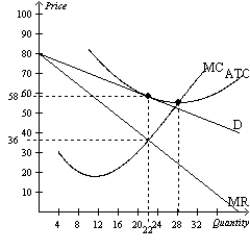 -Refer to Figure 16-12. How much cost per unit could this firm save by producing the efficient level of output rather than the profit-maximizing level of output?
 (Multiple Choice)
4.9/5 (76)
(76) Figure 16-2. The figure is drawn for a monopolistically competitive firm.  -Refer to Figure 16-2. If the ATC=40 at the profit-maximizing level of output, which of the following will occur in the long run in this industry?
 (Multiple Choice)
4.9/5 (87)
(87) 
Filters
- Essay(0)
- Multiple Choice(0)
- Short Answer(0)
- True False(0)
- Matching(0)