



 Chat with AI
Exam 16: Monopolistic Competition

Exam 1: Ten Principles of Economics439 Questions
Exam 2: Thinking Like an Economist617 Questions
Exam 3: Interdependence and the Gains From Trade527 Questions
Exam 4: The Market Forces of Supply and Demand698 Questions
Exam 5: Elasticity and Its Application595 Questions
Exam 6: Supply, Demand, and Government Policies644 Questions
Exam 7: Consumers, Producers, and the Efficiency of Markets549 Questions
Exam 8: Application: The Costs of Taxation511 Questions
Exam 9: Application: International Trade493 Questions
Exam 10: Externalities524 Questions
Exam 11: Public Goods and Common Resources433 Questions
Exam 12: The Design of the Tax System551 Questions
Exam 13: The Costs of Production420 Questions
Exam 14: Firms in Competitive Markets543 Questions
Exam 15: Monopoly637 Questions
Exam 16: Monopolistic Competition587 Questions
Exam 17: Oligopoly496 Questions
Exam 18: The Markets for the Factors of Production564 Questions
Exam 19: Earnings and Discrimination490 Questions
Exam 20: Income Inequality and Poverty457 Questions
Exam 21: The Theory of Consumer Choice440 Questions
Exam 22: Frontiers of Microeconomics441 Questions
Select questions type


Which market structure(s) include(s) many firms with differentiated products who can enter and exit the market freely?
(Short Answer)
4.9/5  (83)
(83) "In a long-run equilibrium, price is equal to average total cost." This statement applies to
(Multiple Choice)
4.8/5 (69)
(69) Which of the following conditions is characteristic of a monopolistically competitive firm in short-run equilibrium?
(Multiple Choice)
4.9/5 (87)
(87) When monopolistically competitive firms advertise, in the long run
(Multiple Choice)
4.8/5 (77)
(77) Scenario 16-2
Suppose market demand for a product is given by the equation P = 20 - Q. For this market demand curve, marginal revenue is MR = 20 - 2Q.
-Refer to Scenario 16-2. If the marginal cost of producing this good is 0, what quantity would a profit-maximizing monopolist produce?
(Multiple Choice)
4.9/5 (63)
(63) Considering perfect competition, monopolistic competition, and monopoly, which of the market structures features entry in the long run?
(Essay)
4.9/5 (78)
(78) When a monopolistically competitive firm is in a long-run equilibrium, the values of marginal cost, average total cost, and price are all the same.
(True/False)
4.9/5 (82)
(82) Table 16-1
The following table shows the percentage of output supplied by the top eight firms in four different industries.
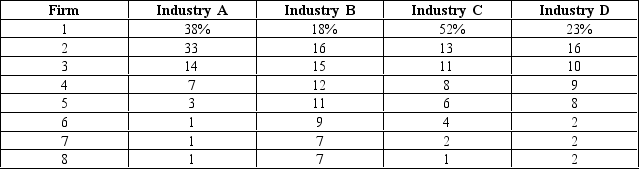 -Refer to Table 16-1. Which industry is the most competitive?
 (Multiple Choice)
4.9/5 (80)
(80) Two college students, Mary and Maggie, are spending spring break in Florida. Mary buys a cup of coffee each morning at the local Starbucks rather than from one of the local coffee shops. Maggie claims that Mary is irrational because she never purchases Starbucks coffee at home, and Starbucks coffee costs more than the coffee sold by local shops. An economist would most likely explain Mary's behavior by suggesting that
(Multiple Choice)
4.8/5 (82)
(82) In the study done by Lee Benham on advertising for eyeglasses,
(Multiple Choice)
4.9/5 (75)
(75) The fact that monopolistically competitive firms charge a price that exceeds marginal cost is responsible for the
(Multiple Choice)
4.8/5 (70)
(70) Figure 16-9
The figure is drawn for a monopolistically-competitive firm.  -Refer to Figure 16-9. Given this firm's cost curves, if the firm were perfectly competitive rather than monopolistically competitive, then in a long-run equilibrium it would produce
 (Multiple Choice)
4.8/5 (73)
(73) Suppose that monopolistically competitive firms in a certain market are earning positive profits. In the transition from this initial situation to a long-run equilibrium,
(Multiple Choice)
4.8/5 (73)
(73) Scenario 16-3
Peter operates an ice cream shop in the center of Fairfield. He sells several unusual flavors of organic, homemade ice cream so he has a monopoly over his own ice cream, though he competes with many other firms selling ice cream in Fairfield for the same customers. Peter's demand and cost values for sales per day are given in the table below. (Everyone who purchases Peter's ice cream buys a double scoop cone because it's so delicious.)
 -Refer to Scenario 16-3. What price should Peter charge to maximize his profits?
 (Short Answer)
4.9/5 (81)
(81) A monopolistically competitive firm's choice of output level is virtually identical to the choice made by
(Multiple Choice)
4.8/5 (68)
(68) A monopolistically competitive firm faces the following demand schedule for its product:  The firm has total fixed costs of $9 and a constant marginal cost of $3 per unit. The firm will maximize profit with
 (Multiple Choice)
4.9/5 (75)
(75) Professional organizations and producer groups have an incentive to
(Multiple Choice)
4.7/5 (73)
(73) 
Filters
- Essay(0)
- Multiple Choice(0)
- Short Answer(0)
- True False(0)
- Matching(0)