



 Chat with AI
Exam 16: Monopolistic Competition

Exam 1: Ten Principles of Economics439 Questions
Exam 2: Thinking Like an Economist617 Questions
Exam 3: Interdependence and the Gains From Trade527 Questions
Exam 4: The Market Forces of Supply and Demand698 Questions
Exam 5: Elasticity and Its Application595 Questions
Exam 6: Supply, Demand, and Government Policies644 Questions
Exam 7: Consumers, Producers, and the Efficiency of Markets549 Questions
Exam 8: Application: The Costs of Taxation511 Questions
Exam 9: Application: International Trade493 Questions
Exam 10: Externalities524 Questions
Exam 11: Public Goods and Common Resources433 Questions
Exam 12: The Design of the Tax System551 Questions
Exam 13: The Costs of Production420 Questions
Exam 14: Firms in Competitive Markets543 Questions
Exam 15: Monopoly637 Questions
Exam 16: Monopolistic Competition587 Questions
Exam 17: Oligopoly496 Questions
Exam 18: The Markets for the Factors of Production564 Questions
Exam 19: Earnings and Discrimination490 Questions
Exam 20: Income Inequality and Poverty457 Questions
Exam 21: The Theory of Consumer Choice440 Questions
Exam 22: Frontiers of Microeconomics441 Questions
Select questions type


Table 16-2
The following table shows the total output produced by the top six firms as well as the total industry output for each industry.
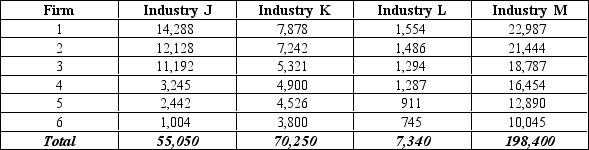 -Refer to Table 16-2. Which industry has the lowest concentration ratio?
 (Multiple Choice)
4.8/5  (77)
(77) When a new firm considers entering a market, it takes into account only the profit it would make. What are the two external effects that occur in the market that the firm does not consider?
(Essay)
4.8/5 (76)
(76) A new Mexican restaurant opens in the city of Manchester. The residents are happy about this new restaurant because they are experiencing what externality?
(Short Answer)
4.7/5 (70)
(70) Figure 16-11  -Refer to Figure 16-11. How much consumer surplus will be derived from the purchase of this product at the monopolistically competitive price?
 (Multiple Choice)
4.8/5 (85)
(85) The debate over the efficiency of markets in which products with brand names are sold
(Multiple Choice)
4.7/5 (67)
(67) The breakfast cereal industry, with its concentration ratio of 80%, would best be described as a(n)
(Multiple Choice)
4.9/5 (78)
(78) The government may not be able to improve the inefficiencies of a monopolistically competitive market.
(True/False)
4.9/5 (91)
(91) If advertising reduces a consumer's price sensitivity between identical goods, it is likely to
(Multiple Choice)
4.8/5 (87)
(87) Scenario 16-5
McDonald's restaurants has recently announced intentions to open a new restaurant in Smalltown, Indiana. Assume that the fast-food restaurant market in Smalltown is characterized by monopolistic competition.
-Refer to Scenario 16-5. As a result of the new McDonald's, existing fast food restaurants in Smalltown are likely to
(Multiple Choice)
4.9/5 (93)
(93) A monopolistically competitive firm chooses the quantity to produce where
(Multiple Choice)
4.9/5 (87)
(87) The commercial jetliner industry consisting of Boeing and Airbus would best be described as a (an)
(Multiple Choice)
4.7/5 (87)
(87) A new Mexican restaurant opens in the city of Manchester. The other restaurant owners are not happy about this new restaurant because they are experiencing what externality?
(Short Answer)
4.9/5 (76)
(76) Table 16-2
The following table shows the total output produced by the top six firms as well as the total industry output for each industry.
-Refer to Table 16-2. What is the concentration ratio for Industry J?
-Refer to Table 16-2. What is the concentration ratio for Industry J? (Multiple Choice)
4.8/5 (83)
(83) Which of the following correctly lists the products in order from most advertised to least advertised?
(Multiple Choice)
4.9/5 (82)
(82) If we observe a great deal more advertising for Mucinex, an over-the-counter drug, than for a Grainger drill press, we can infer that
(Multiple Choice)
4.7/5 (89)
(89) Figure 16-12  -Refer to Figure 16-12. If this firm minimized cost, how much output will it produce?
 (Short Answer)
4.8/5 (84)
(84) In the long run, monopolistically competitive firms produce where demand equals marginal cost.
(True/False)
4.8/5 (73)
(73) Defenders of advertising argue that it is not rational for profit-maximizing firms to spend money on advertising for products that have
(Multiple Choice)
5.0/5 (75)
(75) 
Filters
- Essay(0)
- Multiple Choice(0)
- Short Answer(0)
- True False(0)
- Matching(0)