



 Chat with AI
Exam 16: Monopolistic Competition

Exam 1: Ten Principles of Economics439 Questions
Exam 2: Thinking Like an Economist617 Questions
Exam 3: Interdependence and the Gains From Trade527 Questions
Exam 4: The Market Forces of Supply and Demand698 Questions
Exam 5: Elasticity and Its Application595 Questions
Exam 6: Supply, Demand, and Government Policies644 Questions
Exam 7: Consumers, Producers, and the Efficiency of Markets549 Questions
Exam 8: Application: The Costs of Taxation511 Questions
Exam 9: Application: International Trade493 Questions
Exam 10: Externalities524 Questions
Exam 11: Public Goods and Common Resources433 Questions
Exam 12: The Design of the Tax System551 Questions
Exam 13: The Costs of Production420 Questions
Exam 14: Firms in Competitive Markets543 Questions
Exam 15: Monopoly637 Questions
Exam 16: Monopolistic Competition587 Questions
Exam 17: Oligopoly496 Questions
Exam 18: The Markets for the Factors of Production564 Questions
Exam 19: Earnings and Discrimination490 Questions
Exam 20: Income Inequality and Poverty457 Questions
Exam 21: The Theory of Consumer Choice440 Questions
Exam 22: Frontiers of Microeconomics441 Questions
Select questions type


Which of the following is most likely sold in a monopolistically competitive market?
(Multiple Choice)
4.9/5  (87)
(87) Table 16-7
A monopolistically competitive firm faces the following demand schedule for its product. In addition, the firm has total fixed costs equal to 20.
 -Refer to Table 16-7. If the firm produces its profit-maximizing level of output and there is a constant marginal cost of $7 per unit, which of the following is correct?
 (Multiple Choice)
4.8/5 (84)
(84) Figure 16-3
This figure depicts a situation in a monopolistically competitive market.  -Refer to Figure 16-3. How much consumer surplus will be derived from the purchase of this product at the monopolistically competitive price?
 (Multiple Choice)
4.9/5 (81)
(81) When a monopolistically competitive firm raises its price,
(Multiple Choice)
5.0/5 (86)
(86) Monopolistic competition is considered inefficient because
(Multiple Choice)
4.9/5 (77)
(77) Scenario 16-9
Dean goes to the grocery store to buy chips and soda for a party. He purchases brand name products even though generic versions are available at lower prices. His friend John says he was irrational to spend more for a nearly identical product. His friend Martina agreed with Dean's decision to spend more for the brand name products.
-Refer to Scenario 16-9. If Dean bought the brand name because of advertising he saw for the product, a defender of advertising would say
(Essay)
4.8/5 (75)
(75) Figure 16-11  -Refer to Figure 16-11. The profit for this firm is
 (Multiple Choice)
4.8/5 (71)
(71) The deadweight loss that is associated with a monopolistically competitive market is a result of
(Multiple Choice)
4.8/5 (61)
(61) Under which of the following market structures would consumers likely pay the highest price for a product?
(Multiple Choice)
4.8/5 (76)
(76) Suppose that monopolistically competitive firms in a certain market are experiencing losses. In the transition from this initial situation to a long-run equilibrium,
(Multiple Choice)
4.9/5 (71)
(71) Figure 16-13 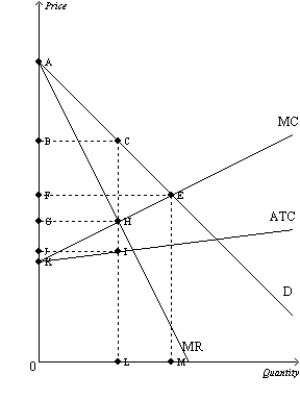 -Refer to Figure 16-13. Which of the following areas represents the profit for this profit maximizing monopolistically competitive firm?
 (Multiple Choice)
4.9/5 (72)
(72) If "too much choice" is a problem for consumers, it would occur in which market structure(s)?
(Multiple Choice)
4.9/5 (83)
(83) A monopolistically competitive firm faces the following demand curve for its product:  The firm has total fixed costs of $120 and a constant marginal cost of $12 per unit. We can conclude that
 (Multiple Choice)
4.8/5 (80)
(80) List five goods that are likely sold in a monopolistically competitive market.
(Essay)
4.9/5 (74)
(74) Figure 16-9
The figure is drawn for a monopolistically-competitive firm.  -Refer to Figure 16-9. The firm's maximum profit is
 (Multiple Choice)
4.8/5 (76)
(76) For a monopolistically competitive firm, at the profit-maximizing quantity of output,
(Multiple Choice)
4.7/5 (96)
(96) Empirical evidence suggests that advertising usually leads to an increase in the price for advertised products.
(True/False)
4.8/5 (71)
(71) 
Filters
- Essay(0)
- Multiple Choice(0)
- Short Answer(0)
- True False(0)
- Matching(0)