



 Chat with AI
Exam 14: Firms in Competitive Markets

Exam 1: Ten Principles of Economics439 Questions
Exam 2: Thinking Like an Economist617 Questions
Exam 3: Interdependence and the Gains From Trade527 Questions
Exam 4: The Market Forces of Supply and Demand698 Questions
Exam 5: Elasticity and Its Application595 Questions
Exam 6: Supply, Demand, and Government Policies644 Questions
Exam 7: Consumers, Producers, and the Efficiency of Markets549 Questions
Exam 8: Application: The Costs of Taxation511 Questions
Exam 9: Application: International Trade493 Questions
Exam 10: Externalities524 Questions
Exam 11: Public Goods and Common Resources433 Questions
Exam 12: The Design of the Tax System551 Questions
Exam 13: The Costs of Production420 Questions
Exam 14: Firms in Competitive Markets543 Questions
Exam 15: Monopoly637 Questions
Exam 16: Monopolistic Competition587 Questions
Exam 17: Oligopoly496 Questions
Exam 18: The Markets for the Factors of Production564 Questions
Exam 19: Earnings and Discrimination490 Questions
Exam 20: Income Inequality and Poverty457 Questions
Exam 21: The Theory of Consumer Choice440 Questions
Exam 22: Frontiers of Microeconomics441 Questions
Select questions type


Give two reasons why the long-run industry supply curve may slope upward. Use an example to demonstrate your reasons.
(Essay)
4.9/5  (89)
(89) In the long run, a firm will enter a competitive industry if
(Multiple Choice)
4.7/5 (73)
(73) When a profit-maximizing firm in a competitive market has zero economic profit, accounting profit
(Multiple Choice)
4.9/5 (72)
(72) A market might have an upward-sloping long-run supply curve if
(Multiple Choice)
4.8/5 (71)
(71) If a competitive firm is currently producing a level of output at which marginal cost exceeds marginal revenue, then
(Multiple Choice)
4.9/5 (80)
(80) In the short run, a market consists of 100 identical firms. The market price is $8, and the total cost to each firm of producing various levels of output is given in the table below. What will total quantity supplied be in the market? 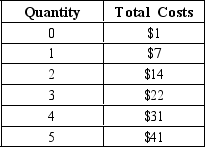
(Multiple Choice)
4.9/5 (87)
(87) Suppose that in a competitive market the equilibrium price is $2.50. What is marginal revenue for the last unit sold by the typical firm in this market?
(Multiple Choice)
4.7/5 (76)
(76) Table 14-12
Bill's Birdhouses
 -Refer to Table 14-12. What is Bill's economic profit at the profit-maximizing output level?
 (Multiple Choice)
4.9/5 (76)
(76) In the long run, a firm will exit a competitive industry if
(Multiple Choice)
4.9/5 (81)
(81) When a profit-maximizing firm in a competitive market experiences rising prices, it will respond with an increase in production.
(True/False)
4.8/5 (99)
(99) We can measure the profits earned by a firm in a competitive industry as
(Multiple Choice)
4.8/5 (83)
(83) In a perfectly competitive market, the process of entry and exit will end when (i) accounting profits are zero.
(ii) economic profits are zero.
(iii) price equals minimum marginal cost.
(iv) price equals minimum average total cost.
(Multiple Choice)
4.7/5 (83)
(83) In a perfectly competitive market, the horizontal sum of all the individual firms' supply curves is
(Multiple Choice)
4.9/5 (92)
(92) A firm's marginal cost has a minimum value of $4, its average variable cost has a minimum value of $6, and its average total cost has a minimum value of $7. Then the firm will shut down in the short run once the price of its product falls below
(Multiple Choice)
4.9/5 (86)
(86) Scenario 14-2
Assume a certain firm is producing Q = 1,000 units of output. At Q = 1,000, the firm's marginal cost equals $20 and its average total cost equals $25. The firm sells its output for $30 per unit.
-Refer to Scenario 14-2. To maximize its profit, the firm should
(Multiple Choice)
5.0/5 (83)
(83) Figure 14-7  -Refer to Figure 14-7. The firm will shut down in the short run if the price of the good is
 (Multiple Choice)
4.8/5 (70)
(70) Table 14-8
Suppose that a firm in a competitive market faces the following revenues and costs:
 -Refer to Table 14-8. In order to maximize profits, the firm will produce
 (Multiple Choice)
4.9/5 (77)
(77) 
Filters
- Essay(0)
- Multiple Choice(0)
- Short Answer(0)
- True False(0)
- Matching(0)