



 Chat with AI
Exam 14: Firms in Competitive Markets

Exam 1: Ten Principles of Economics439 Questions
Exam 2: Thinking Like an Economist617 Questions
Exam 3: Interdependence and the Gains From Trade527 Questions
Exam 4: The Market Forces of Supply and Demand698 Questions
Exam 5: Elasticity and Its Application595 Questions
Exam 6: Supply, Demand, and Government Policies644 Questions
Exam 7: Consumers, Producers, and the Efficiency of Markets549 Questions
Exam 8: Application: The Costs of Taxation511 Questions
Exam 9: Application: International Trade493 Questions
Exam 10: Externalities524 Questions
Exam 11: Public Goods and Common Resources433 Questions
Exam 12: The Design of the Tax System551 Questions
Exam 13: The Costs of Production420 Questions
Exam 14: Firms in Competitive Markets543 Questions
Exam 15: Monopoly637 Questions
Exam 16: Monopolistic Competition587 Questions
Exam 17: Oligopoly496 Questions
Exam 18: The Markets for the Factors of Production564 Questions
Exam 19: Earnings and Discrimination490 Questions
Exam 20: Income Inequality and Poverty457 Questions
Exam 21: The Theory of Consumer Choice440 Questions
Exam 22: Frontiers of Microeconomics441 Questions
Select questions type


Table 14-11
Suppose that a firm in a competitive market faces the following prices and costs:
 -Refer to Table 14-11. In order to maximize profits, the firm should stop producing after it makes the
 (Multiple Choice)
4.9/5  (78)
(78) In calculating accounting profit, accountants typically don't include
(Multiple Choice)
4.8/5 (75)
(75) Figure 14-14
 -Refer to Figure 14-14. If the market starts in equilibrium at point Z in panel (b), a decrease in demand will ultimately lead to
 (Multiple Choice)
4.8/5 (87)
(87) Which of the following firms is the closest to being a perfectly competitive firm?
(Multiple Choice)
4.7/5 (82)
(82) Figure 14-3
Suppose a firm operating in a competitive market has the following cost curves:  -Refer to Figure 14-3. If the market price is $10, what is the firm's total cost?
 (Multiple Choice)
4.9/5 (71)
(71) Table 14-5
The table represents a demand curve faced by a firm in a competitive market.
 -Refer to Table 14-5. For this firm, the average revenue when 14 units are produced and sold is
 (Multiple Choice)
4.8/5 (71)
(71) In the long run, a firm should exit the industry if its total costs exceed its total revenues.
(True/False)
4.9/5 (94)
(94) The short-run supply curve in a competitive market must be more elastic than the long-run supply curve.
(True/False)
4.8/5 (81)
(81) Which of the following is not a characteristic of a competitive market?
(Multiple Choice)
4.8/5 (82)
(82) If a profit-maximizing firm in a competitive market discovers that, at its current level of production, price is greater than marginal cost, it should
(Multiple Choice)
4.9/5 (88)
(88) Firms operating in competitive markets produce output levels where marginal revenue equals
(Multiple Choice)
4.9/5 (65)
(65) Robin owns a horse stables and riding academy and gives riding lessons for children at "pony camp." Her business operates in a competitive industry. Robin gives riding lessons to 20 children per month. Her monthly total revenue is $4,000. The marginal cost of pony camp is $200 per child. In order to maximize profits, Robin should
(Multiple Choice)
4.8/5 (91)
(91) Figure 14-9
In the figure below, panel (a) depicts the linear marginal cost of a firm in a competitive market, and panel (b) depicts the linear market supply curve for a market with a fixed number of identical firms.
 -Refer to Figure 14-9. If at a market price of $1.75, 52,500 units of output are supplied to this market, how many identical firms are participating in this market?
 (Multiple Choice)
4.7/5 (71)
(71) Scenario 14-2
Assume a certain firm is producing Q = 1,000 units of output. At Q = 1,000, the firm's marginal cost equals $20 and its average total cost equals $25. The firm sells its output for $30 per unit.
-Refer to Scenario 14-2. At Q = 999, the firm's profits equal
(Multiple Choice)
4.7/5 (84)
(84) Firms operating in perfectly competitive markets produce an output level where marginal revenue equals marginal cost.
(True/False)
4.7/5 (87)
(87) If all existing firms and all potential firms have the same cost curves, there are no inputs in limited quantities, and the market is characterized by free entry and exit, then the long-run market supply curve
(Multiple Choice)
4.9/5 (98)
(98) Figure 14-6
Suppose a firm operating in a competitive market has the following cost curves:  -Refer to Figure 14-6. Firms will be encouraged to enter this market for all prices that exceed
 (Multiple Choice)
4.8/5 (88)
(88) Figure 14-11 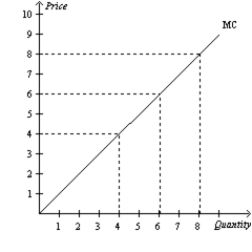 -Refer to Figure 14-11. The figure above is for a firm operating in a competitive industry. If there were four identical firms in the industry, which of the following price-quantity combinations would be on the market supply curve?
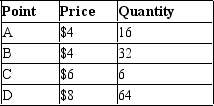
-Refer to Figure 14-11. The figure above is for a firm operating in a competitive industry. If there were four identical firms in the industry, which of the following price-quantity combinations would be on the market supply curve? (Multiple Choice)
4.8/5 (73)
(73) Table 14-1
 -Refer to Table 14-1. Over what range of output is marginal revenue declining?
 (Multiple Choice)
4.8/5 (84)
(84) 
Filters
- Essay(0)
- Multiple Choice(0)
- Short Answer(0)
- True False(0)
- Matching(0)