



 Chat with AI
Exam 14: Firms in Competitive Markets

Exam 1: Ten Principles of Economics439 Questions
Exam 2: Thinking Like an Economist617 Questions
Exam 3: Interdependence and the Gains From Trade527 Questions
Exam 4: The Market Forces of Supply and Demand698 Questions
Exam 5: Elasticity and Its Application595 Questions
Exam 6: Supply, Demand, and Government Policies644 Questions
Exam 7: Consumers, Producers, and the Efficiency of Markets549 Questions
Exam 8: Application: The Costs of Taxation511 Questions
Exam 9: Application: International Trade493 Questions
Exam 10: Externalities524 Questions
Exam 11: Public Goods and Common Resources433 Questions
Exam 12: The Design of the Tax System551 Questions
Exam 13: The Costs of Production420 Questions
Exam 14: Firms in Competitive Markets543 Questions
Exam 15: Monopoly637 Questions
Exam 16: Monopolistic Competition587 Questions
Exam 17: Oligopoly496 Questions
Exam 18: The Markets for the Factors of Production564 Questions
Exam 19: Earnings and Discrimination490 Questions
Exam 20: Income Inequality and Poverty457 Questions
Exam 21: The Theory of Consumer Choice440 Questions
Exam 22: Frontiers of Microeconomics441 Questions
Select questions type


Figure 14-13
Suppose a firm in a competitive industry has the following cost curves:  -Refer to Figure 14-13. If the price is $2 in the short run, what will happen in the long run?
 (Multiple Choice)
4.8/5  (66)
(66) For a particular competitive firm, the minimum value of average variable cost (AVC) is $12 and is reached when 200 units of output are produced. For the same firm, the minimum value of average total cost (ATC) is $15 and is reached when 230 units of output are produced. Which of the following statements is correct?
(Multiple Choice)
4.9/5 (79)
(79) In a competitive market the price is $8. A typical firm in the market has ATC = $6, AVC = $5, and MC = $8. How much economic profit is the firm earning in the short run?
(Multiple Choice)
4.9/5 (73)
(73) Scenario 14-2
Assume a certain firm is producing Q = 1,000 units of output. At Q = 1,000, the firm's marginal cost equals $20 and its average total cost equals $25. The firm sells its output for $30 per unit.
-Refer to Scenario 14-2. At Q = 999, the firm's total costs equal
(Multiple Choice)
4.9/5 (67)
(67) Table 14-4
The table represents a demand curve faced by a firm in a competitive market.
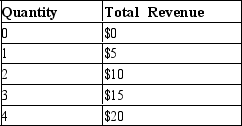 -Refer to Table 14-4. For this firm, the marginal revenue is
 (Multiple Choice)
4.9/5 (87)
(87) Figure 14-4
Suppose a firm operating in a competitive market has the following cost curves:  -Refer to Figure 14-4. When price rises from P2 to P3, the firm finds that
 (Multiple Choice)
4.8/5 (78)
(78) In the short run, a firm should exit the industry if its marginal cost exceeds its marginal revenue.
(True/False)
4.8/5 (80)
(80) The manager of a firm operating in a competitive market can ignore sunk costs when making business decisions.
(True/False)
4.7/5 (75)
(75) A competitive market is in long-run equilibrium. If demand increases, we can be certain that price will
(Multiple Choice)
4.7/5 (81)
(81) Figure 14-2
Suppose a firm operating in a competitive market has the following cost curves:  -Refer to Figure 14-2. If the market price is Pd, in the short run the firm will earn
 (Multiple Choice)
4.9/5 (77)
(77) Scenario 14-4
Victor is the recipient of $1 million from a lawsuit. Victor decides to use the money to purchase a small business in Florida. His business operates in a perfectly competitive industry. If Victor would have invested the $1 million in a risk-free bond fund, he could have earned $100,000 each year. After he bought the small business, Victor quit his job as a market analyst with Research, Inc., where he used to earn $75,000 per year.
-Refer to Scenario 14-4. What is Victor's opportunity costs of operating his new business?
(Multiple Choice)
4.9/5 (84)
(84) Which of the following is not a characteristic of a perfectly competitive market?
(Multiple Choice)
4.8/5 (86)
(86) Figure 14-1
Suppose that a firm in a competitive market has the following cost curves:  -Refer to Figure 14-1. The firm's shortrun supply curve is its marginal cost curve above
 (Multiple Choice)
4.9/5 (89)
(89) Jose's restaurant operates in a perfectly competitive market. At the point where marginal cost equals marginal revenue, ATC = $20, AVC = $15, and the price per unit is $10. In this situation,
(Multiple Choice)
4.8/5 (81)
(81) A firm will shut down in the short run if, for all positive levels of output,
(Multiple Choice)
4.9/5 (83)
(83) The supply curve of a firm in a competitive market is the average variable cost curve above the minimum of marginal cost.
(True/False)
4.9/5 (91)
(91) A profit-maximizing firm will shut down in the short run when
(Multiple Choice)
4.9/5 (83)
(83) Suppose that firms in a competitive industry are earning positive economic profits. All else equal, in the long run, we would expect the number of firms in the industry to
(Multiple Choice)
4.8/5 (88)
(88) The long-run equilibrium in a competitive market characterized by firms with identical costs is generally characterized by firms operating at efficient scale.
(True/False)
4.8/5 (77)
(77) 
Filters
- Essay(0)
- Multiple Choice(0)
- Short Answer(0)
- True False(0)
- Matching(0)