



 Chat with AI
Exam 14: Firms in Competitive Markets

Exam 1: Ten Principles of Economics439 Questions
Exam 2: Thinking Like an Economist617 Questions
Exam 3: Interdependence and the Gains From Trade527 Questions
Exam 4: The Market Forces of Supply and Demand698 Questions
Exam 5: Elasticity and Its Application595 Questions
Exam 6: Supply, Demand, and Government Policies644 Questions
Exam 7: Consumers, Producers, and the Efficiency of Markets549 Questions
Exam 8: Application: The Costs of Taxation511 Questions
Exam 9: Application: International Trade493 Questions
Exam 10: Externalities524 Questions
Exam 11: Public Goods and Common Resources433 Questions
Exam 12: The Design of the Tax System551 Questions
Exam 13: The Costs of Production420 Questions
Exam 14: Firms in Competitive Markets543 Questions
Exam 15: Monopoly637 Questions
Exam 16: Monopolistic Competition587 Questions
Exam 17: Oligopoly496 Questions
Exam 18: The Markets for the Factors of Production564 Questions
Exam 19: Earnings and Discrimination490 Questions
Exam 20: Income Inequality and Poverty457 Questions
Exam 21: The Theory of Consumer Choice440 Questions
Exam 22: Frontiers of Microeconomics441 Questions
Select questions type


News reports from the western United States occasionally report incidents of cattle ranchers slaughtering a large number of newborn calves and burying them in mass graves rather than transporting them to markets. Assuming that this is rational behavior by profit-maximizing "firms," explain what economic factors may influence such behavior.
(Essay)
4.7/5  (73)
(73) Which of the following characteristics of competitive markets is necessary for firms to be price takers? (i) There are many sellers.
(ii) Firms can freely enter or exit the market.
(iii) Goods offered for sale are largely the same.
(Multiple Choice)
4.9/5 (87)
(87) Scenario 14-4
The information below applies to a competitive firm that sells its output for $40 per unit.
-When the firm produces and sells 150 units of output, its average total cost is $24.50.
-When the firm produces and sells 151 units of output, its average total cost is $24.55.
-Refer to Scenario 14-4. When the firm produces 150 units of output, its profit is
(Multiple Choice)
4.9/5 (69)
(69) Table 14-14
The following table presents cost and revenue information for Bob's bakery production and sales.
 -Refer to Table 14-14. What is the marginal revenue of the 4th unit?
 (Multiple Choice)
4.9/5 (88)
(88) Susan quit her job as a teacher, which paid her $36,000 per year, in order to start her own catering business. She spent $12,000 of her savings, which had been earning 10 percent interest per year, on equipment for her business. She also borrowed $12,000 from her bank at 10 percent interest, which she also spent on equipment. For the past several months she has spent $1,000 per month on ingredients and other variable costs. Also for the past several months she has earned $4,500 in monthly revenue. In the short run, Susan should
(Multiple Choice)
4.8/5 (79)
(79) Suppose a firm in a competitive market earned $1,000 in total revenue and had a marginal revenue of $10 for the last unit produced and sold. What is the average revenue per unit, and how many units were sold?
(Multiple Choice)
4.9/5 (92)
(92) In the long run, all of a firm's costs are variable. In this case the exit criterion for a profit-maximizing firm is to shut down if
(Multiple Choice)
4.8/5 (69)
(69) Why does a firm in a competitive industry charge the market price?
(Multiple Choice)
4.7/5 (85)
(85) Suppose that a firm operating in perfectly competitive market sells 300 units of output at a price of $3 each. Which of the following statements is correct? (i) Marginal revenue equals $3.
(ii) Average revenue equals $100.
(iii) Total revenue equals $300.
(Multiple Choice)
4.8/5 (77)
(77) Table 14-12
Bill's Birdhouses
 -Refer to Table 14-12. What is the marginal cost of the 5th unit?
 (Multiple Choice)
4.9/5 (77)
(77) If identical firms that remain in a competitive market over the long run make zero economic profit, why do these firms choose to remain in the market?
(Essay)
5.0/5 (91)
(91) Mrs. Smith is operating a firm in a competitive market. The market price is $6.50. At her profit-maximizing level of output, her average total cost of production is $7.00, and her average variable cost of production is $6.00. Which of the following statements about Mrs. Smith's firm is correct?
(Multiple Choice)
4.9/5 (81)
(81) Suppose a firm in a competitive market produces and sells 8 units of output and has a marginal revenue of $8. What would be the firm's marginal revenue if it instead produced and sold 4 units of output?
(Multiple Choice)
5.0/5 (88)
(88) Figure 14-14
 -Refer to Figure 14-14. Assume that the market starts in equilibrium at point W in panel (b) and that panel (a) illustrates the cost curves facing individual firms. Suppose that demand increases from D0 to D1. Which of the following statements is correct?
 (Multiple Choice)
4.8/5 (90)
(90) For a particular competitive firm, the minimum value of average variable cost (AVC) is $12 and is reached when 200 units of output are produced. For the same firm, the minimum value of average total cost (ATC) is $15 and is reached when 230 units of output are produced. Which of the following statements is correct?
(Multiple Choice)
4.9/5 (96)
(96) List and describe the characteristics of a perfectly competitive market.
(Essay)
4.9/5 (69)
(69) In order to maximize profits in the short run, a firm should produce where
(Multiple Choice)
4.9/5 (83)
(83) Table 14-6
The following table presents cost and revenue information for a firm operating in a competitive industry.
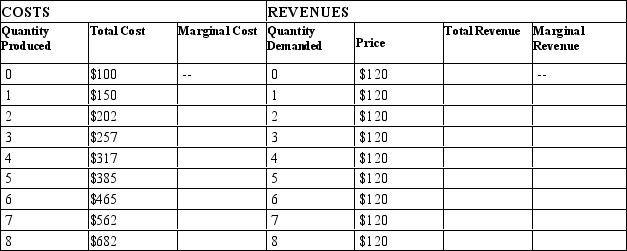 -Refer to Table 14-6. What is the total revenue from selling 7 units?
 (Multiple Choice)
4.9/5 (79)
(79) When an individual firm in a competitive market increases its production, it is likely that the market price will fall.
(True/False)
4.8/5 (82)
(82) 
Filters
- Essay(0)
- Multiple Choice(0)
- Short Answer(0)
- True False(0)
- Matching(0)