



 Chat with AI
Exam 14: Firms in Competitive Markets

Exam 1: Ten Principles of Economics439 Questions
Exam 2: Thinking Like an Economist617 Questions
Exam 3: Interdependence and the Gains From Trade527 Questions
Exam 4: The Market Forces of Supply and Demand698 Questions
Exam 5: Elasticity and Its Application595 Questions
Exam 6: Supply, Demand, and Government Policies644 Questions
Exam 7: Consumers, Producers, and the Efficiency of Markets549 Questions
Exam 8: Application: The Costs of Taxation511 Questions
Exam 9: Application: International Trade493 Questions
Exam 10: Externalities524 Questions
Exam 11: Public Goods and Common Resources433 Questions
Exam 12: The Design of the Tax System551 Questions
Exam 13: The Costs of Production420 Questions
Exam 14: Firms in Competitive Markets543 Questions
Exam 15: Monopoly637 Questions
Exam 16: Monopolistic Competition587 Questions
Exam 17: Oligopoly496 Questions
Exam 18: The Markets for the Factors of Production564 Questions
Exam 19: Earnings and Discrimination490 Questions
Exam 20: Income Inequality and Poverty457 Questions
Exam 21: The Theory of Consumer Choice440 Questions
Exam 22: Frontiers of Microeconomics441 Questions
Select questions type


Suppose a firm in a competitive market produces and sells 150 units of output and earns $1,800 in total revenue from the sales. If the firm increases its output to 200 units, the average revenue of the 200th unit will be
(Multiple Choice)
4.9/5  (90)
(90) In a competitive market the current price is $5. The typical firm in the market has ATC = $5.50 and AVC = $4.50.
(Multiple Choice)
4.8/5 (75)
(75) Use a graph to demonstrate the circumstances that would prevail in a perfectly competitive market where firms are experiencing economic losses. Identify costs, revenue, and the economic losses on your graph. Using your graph, determine whether an individual firm will shut down in the short run, or choose to remain in the market. Explain your answer.
(Essay)
4.7/5 (83)
(83) Land of Many Lakes (LML) sells butter to a broker in Albert Lea, Minnesota. Because the market for butter is generally considered to be competitive, LML does not
(Multiple Choice)
4.8/5 (76)
(76) Figure 14-13
Suppose a firm in a competitive industry has the following cost curves:  -Refer to Figure 14-13. If the price is $6 in the short run, what will happen in the long run?
 (Multiple Choice)
5.0/5 (66)
(66) Table 14-14
The following table presents cost and revenue information for Bob's bakery production and sales.
 -Refer to Table 14-14. Suppose that due to a decrease in the market demand for bread the market price of bread drops to $2.75. At this new price, if Bob produces and sells the profit-maximizing quantity, how much profit will he earn?
 (Multiple Choice)
4.9/5 (73)
(73) Figure 14-3
Suppose a firm operating in a competitive market has the following cost curves:  -Refer to Figure 14-3. If the market price is $10, what is the firm's shortrun economic profit?
 (Multiple Choice)
4.9/5 (81)
(81) The competitive firm's short-run supply curve is that portion of the
(Multiple Choice)
4.9/5 (87)
(87) In the short run, there are 500 identical firms in a competitive market. The firms do not use any resources that are available in limited quantities, and each of them has the following cost structure: 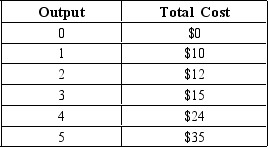 Which of the following is a point on the long-run supply curve?
 (Multiple Choice)
4.9/5 (80)
(80) A long-run supply curve is flatter than a short-run supply curve because
(Multiple Choice)
4.9/5 (73)
(73) A profit-maximizing firm in a competitive market will earn zero accounting profits in the long run.
(True/False)
4.7/5 (77)
(77) If occupational safety laws were changed so that firms no longer had to take expensive steps to meet regulatory requirements, we would expect that
(Multiple Choice)
4.8/5 (65)
(65) Scenario 14-1
Assume a certain firm in a competitive market is producing Q = 1,000 units of output. At Q = 1,000, the firm's marginal cost equals $15 and its average total cost equals $11. The firm sells its output for $12 per unit.
-Refer to Scenario 14-1. At Q = 999, the firm's profits equal
(Multiple Choice)
4.9/5 (67)
(67) When a certain competitive firm produces and sells 100 units of output, marginal revenue is $80. When the same firm produces and sells 200 units of output, what is average revenue?
(Multiple Choice)
5.0/5 (75)
(75) In the long run, a competitive market with 1,000 identical firms will experience an equilibrium price equal to the minimum of each firm's average total cost.
(True/False)
4.9/5 (78)
(78) Table 14-9
Suppose that a firm in a competitive market faces the following revenues and costs:
 -Refer to Table 14-9. If the firm's marginal cost is $5, it should
 (Multiple Choice)
4.8/5 (76)
(76) Figure 14-10
In the figure below, panel (a) depicts the linear marginal cost of a firm in a competitive market, and panel (b) depicts the linear market supply curve for a market with a fixed number of identical firms.
 -Refer to Figure 14-10. If there are 500 identical firms in this market, what is the value of Q2?
 (Multiple Choice)
5.0/5 (66)
(66) Figure 14-6
Suppose a firm operating in a competitive market has the following cost curves:  -Refer to Figure 14-6. Firms will earn positive profits in the short run if the market price
 (Multiple Choice)
4.9/5 (94)
(94) Table 14-4
The table represents a demand curve faced by a firm in a competitive market.
 -Refer to Table 14-4. For this firm, the price is
 (Multiple Choice)
4.8/5 (71)
(71) When new entrants into a competitive market have higher costs than existing firms,
(Multiple Choice)
4.9/5 (83)
(83) 
Filters
- Essay(0)
- Multiple Choice(0)
- Short Answer(0)
- True False(0)
- Matching(0)