



 Chat with AI
Exam 17: Oligopoly

Exam 1: Ten Principles of Economics439 Questions
Exam 2: Thinking Like an Economist617 Questions
Exam 3: Interdependence and the Gains From Trade527 Questions
Exam 4: The Market Forces of Supply and Demand698 Questions
Exam 5: Elasticity and Its Application595 Questions
Exam 6: Supply, Demand, and Government Policies644 Questions
Exam 7: Consumers, Producers, and the Efficiency of Markets549 Questions
Exam 8: Application: The Costs of Taxation511 Questions
Exam 9: Application: International Trade493 Questions
Exam 10: Externalities524 Questions
Exam 11: Public Goods and Common Resources433 Questions
Exam 12: The Design of the Tax System551 Questions
Exam 13: The Costs of Production420 Questions
Exam 14: Firms in Competitive Markets543 Questions
Exam 15: Monopoly637 Questions
Exam 16: Monopolistic Competition587 Questions
Exam 17: Oligopoly496 Questions
Exam 18: The Markets for the Factors of Production564 Questions
Exam 19: Earnings and Discrimination490 Questions
Exam 20: Income Inequality and Poverty457 Questions
Exam 21: The Theory of Consumer Choice440 Questions
Exam 22: Frontiers of Microeconomics441 Questions
Select questions type


Game theory is necessary to understand which kinds of markets? (i) perfectly competitive
(ii) monopolistically competitive
(iii) oligopoly
(iv) duopoly
(v) monopoly
(Multiple Choice)
4.8/5  (80)
(80) Table 17-1
Imagine a small town in which only two residents, Rochelle and Alec, own wells that produce safe drinking water. Each week Rochelle and Alec work together to decide how many gallons of water to pump. They bring the water to town and sell it at whatever price the market will bear. To keep things simple, suppose that Rochelle and Alec can pump as much water as they want without cost so that the marginal cost of water equals zero. The weekly town demand schedule and total revenue schedule for water is shown in the table below:
 21.
-Refer to Table 17-1. If Rochelle and Alec operate as a profit-maximizing monopoly in the market for water, what price will they charge?
21.
-Refer to Table 17-1. If Rochelle and Alec operate as a profit-maximizing monopoly in the market for water, what price will they charge? (Multiple Choice)
4.8/5 (89)
(89) In which of the following games is it clearly the case that the cooperative outcome of the game is good for the two players and bad for society?
(Multiple Choice)
4.7/5 (68)
(68) The Sherman Antitrust Act prohibits price-fixing in the sense that
(Multiple Choice)
4.7/5 (85)
(85) Which of the following is correct? When oligopolies collude
(Multiple Choice)
4.9/5 (73)
(73) All examples of the prisoner's dilemma game are characterized by one and only one Nash equilibrium.
(True/False)
4.8/5 (93)
(93) Table 17-17
This table shows a game played between two firms, Firm A and Firm B. In this game each firm must decide how much output (Q) to produce: 2 units or 3 units. The profit for each firm is given in the table as (Profit for Firm A, Profit for Firm B).
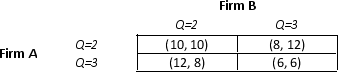 -Refer to Table 17-17. Which of the following outcomes represent the Nash equilibrium in this game?
 (Multiple Choice)
4.8/5 (74)
(74) Table 17-22
Brian and Matt own the only two bicycle repair shops in town. Each must choose between a low price for repair work and a high price. The annual economic profit from each strategy is indicated in the table. The profits are shown as (Matt, Brian) in each cell.
 -Refer to Table 17-22. Which of the following statements is correct?
 (Multiple Choice)
4.8/5 (75)
(75) Which of the following statements about oligopolies is not correct?
(Multiple Choice)
4.8/5 (73)
(73) From society's standpoint, cooperation among oligopolists is
(Multiple Choice)
4.8/5 (93)
(93) Reaching and enforcing an agreement between members of a cartel becomes more difficult as the size of the group __________.
(Short Answer)
4.9/5 (74)
(74) Figure 17-5. Two companies, ABC and QRS, are sellers in the same market. Each company decides whether to charge a high price or a low price. In the figure, the dollar amounts are payoffs and they represent annual profits for the two companies.  -Refer to Figure 17-5. Suppose we observe that the outcome of the game is one in which each company earns a profit of $10 million. This outcome
 (Multiple Choice)
4.8/5 (79)
(79) Scenario 17-4.
Consider two cigarette companies, PM Inc. and Brown Inc. If neither company advertises, the two companies split the market and earn $50 million each. If they both advertise, they again split the market, but profits are lower by $10 million since each company must bear the cost of advertising. Yet if one company advertises while the other does not, the one that advertises attracts customers from the other. In this case, the company that advertises earns $60 million while the company that does not advertise earns only $30 million.
-Refer to Scenario 17-4. In 1971, Congress passed a law that banned cigarette advertising on television. If cigarette companies are profit maximizers, it is likely that
(Multiple Choice)
4.9/5 (84)
(84) Figure 17-3. Hector and Bart are roommates. On a particular day, their apartment needs to be cleaned. Each person has to decide whether to take part in cleaning. At the end of the day, either the apartment will be completely clean (if one or both roommates take part in cleaning), or it will remain dirty (if neither roommate cleans). With happiness measured on a scale of 1 (very unhappy) to 10 (very happy), the possible outcomes are as follows:
 -Refer to Figure 17-3. If this game is played only once, then the most likely outcome is that
 (Multiple Choice)
4.8/5 (85)
(85) Scenario 17-4.
Consider two cigarette companies, PM Inc. and Brown Inc. If neither company advertises, the two companies split the market and earn $50 million each. If they both advertise, they again split the market, but profits are lower by $10 million since each company must bear the cost of advertising. Yet if one company advertises while the other does not, the one that advertises attracts customers from the other. In this case, the company that advertises earns $60 million while the company that does not advertise earns only $30 million.
-Refer to Scenario 17-4. What will these two companies do if they behave as individual profit maximizers?
(Multiple Choice)
4.8/5 (78)
(78) Scenario 17-6
Assume that a local telecommunications company sells high speed internet access and cable television. The company's only two customers are Taylor and Tim. Taylor is willing to pay $50 per month for high speed internet access and $50 per month for cable television. Tim is willing to pay only $20 per month for high speed internet access, but is willing to pay $70 per month for cable television. Assume that the telecommunications company can provide each of these products at zero marginal cost.
-Refer to Scenario 17-6. If the telecommunications company is unable to use tying, what is the profit-maximizing price to charge for cable television?
(Short Answer)
4.9/5 (78)
(78) 
Filters
- Essay(0)
- Multiple Choice(0)
- Short Answer(0)
- True False(0)
- Matching(0)