



 Chat with AI
Exam 17: Oligopoly

Exam 1: Ten Principles of Economics439 Questions
Exam 2: Thinking Like an Economist617 Questions
Exam 3: Interdependence and the Gains From Trade527 Questions
Exam 4: The Market Forces of Supply and Demand698 Questions
Exam 5: Elasticity and Its Application595 Questions
Exam 6: Supply, Demand, and Government Policies644 Questions
Exam 7: Consumers, Producers, and the Efficiency of Markets549 Questions
Exam 8: Application: The Costs of Taxation511 Questions
Exam 9: Application: International Trade493 Questions
Exam 10: Externalities524 Questions
Exam 11: Public Goods and Common Resources433 Questions
Exam 12: The Design of the Tax System551 Questions
Exam 13: The Costs of Production420 Questions
Exam 14: Firms in Competitive Markets543 Questions
Exam 15: Monopoly637 Questions
Exam 16: Monopolistic Competition587 Questions
Exam 17: Oligopoly496 Questions
Exam 18: The Markets for the Factors of Production564 Questions
Exam 19: Earnings and Discrimination490 Questions
Exam 20: Income Inequality and Poverty457 Questions
Exam 21: The Theory of Consumer Choice440 Questions
Exam 22: Frontiers of Microeconomics441 Questions
Select questions type


Table 17-19
Consider a small town that has two grocery stores from which residents can choose to buy a loaf of bread. The store owners each must make a decision to set a high bread price or a low bread price. The payoff table, showing profit per week, is provided below. The profit in each cell is shown as (Store 1, Store 2).
 -Refer to Table 17-19. What is grocery store 2's dominant strategy?
 (Multiple Choice)
4.9/5  (82)
(82) OPEC (Organization of Petroleum Exporting Countries) is an example of a cartel in the output market for petroleum. Major League Baseball could be considered a cartel in the market for baseball players.
(Short Answer)
4.9/5 (80)
(80) Table 17-6
Imagine a small town in which only two residents, Kunal and Naj, own wells that produce safe drinking water. Each week Kunal and Naj work together to decide how many gallons of water to pump, to bring the water to town, and to sell it at whatever price the market will bear. Assume Kunal and Naj can pump as much water as they want without cost so that the marginal cost of water equals zero.
The weekly town demand schedule and total revenue schedule for water are shown in the table below.
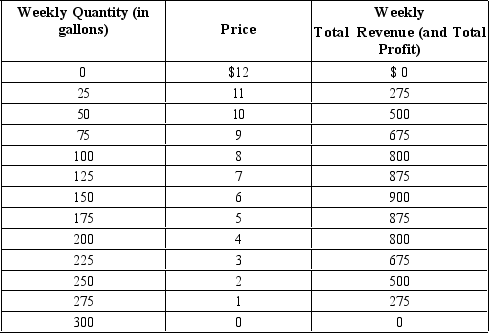 -Refer to Table 17-6. Since Kunal and Naj operate as a profit-maximizing monopoly in the market for water, what price will they charge for water?
 (Multiple Choice)
4.8/5 (79)
(79) An oligopoly would tend to restrict output and drive up price if
(Multiple Choice)
4.9/5 (90)
(90) Which of the following is necessarily a problem with antitrust laws?
(Multiple Choice)
4.8/5 (74)
(74) The notion of a tit-for-tat strategy applies to a prisoners' dilemma game that is played repeatedly, but it does not apply if the game is played only once.
(True/False)
4.9/5 (74)
(74) The argument that consumers will not be willing to pay any more for two items sold as one than they would for the two items sold separately is used to justify the legality of which of the following?
(Multiple Choice)
4.9/5 (78)
(78) To function as a monopoly, OPEC and other cartels rely on among members.
(Short Answer)
4.8/5 (72)
(72) Scenario 17-2.
Imagine that two oil companies, BQ and Exxoff, own adjacent oil fields. Under the fields is a common pool of oil worth $144 million. Drilling a well to recover oil costs $5 million per well. If each company drills one well, each will get half of the oil and earn a $67 million profit ($72 million in revenue - $5 million in costs). Assume that having X percent of the total wells means that a company will collect X percent of the total revenue.
-Refer to Scenario 17-2. If BQ and Exxoff are able to successfully collude to maximize their joint profits, BQ will earn
(Multiple Choice)
4.9/5 (76)
(76) One way that public policy encourages cooperation among oligopolists is through antitrust law.
(True/False)
4.9/5 (77)
(77) Table 17-34
Suppose that two oil companies - BP and Exxon - own adjacent natural gas fields. The profits that each firm earns depends on both the number of wells it drills and the number of wells drilled by the other firm. The table below lists each firm's individual profits:
Exxon
Drill one well Drill two wells
 -Refer to Table 17-34. Does BP have a dominant strategy? If so, describe it.
 (Essay)
4.8/5 (86)
(86) Scenario 17-2.
Imagine that two oil companies, BQ and Exxoff, own adjacent oil fields. Under the fields is a common pool of oil worth $144 million. Drilling a well to recover oil costs $5 million per well. If each company drills one well, each will get half of the oil and earn a $67 million profit ($72 million in revenue - $5 million in costs). Assume that having X percent of the total wells means that a company will collect X percent of the total revenue.
-Refer to Scenario 17-2. If BQ and Exxoff are able to successfully collude to maximize their joint profits, BQ will
(Multiple Choice)
4.9/5 (91)
(91) The Clayton Act of 1914 allows those harmed by illegal arrangements to restrain trade to
(Multiple Choice)
4.8/5 (79)
(79) The essence of an oligopolistic market is that there are only a few sellers.
(True/False)
4.9/5 (73)
(73) Suppose the market for home-grown peppers in the town of Smallville is comprised of two farmers. Explain why they might try to collude.
(Essay)
5.0/5 (93)
(93) Table 17-29
Suppose that two firms, Wild Willy's Wonderdrink (Firm W) and Hyper Hank's Hydration (Firm H), comprise the market for energy drinks. Each firm determines that it could lower its costs and increase its profits if both firms reduced their advertising budgets. But for the plan to work, each firm must agree to refrain from advertising. Each firm believes that advertising works by increasing the demand for the firm's energy drinks, but each firm also believes that if neither firm advertises, the cost savings will outweigh the lost sales. The table below lists each firm's individual profits:
Firm W
Breaks agreement Maintains agreement
and advertises and does not advertise
 -Refer to Table 17-29. Which of the following statement(s) correctly characterizes the outcome of this game?
 (Multiple Choice)
4.8/5 (80)
(80) 
Filters
- Essay(0)
- Multiple Choice(0)
- Short Answer(0)
- True False(0)
- Matching(0)