



 Chat with AI
Exam 17: Oligopoly

Exam 1: Ten Principles of Economics439 Questions
Exam 2: Thinking Like an Economist617 Questions
Exam 3: Interdependence and the Gains From Trade527 Questions
Exam 4: The Market Forces of Supply and Demand698 Questions
Exam 5: Elasticity and Its Application595 Questions
Exam 6: Supply, Demand, and Government Policies644 Questions
Exam 7: Consumers, Producers, and the Efficiency of Markets549 Questions
Exam 8: Application: The Costs of Taxation511 Questions
Exam 9: Application: International Trade493 Questions
Exam 10: Externalities524 Questions
Exam 11: Public Goods and Common Resources433 Questions
Exam 12: The Design of the Tax System551 Questions
Exam 13: The Costs of Production420 Questions
Exam 14: Firms in Competitive Markets543 Questions
Exam 15: Monopoly637 Questions
Exam 16: Monopolistic Competition587 Questions
Exam 17: Oligopoly496 Questions
Exam 18: The Markets for the Factors of Production564 Questions
Exam 19: Earnings and Discrimination490 Questions
Exam 20: Income Inequality and Poverty457 Questions
Exam 21: The Theory of Consumer Choice440 Questions
Exam 22: Frontiers of Microeconomics441 Questions
Select questions type


Table 17-3
Imagine a small town in a remote area where only two residents, Maria and Miguel, own dairies that produce milk that is safe to drink. Each week Maria and Miguel work together to decide how many gallons of milk to produce. They bring milk to town and sell it at whatever price the market will bear. To keep things simple, suppose that Maria and Miguel can produce as much milk as they want without cost so that the marginal cost is zero. The weekly town demand schedule and total revenue schedule for milk is shown in the table below:
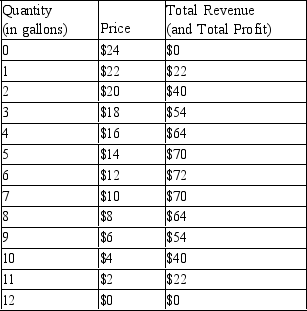 -Refer to Table 17-3. If this market for milk were perfectly competitive instead of monopolistic, what would be the price for milk?
 (Multiple Choice)
4.8/5  (81)
(81) Table 17-12
The table shows the town of Driveaway's demand schedule for gasoline. Assume the town's gasoline seller(s) incurs a cost of $2 for each gallon sold, with no fixed cost.
 -Refer to Table 17-12. If there are exactly two sellers of gasoline in Driveaway and if they collude, then which of the following outcomes is most likely?
 (Multiple Choice)
4.7/5 (91)
(91) The Clayton Act of 1914 allowed a person who successfully sued a company for damages caused by an illegal arrangement to restrain trade to recover damages.
(Short Answer)
4.9/5 (91)
(91) Individual profit earned by Dave, the oligopolist, depends on which of the following? (i) The quantity of output that Dave produces
(ii) The quantities of output that the other firms in the market produce
(iii) The extent of collusion between Dave and the other firms in the market
(Multiple Choice)
4.7/5 (79)
(79) Table 17-11
Only two firms, ABC and XYZ, sell a particular product. The table below shows the demand curve for their product. Each firm has the same constant marginal cost of $8 and zero fixed cost.
 -Refer to Table 17-11. If ABC and XYZ operate to jointly maximize profits and agree to share the profit equally, then how much profit will each of them earn?
 (Multiple Choice)
4.8/5 (79)
(79) Figure 17-1  -Refer to Figure 17-1. Suppose this market is served by two firms who each face the marginal cost curve shown in the diagram and have zero fixed cost. The marginal revenue curve that a monopolist would face in this market is also shown. If the firms are able to collude successfully, each firm should earn a profit equal to
 (Multiple Choice)
4.9/5 (68)
(68) We know that people tend to overuse common resources. This problem can be viewed as an example of
(Multiple Choice)
4.9/5 (76)
(76) Scenario 17-5
Assume that a local restaurant sells two items, salads and steaks. The restaurant's only two customers on a particular day are Mr. Carnivore and Ms. Leafygreens. Mr. Carnivore is willing to pay $20 for a steak and $7 for a salad. Ms. Leafygreens is willing to pay only $8 for a steak, but is willing to pay $12 for a salad. Assume that the restaurant can provide each of these items at zero marginal cost.
-Refer to Scenario 17-5. If the restaurant is able to use tying to price salads and steaks, what is the profit- maximizing price to charge for the "tied" good?
(Multiple Choice)
4.9/5 (86)
(86) Because each oligopolist cares about its own profit rather than the collective profit of all the oligopolists together,
(Multiple Choice)
4.9/5 (81)
(81) Table 17-18
This table shows a game played between two firms, Firm A and Firm B. In this game each firm must decide how much output (Q) to produce: 10 units or 12 units. The profit for each firm is given in the table as (Profit for Firm A, Profit for Firm B).
 -Refer to Table 17-18. If these two firms agree to cooperate to maximize their joint profit, the outcome of the game will be
 (Multiple Choice)
4.8/5 (89)
(89) Table 17-33
Suppose that Robert and Howard own the only two movie studios in California. Each producer must choose between a low budget and a high budget strategy for his next film. The economic profit from each strategy is indicated in the table below:
Howard
Low budget High budget
 -Refer to Table 17-33. Does Robert have a dominant strategy? If so, describe it.
 (Essay)
4.9/5 (73)
(73) The theory of oligopoly provides another reason that free trade can benefit all countries because
(Multiple Choice)
4.8/5 (83)
(83) Table 17-27
Each year the United States considers renewal of Most Favored Nation (MFN) trading status with Farland (a mythical nation). Historically, legislators have made threats of not renewing MFN status because of human rights abuses in Farland. The non-renewal of MFN trading status is likely to involve some retaliatory measures by Farland. The payoff table below shows the potential economic gains associated with a game in which Farland may impose trade sanctions against U.S. firms and the United States may not renew MFN status with Farland. The table contains the dollar value of all trade-flow benefits to the United States and Farland.
 -Refer to Table 17-27. If both countries follow a dominant strategy, the value of trade flow benefits for the United States will be
 (Multiple Choice)
4.8/5 (72)
(72) Suppose that Barack and Michelle are duopolists. Barack is producing 300 units of output, and Michelle is producing 400 units of output. When Michelle produces 400 units, Barack maximizes profit by producing 300 units. When Barack produces 300 units of output, Michelle maximizes profit by producing 400 units. Barack and Michelle are
(Multiple Choice)
4.8/5 (87)
(87) Suppose that Makemoney Movies produces two new films - The Hulk and The Piano. Makemoney offers theaters the two films together at a single price but will not supply the movies separately. What do economists call this business practice?
(Multiple Choice)
4.8/5 (85)
(85) Figure 17-3. Hector and Bart are roommates. On a particular day, their apartment needs to be cleaned. Each person has to decide whether to take part in cleaning. At the end of the day, either the apartment will be completely clean (if one or both roommates take part in cleaning), or it will remain dirty (if neither roommate cleans). With happiness measured on a scale of 1 (very unhappy) to 10 (very happy), the possible outcomes are as follows:
 -Refer to Figure 17-3. The dominant strategy for Hector is to
 (Multiple Choice)
4.8/5 (84)
(84) How did the Clayton Act of 1914 differ from the Sherman Antitrust Act of 1890?
(Essay)
4.7/5 (89)
(89) Other things the same, in which case is the quantity produced the highest?
(Multiple Choice)
4.9/5 (67)
(67) 
Filters
- Essay(0)
- Multiple Choice(0)
- Short Answer(0)
- True False(0)
- Matching(0)