



 Chat with AI
Exam 17: Oligopoly

Exam 1: Ten Principles of Economics439 Questions
Exam 2: Thinking Like an Economist617 Questions
Exam 3: Interdependence and the Gains From Trade527 Questions
Exam 4: The Market Forces of Supply and Demand698 Questions
Exam 5: Elasticity and Its Application595 Questions
Exam 6: Supply, Demand, and Government Policies644 Questions
Exam 7: Consumers, Producers, and the Efficiency of Markets549 Questions
Exam 8: Application: The Costs of Taxation511 Questions
Exam 9: Application: International Trade493 Questions
Exam 10: Externalities524 Questions
Exam 11: Public Goods and Common Resources433 Questions
Exam 12: The Design of the Tax System551 Questions
Exam 13: The Costs of Production420 Questions
Exam 14: Firms in Competitive Markets543 Questions
Exam 15: Monopoly637 Questions
Exam 16: Monopolistic Competition587 Questions
Exam 17: Oligopoly496 Questions
Exam 18: The Markets for the Factors of Production564 Questions
Exam 19: Earnings and Discrimination490 Questions
Exam 20: Income Inequality and Poverty457 Questions
Exam 21: The Theory of Consumer Choice440 Questions
Exam 22: Frontiers of Microeconomics441 Questions
Select questions type


Table 17-12
The table shows the town of Driveaway's demand schedule for gasoline. Assume the town's gasoline seller(s) incurs a cost of $2 for each gallon sold, with no fixed cost.
 -Refer to Table 17-12. If the market for gasoline in Driveaway is a monopoly, then the profit-maximizing monopolist will charge a price of
 (Multiple Choice)
5.0/5  (77)
(77) A central issue in the Microsoft antitrust lawsuit involved Microsoft's integration of its Internet browser into its Windows operating system, to be sold as one unit. This practice is known as
(Multiple Choice)
4.8/5 (62)
(62) Scenario 17-5
Assume that a local restaurant sells two items, salads and steaks. The restaurant's only two customers on a particular day are Mr. Carnivore and Ms. Leafygreens. Mr. Carnivore is willing to pay $20 for a steak and $7 for a salad. Ms. Leafygreens is willing to pay only $8 for a steak, but is willing to pay $12 for a salad. Assume that the restaurant can provide each of these items at zero marginal cost.
-Refer to Scenario 17-5. If the restaurant is unable to use tying, what is the profit-maximizing price to charge for a salad?
(Multiple Choice)
4.9/5 (82)
(82) A manufacturer of light bulbs sells its products to retail stores and requires the stores to sell the bulbs to customers for $2 per bulb. This practice is known as tying.
(True/False)
4.8/5 (67)
(67) Suppose that antitrust laws were successful in moving the allocation of resources in the computer software industry closer to the social optimum. This situation would illustrate which of the following Ten Principles of Economics?
(Multiple Choice)
4.9/5 (76)
(76) Table 17-7
The information in the table below shows the total demand for internet radio subscriptions in a small urban market. Assume that each company that provides these subscriptions incurs an annual fixed cost of $20,000 (per year) and that the marginal cost of providing an additional subscription is always $16.
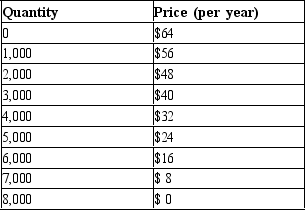 -Refer to Table 17-7. Assume there are two profit-maximizing internet radio providers operating in this market. Further assume that they are able to collude on the quantity of subscriptions that will be sold and on the price that will be charged for subscriptions. If the firms divide the market evenly, how much profit will each company earn?
 (Multiple Choice)
5.0/5 (82)
(82) A particular cable TV company requires a household to subscribe to its high-speed Internet service if it subscribes to cable TV, and vice versa. This practice
(Multiple Choice)
4.8/5 (81)
(81) As the number of firms in an oligopoly increases, the magnitude of the price effect increases.
(True/False)
4.9/5 (90)
(90) Table 17-2
Imagine a small town in which only two residents, Abby and Brad, own wells that produce safe drinking water. Each week Abby and Brad work together to decide how many gallons of water to pump. They bring water to town and sell it at whatever price the market will bear. To keep things simple, suppose that Abby and Brad can pump as much water as they want without cost so that the marginal cost is zero. The weekly town demand schedule and total revenue schedule for water is shown in the table below:
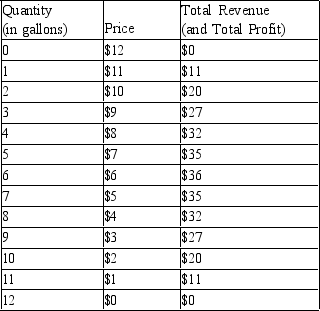 -Refer to Table 17-2. If this market for water were perfectly competitive instead of monopolistic, how many gallons of water would be produced and sold?
 (Multiple Choice)
4.7/5 (81)
(81) Table 17-11
Only two firms, ABC and XYZ, sell a particular product. The table below shows the demand curve for their product. Each firm has the same constant marginal cost of $8 and zero fixed cost.
 -Refer to Table 17-11. If ABC and XYZ operate to jointly maximize profits, then what is the price?
 (Multiple Choice)
4.8/5 (70)
(70) Table 17-35
Suppose that two coal mining companies - Allied and Barclay - own adjacent land suitable for excavating coal mines. The profits that each firm earns depends on both the number of mines it excavates and the number of mines excavated by the other firm. The table below lists each firm's individual profits:
Allied
Excavate one mine Excavate two mines
 -Refer to Table 17-35. Does Allied have a dominant strategy? If so, describe it.
 (Essay)
4.7/5 (79)
(79) When strategic interactions are important to pricing and production decisions, a typical firm will
(Multiple Choice)
4.9/5 (66)
(66) Table 17-7
The information in the table below shows the total demand for internet radio subscriptions in a small urban market. Assume that each company that provides these subscriptions incurs an annual fixed cost of $20,000 (per year) and that the marginal cost of providing an additional subscription is always $16.
-Refer to Table 17-7. Assume there are two profit-maximizing internet radio providers operating in this market. Further assume that they are not able to collude on the price and quantity of subscriptions to sell. What price will they charge for a subscription when this market reaches a Nash equilibrium?
-Refer to Table 17-7. Assume there are two profit-maximizing internet radio providers operating in this market. Further assume that they are not able to collude on the price and quantity of subscriptions to sell. What price will they charge for a subscription when this market reaches a Nash equilibrium? (Multiple Choice)
4.9/5 (90)
(90) When a group of firms acts in unison to maximize profits as if they were a monopoly, they form a
.
(Short Answer)
4.9/5 (76)
(76) 
Filters
- Essay(0)
- Multiple Choice(0)
- Short Answer(0)
- True False(0)
- Matching(0)