



 Chat with AI
Exam 17: Oligopoly

Exam 1: Ten Principles of Economics439 Questions
Exam 2: Thinking Like an Economist617 Questions
Exam 3: Interdependence and the Gains From Trade527 Questions
Exam 4: The Market Forces of Supply and Demand698 Questions
Exam 5: Elasticity and Its Application595 Questions
Exam 6: Supply, Demand, and Government Policies644 Questions
Exam 7: Consumers, Producers, and the Efficiency of Markets549 Questions
Exam 8: Application: The Costs of Taxation511 Questions
Exam 9: Application: International Trade493 Questions
Exam 10: Externalities524 Questions
Exam 11: Public Goods and Common Resources433 Questions
Exam 12: The Design of the Tax System551 Questions
Exam 13: The Costs of Production420 Questions
Exam 14: Firms in Competitive Markets543 Questions
Exam 15: Monopoly637 Questions
Exam 16: Monopolistic Competition587 Questions
Exam 17: Oligopoly496 Questions
Exam 18: The Markets for the Factors of Production564 Questions
Exam 19: Earnings and Discrimination490 Questions
Exam 20: Income Inequality and Poverty457 Questions
Exam 21: The Theory of Consumer Choice440 Questions
Exam 22: Frontiers of Microeconomics441 Questions
Select questions type


Table 17-24
Two firms are considering going out of business and selling their assets. Each considers what happens if the other goes out of business. The payoff matrix below shows the net gain or loss to each firm.
 -Refer to Table 17-24. What is the Nash equilibrium?
 (Multiple Choice)
4.8/5  (71)
(71) Table 17-11
Only two firms, ABC and XYZ, sell a particular product. The table below shows the demand curve for their product. Each firm has the same constant marginal cost of $8 and zero fixed cost.
 -Refer to Table 17-11. If ABC and XYZ operate to jointly maximize profits, then what quantity is sold?
 (Multiple Choice)
4.8/5 (80)
(80) The Sherman Antitrust Act prohibits competing firms from even talking about fixing prices.
(True/False)
4.9/5 (86)
(86) Consider a game of the "Jack and Jill" type in which a market is a duopoly and each firm decides to produce either a "high" quantity of output or a "low" quantity of output. If the two firms successfully reach and maintain the cooperative outcome of the game, then
(Multiple Choice)
4.9/5 (74)
(74) Game theory is just as necessary for understanding competitive or monopoly markets as it is for understanding oligopolistic markets.
(True/False)
4.9/5 (77)
(77) Table 17-3
Imagine a small town in a remote area where only two residents, Maria and Miguel, own dairies that produce milk that is safe to drink. Each week Maria and Miguel work together to decide how many gallons of milk to produce. They bring milk to town and sell it at whatever price the market will bear. To keep things simple, suppose that Maria and Miguel can produce as much milk as they want without cost so that the marginal cost is zero. The weekly town demand schedule and total revenue schedule for milk is shown in the table below:
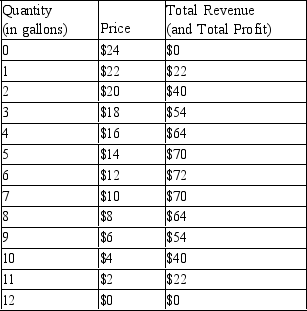 -Refer to Table 17-3. Suppose the town enacts new antitrust laws that prohibit Maria and Miguel from operating as a monopoly. What will be the price of milk once Maria and Miguel reach a Nash equilibrium?
 (Multiple Choice)
4.8/5 (83)
(83) Table 17-32
Suppose that Angelina and Brad own the only two professional photography stores in town. Each must choose between a low price and a high price for senior photo packages. The annual economic profit from each strategy is indicated in the table below:
Angelina
Low price High price
 -Refer to Table 17-32. Does Brad have a dominant strategy? If so, describe it.
 (Essay)
4.8/5 (89)
(89) Table 17-22
Brian and Matt own the only two bicycle repair shops in town. Each must choose between a low price for repair work and a high price. The annual economic profit from each strategy is indicated in the table. The profits are shown as (Matt, Brian) in each cell.
 -Refer to Table 17-22. Which of the following statements is correct if Brian and Matt will play this game only once?
 (Multiple Choice)
4.8/5 (90)
(90) Nike and Reebok (athletic shoe companies) are considering whether to advertise during the Super Bowl. Devise a simple prisoners' dilemma game to demonstrate the strategic considerations that are relevant to this decision. Does the repeated game scenario differ from a single period game? Is it possible that a repeated game (without collusive agreements) could lead to an outcome that is better than a single-period game? Explain the circumstances in which this may be true.
(Essay)
4.8/5 (81)
(81) Table 17-1
Imagine a small town in which only two residents, Rochelle and Alec, own wells that produce safe drinking water. Each week Rochelle and Alec work together to decide how many gallons of water to pump. They bring the water to town and sell it at whatever price the market will bear. To keep things simple, suppose that Rochelle and Alec can pump as much water as they want without cost so that the marginal cost of water equals zero. The weekly town demand schedule and total revenue schedule for water is shown in the table below:
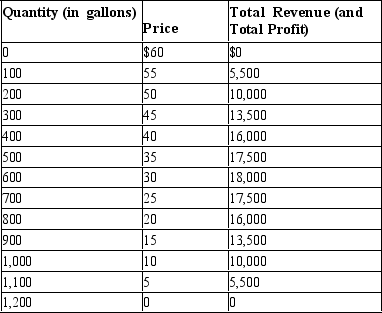 21.
-Refer to Table 17-1. Suppose the town enacts new antitrust laws that prohibit Rochelle and Alec from operating as a monopoly. What will be the price of water once Rochelle and Alec reach a Nash equilibrium?
21.
-Refer to Table 17-1. Suppose the town enacts new antitrust laws that prohibit Rochelle and Alec from operating as a monopoly. What will be the price of water once Rochelle and Alec reach a Nash equilibrium? (Multiple Choice)
4.8/5 (64)
(64) Table 17-10
The table shows the demand schedule for a particular product.
 -Refer to Table 17-10. Suppose the market for this product is served by two firms who have formed a cartel and are colluding to set the price and quantity in this market. If the marginal cost to produce this product is constant at $40 per unit and there is no fixed cost, then what will the combined profit of the cartel be?
 (Multiple Choice)
4.9/5 (88)
(88) Assuming that oligopolists do not have the opportunity to collude, once they have reached the Nash equilibrium, it
(Multiple Choice)
4.9/5 (85)
(85) A lack of cooperation by oligopolists trying to maintain monopoly profits
(Multiple Choice)
5.0/5 (82)
(82) Table 17-23
Two bottled beverage manufacturers (Firm A and Firm B) determine that they could lower their costs, and thus increase their profits, if they reduced their advertising budgets. But for the plan to work, each firm must agree to refrain from advertising. Each firm believes that advertising works by increasing the demand for the firm's product, but each firm also believes that if neither firm advertises, the costs savings will outweigh the lost sales. Listed in the table below are the individual profits for each firm.
 -Refer to Table 17-23. At the Nash equilibrium, how much profit will Firm A earn?
 (Multiple Choice)
4.8/5 (77)
(77) Assume that Samorola has entered into an enforceable resale price maintenance agreement with Trint and U- Mobile. Which of the following will always be true?
(Multiple Choice)
4.8/5 (87)
(87) The players in a two-person game are choosing between Strategy X and Strategy Y. If the second player chooses Strategy X, the first player's best outcome is to select X. If the second player chooses Strategy Y, the first player's best outcome is to select X. For the first player, Strategy X is called a
(Multiple Choice)
4.9/5 (85)
(85) Scenario 17-2.
Imagine that two oil companies, BQ and Exxoff, own adjacent oil fields. Under the fields is a common pool of oil worth $144 million. Drilling a well to recover oil costs $5 million per well. If each company drills one well, each will get half of the oil and earn a $67 million profit ($72 million in revenue - $5 million in costs). Assume that having X percent of the total wells means that a company will collect X percent of the total revenue.
-Refer to Scenario 17-2. If BQ were to drill a second well and Exxoff also drilled a second well, what would BQ's profit be?
(Multiple Choice)
4.8/5 (84)
(84) 
Filters
- Essay(0)
- Multiple Choice(0)
- Short Answer(0)
- True False(0)
- Matching(0)